


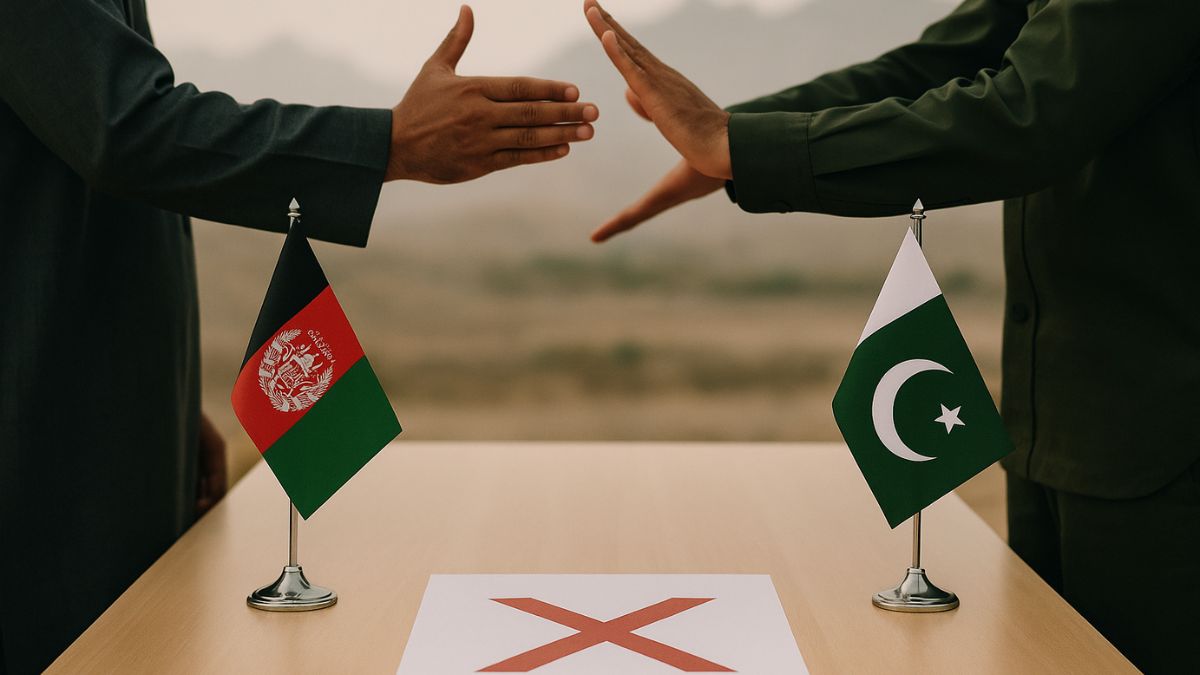
Amid renewed border tensions and sporadic exchanges of fire, peace talks between Afghanistan and Pakistan have collapsed once again, signalling a sharp downturn in relations between the two uneasy neighbours. However, they say that the ceasefire is still in place.
According to Taliban spokesperson Zabihullah Mujahid, negotiations in Istanbul broke down after Islamabad allegedly demanded that Afghanistan take responsibility for Pakistan’s internal security, a request Kabul dismissed as beyond its “capacity and mandate.”
“The ceasefire that has been established has not been violated by us so far, and it will continue to be observed,” Mujahid said, adding that Afghanistan remains committed to avoiding escalation despite provocations.
Pakistan-Afghanistan peace talks: What happened in Istanbul?
While Taliban has maintained that they did not breach the ceasefire, Pakistani Defence Minister Khawaja Muhammad Asif confirmed that the Istanbul talks, aimed at preventing renewed border clashes, had failed to reach a long-term deal, though the ceasefire signed in Doha in October “would continue as long as there are no attacks from Afghan soil.”
The breakdown came just days after Afghan and Pakistani troops exchanged fire along the Durand Line, underscoring how fragile the truce remains despite diplomatic mediation by Turkey and Qatar.
How did the situation escalate after the October clashes?
The current standoff follows deadly cross-border clashes in October 2025, the worst since the Taliban’s return to power in 2021, which claimed dozens of lives on both sides. Those hostilities were sparked by Pakistani airstrikes on Kabul and other locations, targeting senior figures of the Tehreek-e-Taliban Pakistan (TTP).
Notably, Paksitan’s airstrikes on Kabul coincided with Taliban Foreign Minister Amir Khan Muttaqi’s New Delhi visit, signalling Istanbul’s irritation on seeing growing relations between India and Aghanistan.
Although Qatar-brokered talks secured a temporary ceasefire last month on October 19, tensions have continued to simmer. The second round of peace negotiations in Istanbul failed last week after disagreements over militant groups allegedly operating from Afghan territory.
Turkey’s President Recep Tayyip Erdoğan, who met Pakistan’s Prime Minister Shehbaz Sharif in Baku on Saturday (November 8, 2025), expressed hope that Ankara’s mediation would “yield results toward lasting stability,” reaffirming Turkey’s role as a regional peace facilitator.
What is Taliban government’s stance on Pakistan’s accusations?
In a strongly worded statement, the Islamic Emirate of Afghanistan accused elements within the Pakistani military establishment of pursuing “anti-Afghanistan policies” and deliberately creating tensions under “manufactured pretexts.” Taliban reiterated its “principled position” that no group will be allowed to use Afghan territory to launch attacks against another country.
At the same time, Afghanistan has also warned that it would firmly defend its sovereignty and territory against any aggression. “If war breaks out, we have the right to defend ourselves,” Mujahid said, noting that while Afghanistan “(does) not want insecurity in the region, and entering into war is not our first choice”.
“The defence of the people and land of Afghanistan is the Islamic and national duty of the Islamic Emirate,” the statement read, adding that while the people of Pakistan are regarded as brothers, the “irresponsible and non-cooperative attitude” of the Pakistani delegation had prevented any meaningful outcome from the peace talks.
“The defence of the people and land of Afghanistan is the Islamic and national duty of the Islamic Emirate”, it further said, adding that Afghanistan will defend itself against any aggression.
What lies ahead for Afghanistan-Pakistan’s fragile ceasefire?
Despite the collapse of formal negotiations, both sides have so far avoided violating the ceasefire, though local commanders remain on high alert along the volatile border. For now, the ceasefire brokered in Doha and reinforced in Istanbul remains in place, but with mutual distrust, cross-border accusations, and the unresolved TTP issue, peace hangs by a thread.