


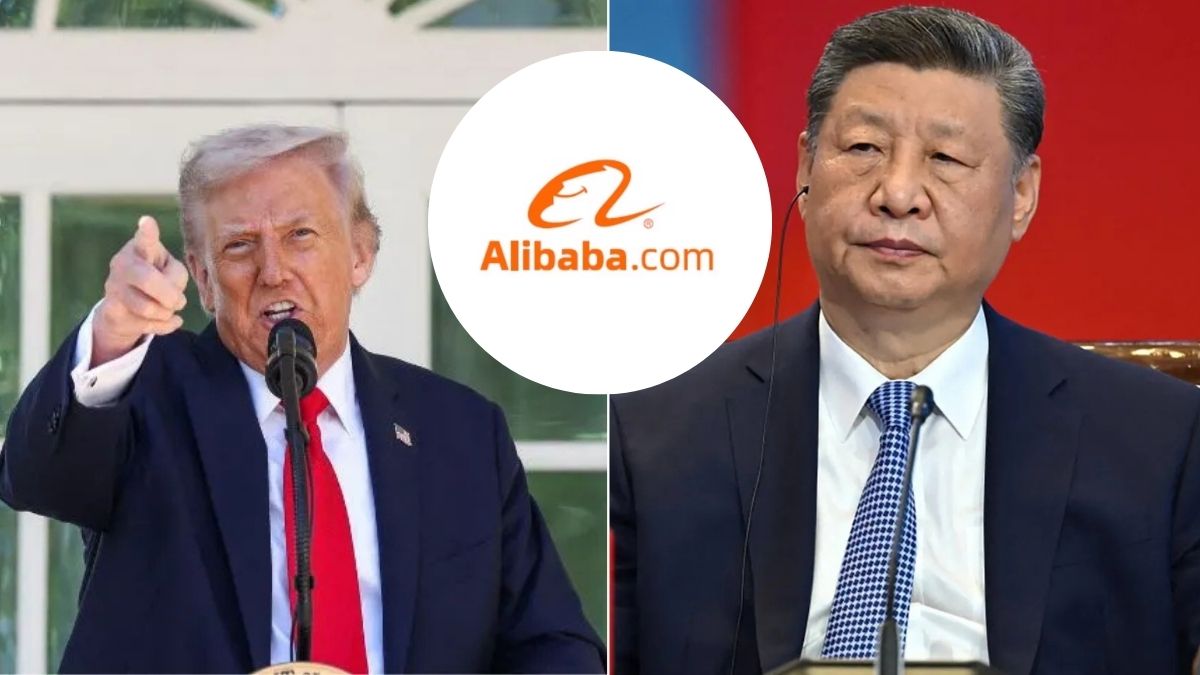
A declassified White House memo seems to have triggered a new flashpoint in already rebsed US–China relations. Issued right after US President Donald Trump met his Chinese counterpart Xi Jinping and agreed to a one-year trade truce, a confidential White House national security memo has alleged that Alibaba aided Chinese military in targeting the US.
The confidential memo further claimed that the Chinese e-commerce giant provided technology, data access and AI support to the country’s military for operations targeting the United States. The Financial Times, which first reported the contents, said the memo contained formerly top secret assessments describing the tech giant as a potential enabler of PLA cyber operations against US targets.
The timing could not have been more combustible as what was meant to be a cooling period in the Trump–Xi trade standoff is now overshadowed by an intelligence leak that Washington officials say presents a “serious national security risk”.
What exactly does the White House memo accuse Alibaba of?
According to the memo, Alibaba allegedly offered the PLA and Chinese authorities access to customer data, including IP addresses, WiFi records and payment trails, provided AI-powered tools and cloud services useful for military intelligence, enabled employees to transfer knowledge of zero-day exploits to PLA-linked actors.
US intelligence has warned since March 2025 that China’s cyber units are capable of infiltrating American critical infrastructure, including telecom networks, airports and logistics nodes, a capability highlighted in the major breach codenamed Salt Typhoon.
In this context, the memo frames Alibaba as part of a growing ecosystem of Chinese firms that could be leveraged for Beijing’s military-civil fusion strategy.
How has Alibaba responded to the explosive allegations?
Alibaba has strongly denied the claims, calling the memo “complete nonsense,” a “malicious PR operation,” and the work of a “rogue voice looking to undermine President Trump’s recent trade deal with China.” The company did not clarify whether it has ever had any relationship with the PLA.
The Hangzhou-based firm called the memo a “malicious PR operation (that) clearly came from a rogue voice looking to undermine President Trump’s recent trade deal with China”.
Beijing backed Alibaba, accusing Washington of a “complete distortion of facts” and insisting that China “has never and will never” demand overseas data in violation of foreign laws.
Could this be a turning point for US policy toward Chinese tech giants?
The memo adds fuel to a long-running campaign in Washington urging tighter restrictions on Chinese firms. US lawmakers, including China Committee chair John Moolenaar, have already urged delisting Chinese firms, including Alibaba, from US markets. He added that the use of “untrusted vendors” in the American digital ecosystem be banned and called for the blocking of Chinese cloud and AI companies from sensitive sectors.
“The federal government and industry must take steps to protect the American people and eliminate Chinese companies’ access to our markets and innovation,” he stated.
Security experts warn that global militaries increasingly rely on private tech firms, amplifying risks when companies are tethered, legally or politically, to powerful state militaries like the PLA. Former CIA China chief Dennis Wilder described the PLA’s cyber intrusions as “widespread and daily”, aimed at preparing for “system-destruction warfare” in a potential conflict.
How does Trump’s recent meeting with Xi fit into this?
The memo’s date, November 1, just after the Trump–Xi summit in South Korea, is of crucial importance here, lying at the heart of the geopolitical tension. What was framed publicly as a diplomatic reset and a temporary halt to tariff escalation now appears to have been followed by a damaging intelligence disclosure.
The dispute now threatens to derail the fragile pause in the US–China trade war and could precipitate new sanctions or export controls.
Worth mentioning here is that the memo arrives amid several parallel developments, including California-based AI firm Anthropic recently exposing what it described as the first largely autonomous AI-led cyber-espionage campaign, attributed to a Chinese state-sponsored group, GTG-1002.
US intelligence agencies continue to warn of Beijing’s ability to compromise US infrastructure for activation “during a conflict”. However, Chinese spokesmen have rejected all allegations, saying Beijing “consistently opposes hacking”.