


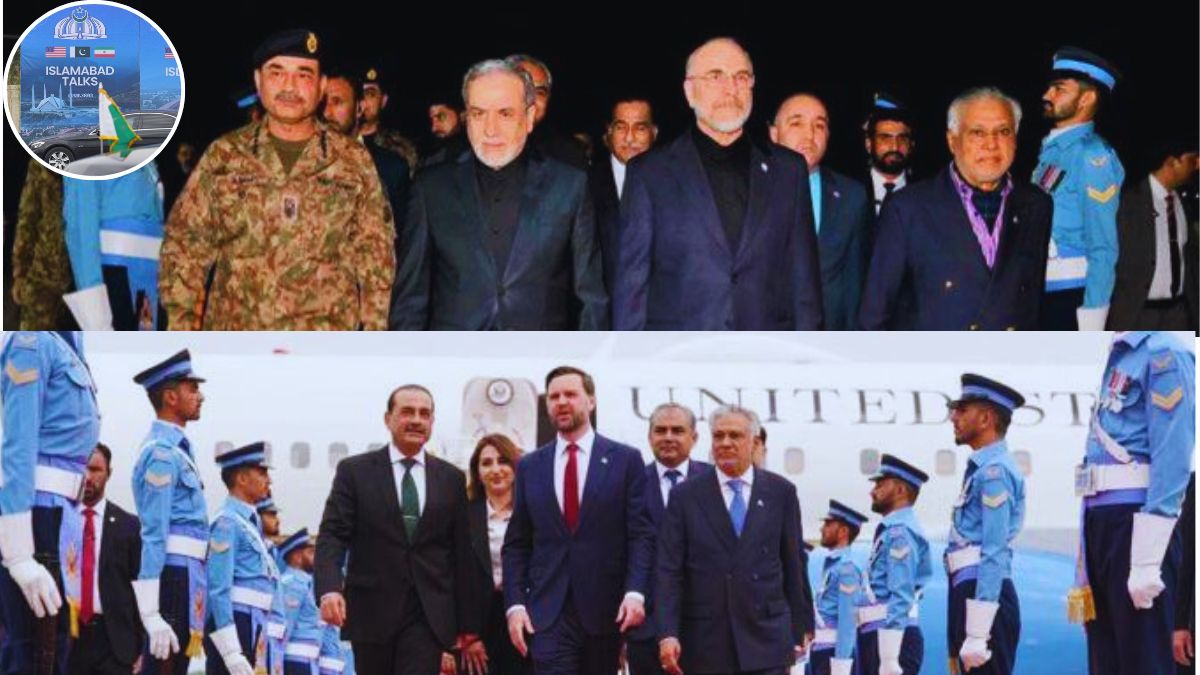
History was in the making in Islamabad on Friday (April 11, 2026) when top negotiators from the US and Iran gathered in Pakistan’s capital city to thrash out a solution to their 37-day war.
Only on Tuesday (April 8), US President Donald Trump announced a two-week ceasefire in the military operations to allow for talks to find an end to the war in West Asia.
The ceasefire came about after Iran and Israel endorsed the temporary truce insisted by Pakistan Prime Minister Shahbaz Sharif to enable peace in the region that is critical to the world’s energy security.
Who Are Heading the US, Iran Delegations
On Friday, US Vice President J. D. Vance, along with a delegation comprising special envoy Steve Witkoff and Donald Trump’s son-in-law and adviser Jared Kushner landed in Islamabad ahead of the talks with the Iranian delegation.
Vance was the preferred choice of Iran for heading the talks, while the other big American names in the negotiations were already involved in West Asian talks, apart from the Russian-Ukrainian conflict in a similar capacity.
The Iranian side would be led by Parliament Speaker Mohammad Bagher Ghalibaf. The delegation would also have Foreign Minister Abbas Araghchi. Another member in the talks would be Central Bank Governor Abdolnaser Hemmati.
Ghalibaf is a key figure in Iran and he has been an hardline voice on the war with the US in the last 40 days of the conflict, which began on February 28, when the US-Israel bombing killed the Supreme Leader Ayatollah Ali Khameni.
He has been one of the prominent Iranian leader, who has attacked the US and Israel for the war in West Asia, sometimes issuing harsh statements against the two enemy nations and expressed distrust.
Araghchi has been a key player in the negotiations over Iran’s long-disputed nuclear programme, which has led to Western sanctions, even before the present war began, including the one just two days before the February 28 airstrikes by the US and Israel.
Key Differences In Negotiations
Ahead of the talks in Islamabad, both the US and Iran presented their respective expectations as outcomes of the negotiations mediated by Pakistan.
The US is said to have given out a 15-point agenda for talks, while Iran has placed its 10-point talking points for the Islamabad round of negotiations.
However, it is the expectations of either side that would pose a major hurdle in arriving at a mutually acceptable solution to the vexed problem between the two sides.
According to the Council on Foreign Relations, the areas of contention between the US and Iran in Islamabad could come on five fronts.
One, the Strait of Hormuz and its control would be aggressively negotiated, as Iran wants full control over the narrow waterway clearly in Iranian territorial waters, while the US wants unbridled access and maritime passage.
Two, the Iranian nuclear programme would be the most difficult to negotiate. While Iran wants its sovereign right to enrichment of nuclear fuel, the US wants full commitment on giving up nuclear and missile projects and enrichment rights.
Three, the Iranian proxies, such as the Hezbollah in Lebanon and Houthis, would become a bone of content during the talks. The US wants Iran to end support these non-state actors that threaten both the American and Israeli interests in West Asia. Iran, on the other hand, wants an end to Israeli strikes on these proxies.
Despite the ceasefire announcement, the Israeli targeting of the Hezbollah in Lebanon hasn’t stopped. Israel and the US argue that Lebanon was not part of the ceasefire arrangement, Iran insists it does.
On the military front, Iran wants non-aggression guarantees. On the economic front, Tehran insists on removal of all sanctions and compensation for the war damage. The US is unwilling on both these fronts, instead seeking limits on Iranian military capabilities, and no reparations whatsoever.
However, the talks itself is historic, as both Iran and the US want to find a way out for the knot that they have got themselves into. And the world is watching with bated breath on what the outcomes of the talks would be.