


India and the United States might have their differences on tariffs over the purchase of Russian oil, but both the sides seem united on one front – ending China’s dominance in rare earths. Just a few days after reports indicated that China is restricting rare earths exports to Japanese firms, the US is uniting leading economies, including India.
India has stepped up high-level engagement on critical minerals in Washington, signalling deeper alignment with the United States and G7 economies as they move to reduce reliance on China-dominated supply chains. Electronics and IT Minister Ashwini Vaishnaw took part in a ministerial-level meeting on the same.
Ending China’s dominance in rare earths: Ministerial meet held
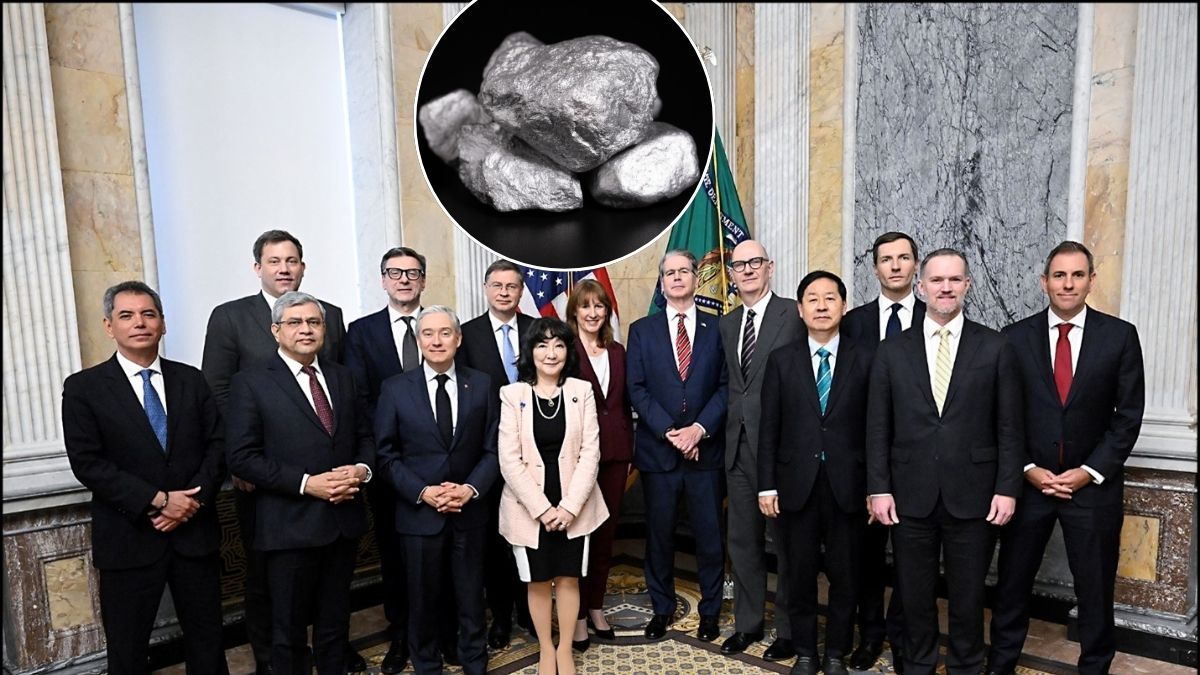
Union Minister Vaishnaw arrived in Washington DC on Sunday (January 11, 2026) to participate in a ministerial-level meeting hosted by US Treasury Secretary Scott Bessent, focused on strengthening global supply chain resilience for essential minerals. The discussions took place on the sidelines of a broader gathering of G7 finance ministers.
Vaishnaw joined the finance ministers of G7 nations including Canada, France, Germany, Italy, Japan, the UK, the US and the European Union. India and Australia were invited as key partners, underlining Washington’s intent to broaden coordination beyond advanced economies.
The meeting brought together multiple countries to examine long-term strategies for securing the availability and sustainability of minerals critical to modern industries.
‘Manufacturing growth needs secure mineral supply’
Following the meeting, Vaishnaw underscored the urgency of building resilient supply chains at a time when global manufacturing, particularly electronics manufacturing in India, is expanding rapidly.
“When the manufacturing sector is growing rapidly, especially electronics manufacturing, it’s very important for all countries, including India, to have a resilient supply chain of critical minerals,” Vaishnaw said. He stressed the need to secure rare earths and permanent magnets in a sustainable manner to support long-term industrial growth.
Focus on refining, processing and tech sharing
According to Vaishnaw, discussions centred on advancing refining and processing technologies, which are crucial for converting raw ores into high-quality critical minerals.
“There were discussions around funding new projects, technology sharing between different countries, and very important discussions on recycling, which is a good way of harnessing minerals from waste products,” he said.
Participants also explored agreements on sharing research and best practices to improve both the quality and availability of critical minerals globally.
US pushes ‘derisking’ over decoupling
US Treasury Secretary Scott Bessent said the meeting reflected a shared recognition of vulnerabilities in existing supply chains and the need for swift action. “I was pleased to hear a strong, shared desire to quickly address key vulnerabilities in critical minerals supply chains,” Bessent said in a post on X, adding that countries were inclined towards “prudent derisking over decoupling.”
Bessent noted that India, Australia and several other countries were included in the discussions to widen cooperation beyond the G7.
China’s rare earths dominance looms large
The talks come against the backdrop of China’s overwhelming dominance in critical mineral processing. According to the International Energy Agency, China is the world’s leading refiner for most major critical minerals, including copper, lithium, nickel, cobalt, graphite and rare earth elements, with an average market share of about 70%.
Beijing also controls downstream components such as manganese sulphate and phosphoric acid, which are essential inputs for batteries and advanced manufacturing.
US Treasury Secretary Bessent underlined that he had been advocating a dedicated G7 discussion on critical minerals since last summer’s leaders’ summit, citing what he described as China’s weaponisation of supply chains.
India to join another major US-led initiative
In another related development, US Ambassador-designate to India Sergio Gor announced on Monday (January 12, 2026) that India will be invited to join the US-led PaxSilica group as a full member next month. “I am pleased to announce that India will be invited to join PaxSilica as a full member next month,” Gor said.
Launched in December 2025, PaxSilica is a US-led strategic economic alliance aimed at building a secure, innovation-driven silicon supply chain, from critical minerals and energy inputs to advanced manufacturing, semiconductors, artificial intelligence and logistics. India’s inclusion is expected to significantly boost its role in global semiconductor and electronics ecosystems.