


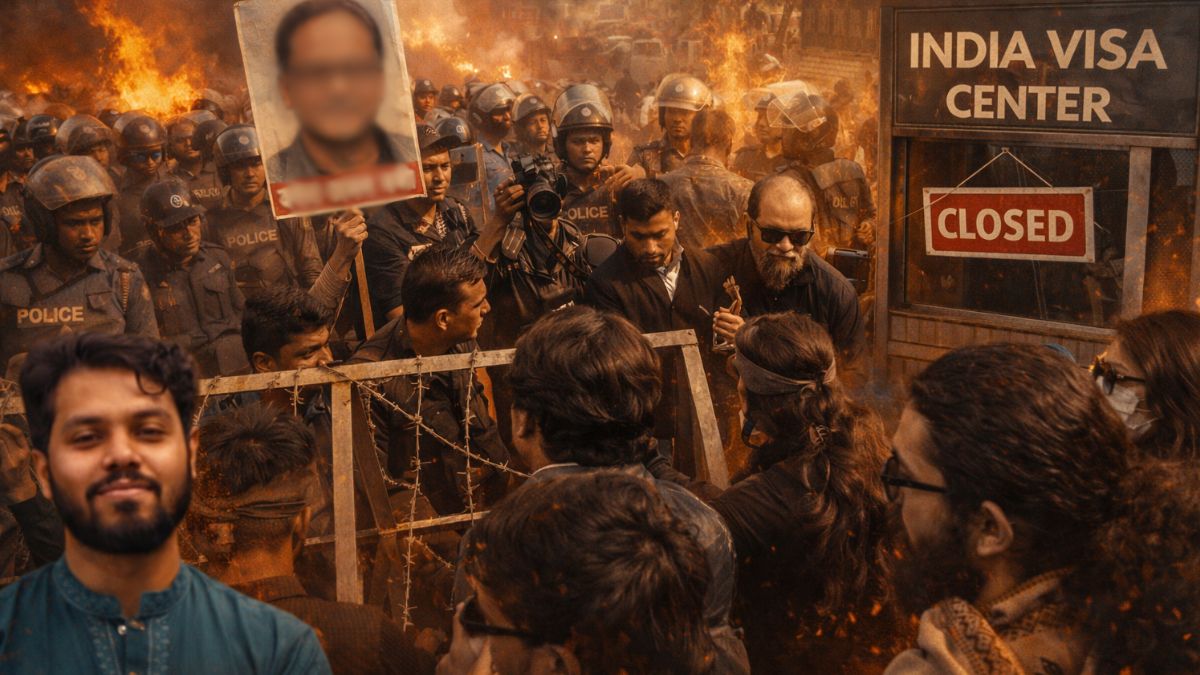
Bangladesh plunged deeper into political and security turmoil on Thursday (December 18, 2025) after Sharif Osman Hadi, a prominent leader of the July Uprising and a candidate in the upcoming February 12 general elections, died from gunshot injuries in Singapore, even as India shut two more visa application centres in Bangladesh, citing a deteriorating security situation.
Hadi, who was shot in the head by masked gunmen last week while launching his election campaign in Dhaka’s Bijoynagar area, succumbed to his injuries after battling for life for six days.
His death has triggered widespread protests, vandalism, and heightened tensions in the capital, underscoring growing instability under the interim government led by Nobel laureate Muhammad Yunus.
What did Yunus say about Hadi’s death?
Announcing the death in a late-night televised address, Chief Adviser Yunus called Hadi a “fearless frontline fighter of the July Uprising” and vowed swift justice.
“No leniency will be shown to the killers,” he said, urging citizens to exercise restraint and allow law enforcement agencies to conduct investigations professionally. Yunus described the killing as an “irreparable loss” to Bangladesh’s political and democratic landscape.
What political fallout did Hadi’s death have in Bangladesh?
Hadi had been airlifted to Singapore on Monday (December 15, 2025) after doctors in Dhaka described his condition as “extremely critical.” He died hours after his family consented to a last-ditch surgical attempt to save him.
The interim government announced a one-day state mourning on December 20, with national flags at half-mast and special prayers across mosques nationwide.
His death immediately sparked street protests. Hundreds of students and activists gathered at Shahbagh intersection near Dhaka University, chanting slogans in his memory.
The student group Jatiya Chhatra Shakti organised a mourning procession and burnt an effigy of the home adviser, demanding his resignation over alleged failure to arrest the attackers.
Why Hadi’s outfit warned of protests following his death?
The protests later turned violent, with mobs vandalising the offices of leading newspapers Prothom Alo and The Daily Star in Dhaka, trapping journalists inside and setting fire outside the buildings.
The Inqilab Mancha, the platform Hadi represented, warned of sustained sit-in protests until the perpetrators are arrested, even demanding that suspects fleeing to India be extradited if necessary.
Police have announced a reward of Taka 50 lakh for information and arrested family members and associates of the prime suspect.
Was India closing visa centres connected to the Bangladesh unrest?
The unrest coincided with India’s decision to close two additional Indian Visa Application Centres (IVACs) in Rajshahi and Khulna on December 18, a day after radical Islamist groups protested near the Indian High Commission in Dhaka. An official IVAC notification cited the “ongoing security situation,” assuring applicants of rescheduled appointments.
The closures follow the earlier shutdown of a visa centre in Dhaka and come amid rising anti-India rhetoric in Bangladesh. New Delhi has flagged increasing open hostility, particularly targeting India’s northeastern states, under the Yunus-led interim dispensation, which has also signalled warmer ties with Pakistan.
Why did Bangladesh dismiss India’s concerns?
Bangladesh’s Foreign Affairs Adviser Touhid Hossain dismissed India’s concerns, denying any deterioration in law and order. He distanced the government from inflammatory remarks by National Citizen Party (NCP) leader Hasnat Abdullah, who had threatened to sever India’s “seven sisters” and expel the Indian High Commissioner. “Hasnat is not part of the government,” Hossain said, calling such comments “irrelevant.”
However, critics argue that radical elements like the NCP, an offshoot of the student protests that toppled Sheikh Hasina’s Awami League government in August 2024, have been emboldened under the interim setup.
While the NCP has limited popular support, it has openly backed Yunus and aligned with Islamist groups such as Jamaat-e-Islami and its student wing, Chhatra Shibir.
How has India reacted to the Bangladesh unrest?
India, meanwhile, has maintained a measured tone. In a statement, the Ministry of External Affairs urged Bangladesh’s interim government to ensure internal law and order and hold peaceful elections to restore an elected mandate.
Observers warn that escalating violence, the killing of key political figures like Hadi, and rising anti-India sentiment could be used by radical groups to derail the February polls, potentially prolonging the tenure of the unelected interim government.
As Bangladesh mourns a slain uprising leader and grapples with street unrest, the parallel tightening of India’s visa operations reflects broader regional anxieties over security, stability, and the future trajectory of Dhaka’s fragile democratic transition.