


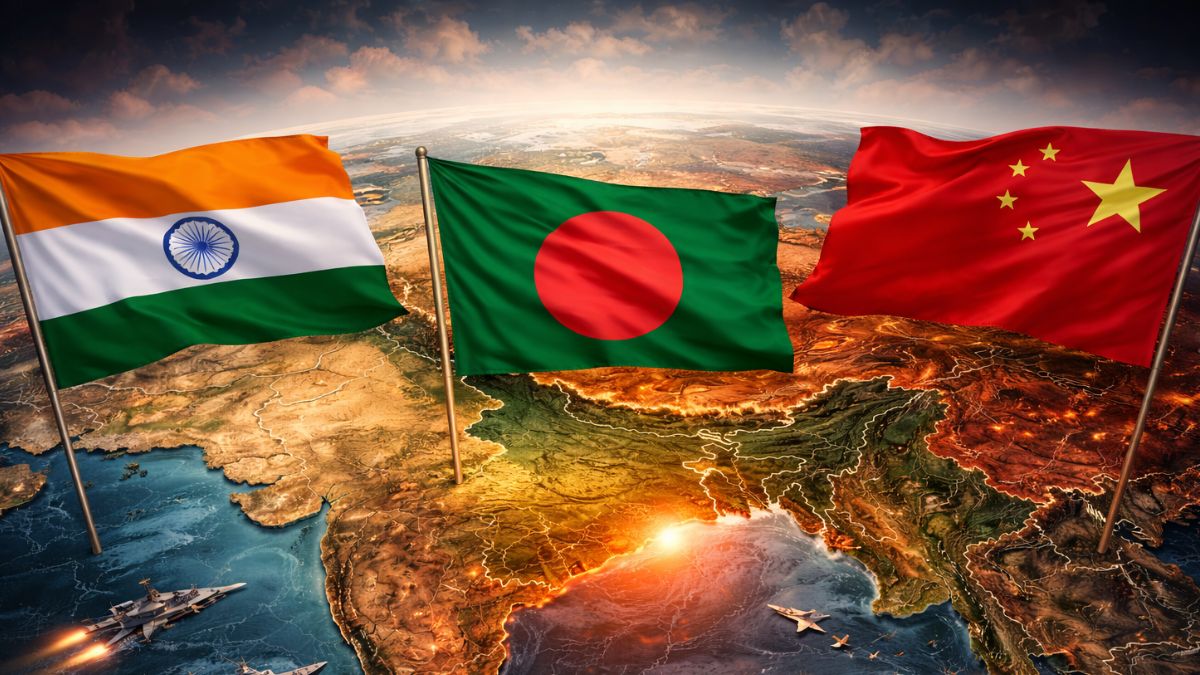
Political turmoil in Bangladesh is rapidly emerging as a strategic concern for India, with New Delhi closely monitoring growing instability, rising anti-India rhetoric and expanding Chinese influence in the neighbouring country.
Former Indian envoy to Bangladesh Pinak Ranjan Chakravarty has publicly criticised Dhaka’s leadership, accusing it of irresponsible conduct and a lack of strategic foresight at a time of mounting internal unrest.
What is happening in Bangladesh?
Bangladesh has witnessed violent protests and political uncertainty in recent months, creating an environment that regional analysts warn could be exploited by external powers.
Parliamentary findings and security assessments in India suggest that China is steadily expanding its footprint in Bangladesh through large-scale infrastructure projects with potential strategic implications.
What are the key concerns about the Chinese role in Bangladesh?
Among the key concerns is Chinese involvement in projects linked to an airbase near the Siliguri Corridor—India’s narrow land bridge connecting the northeastern states to the rest of the country, and the development of a submarine-related facility along the Bay of Bengal coast.
While Bangladeshi authorities have maintained that these projects are non-military in nature, Indian experts caution that the pattern closely resembles Beijing’s approach elsewhere in South Asia.
How has China increased its presence in Bangladesh?
China has significantly increased its presence in the region through investments in ports, logistics hubs, trade corridors, and political outreach, often under the banner of economic cooperation.
In several neighbouring countries, such projects have later acquired strategic or dual-use dimensions, heightening India’s security concerns.
What has caused fears of Chinese encirclement?
With Bangladesh entering a volatile political phase, Indian policymakers fear that deeper Chinese engagement could alter regional power equations and add to the risk of strategic encirclement.
As developments unfold, New Delhi is expected to intensify diplomatic and security assessments to safeguard its interests in eastern South Asia.