


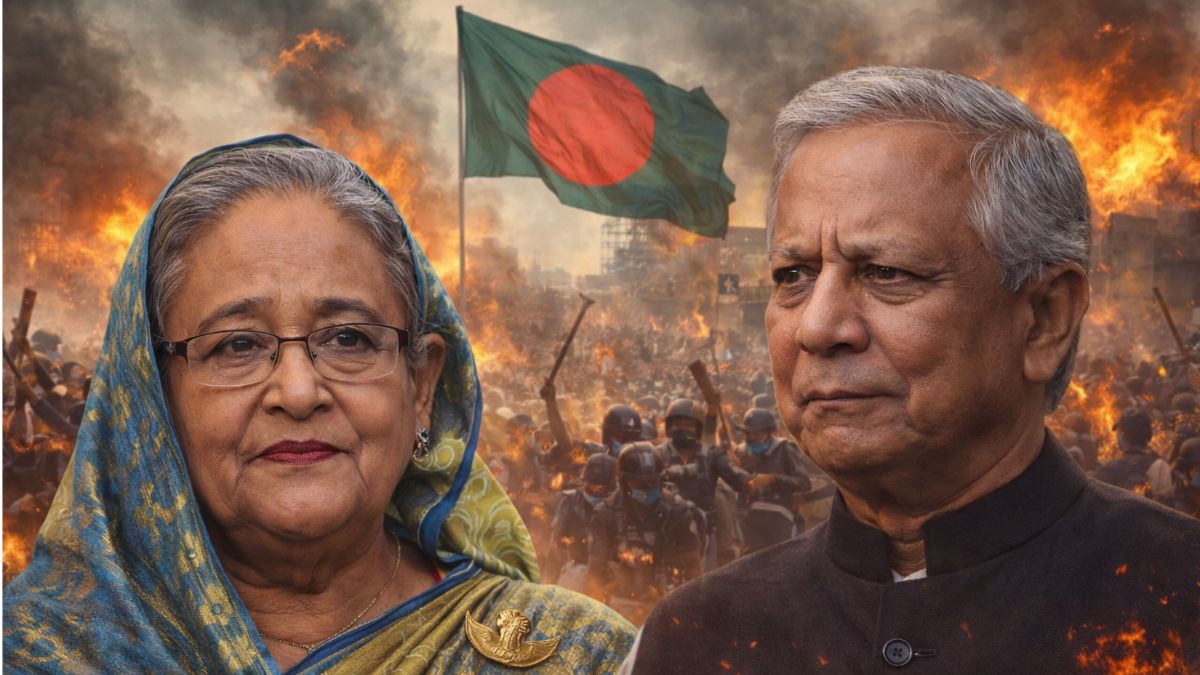
Bangladesh has witnessed a sustained and deeply troubling surge in violence against religious and ethnic minorities since the ouster of Prime Minister Sheikh Hasina and the installation of an interim government led by Muhammad Yunus.
Documented evidence points to widespread human rights violations that many observers now describe as genocidal in intent and effect.
Far from stabilising the country, the political transition since August 2024 has coincided with an explosion of targeted killings, mass arson, sexual violence, land seizures, and systematic attacks on places of worship of minority communities.
This exposes the vulnerability of minority communities in an increasingly lawless environment in Bangladesh since August 2024.
How did violence against minorities spread after Yunus took charge?
Data compiled by the Bangladesh Hindu Buddhist Christian Unity Council (BHBCUC) shows that between August 4 and August 20, 2024, immediately after the interim government took charge, an astonishing 2,010 incidents of communal violence were recorded.
These included nine murders, 69 attacks on temples and other places of worship, and nearly 1,900 incidents of arson, looting, and vandalism targeting minority homes and businesses.
The sheer scale and intensity of violence during this short window underscored how quickly the security situation deteriorated once the political order shifted.
Was Yunus successful in stopping the violence against minorities?
The violence did not abate with time. From August 21 to December 31, 2024, another 174 serious incidents were documented, including 23 killings, nine cases of rape or gang rape, and 64 attacks on religious sites.
Notably, the period also saw a spike in arrests and torture linked to alleged blasphemy, highlighting how legal and religious pretexts are increasingly weaponised against minorities.
According to India’s Ministry of External Affairs, more than 2,900 violent incidents against minority communities have taken place since the interim government assumed power, describing the situation as one of “unremitting hostility.”
Did 2025 see any relief for the minorities in Bangladesh?
The pattern continued into 2025. Between January and June 2025, BHBCUC recorded 258 incidents, including 27 murders, 20 cases of sexual violence, and 59 attacks on places of worship.
Land grabbing, forced occupation of homes and businesses, and physical abuse remained persistent features, suggesting not sporadic unrest but a systematic campaign of intimidation and dispossession.
Particularly alarming were incidents involving indigenous communities, pointing to the ethnic dimension of the violence.
Was there any respite for the minorities in Bangladesh?
Mid-2025 offered little respite. From July to October 2025 alone, 181 incidents were reported, ranging from murders and suspicious deaths to temple vandalism, sexual assault, and forced evictions.
The granular monthly breakdown reveals a grim normalisation of violence: idol vandalism and land grabbing recur month after month, while blasphemy-related harassment continues to claim lives.
Even as overall numbers dipped slightly toward the end of the year, November and December 2025 still saw 19 incidents, including seven murders—one explicitly linked to blasphemy allegations.
How has Yunus failed to protect minorities?
Taken together, the data paint a disturbing picture of continuity rather than crisis management. The interim government’s repeated assurances of protecting minorities have not translated into effective law enforcement or accountability.
In many cases, victims report police inaction, delayed investigations, or fear of reprisals if complaints are pursued, conditions that embolden perpetrators and deepen impunity.
Human rights defenders argue that while “genocide” is a legally precise term, the cumulative impact of killings, mass displacement, destruction of religious symbols, and economic strangulation points toward an intent to erase minority presence from large swathes of Bangladesh.
The violence is not only physical but structural: by stripping communities of land, livelihoods, and legal protection, it pushes them toward forced migration or silent submission.
How does data debunk Yunus’ credibility as an administrator?
As Bangladesh’s interim leadership seeks international legitimacy, the data emerging from the ground tells a far harsher story.
Without urgent domestic accountability and sustained international pressure, the post-Hasina period risks being remembered not as a democratic reset, but as the moment when violence against minorities became routine, and their survival uncertain.