


In a major moment of international recognition, the United Nations has praised Indian peacekeepers for their critical role in restoring a key supply route in conflict-hit South Sudan, highlighting India’s growing stature as a pillar of global peacekeeping and humanitarian support.
The United Nations has specifically lauded Indian peacekeepers for reopening a vital supply corridor between Malakal and Renk, a route that had remained shut since devastating floods last year. UN spokesperson Stephane Dujarric underscored the significance of this achievement, stating, “… in South Sudan, amid these difficult times, there are some hopeful developments.”
The commendation comes at a time when UN missions are under increasing pressure to deliver both security and humanitarian relief in some of the world’s most challenging environments.
Indian peacekeepers in Sudan lauded
UN spokesperson Dujarric underlined, “Our Peacekeeping Mission there (UNMISS) reports that in Upper Nile State, Indian peacekeepers from the Engineering Unit have successfully reopened a key section of the Malakal–Renk main supply route, which had been closed since last year’s floods.”
This route is not just a road, it is a lifeline for humanitarian aid, trade, and civilian movement in a region grappling with both conflict and climate-driven disasters.
What makes this development so crucial on the ground?
The reopening of the route has dramatically improved access in Upper Nile State, enabling faster delivery of humanitarian aid, improved mobility for civilians and relief workers, and greater connectivity between vulnerable regions.
Dujarric highlighted the broader impact, saying, “These efforts also underscore the vital role that the Peacekeeping Mission plays in supporting stability and enabling critical assistance to reach vulnerable civilians in some of the most challenging environments.”
Indian engineers went beyond routine repairs, they reclaimed land from floodwaters and created a new road alignment, ensuring long-term usability even in difficult terrain.
How did Indian peacekeepers achieve this?
According to UNMISS, the Indian contingent restored connectivity through a newly aligned route – Akoka – Kilo 20 – Paloich – Renk corridor. It was built in coordination with local authorities and UN partners.
In a post on X, UNMISS noted, “Indian peacekeepers reopened the key Malakal-Renk main supply route via New Paloich, which had been closed since last year’s floods.” The mission required technical expertise, coordination, and the ability to operate in flood-ravaged, unstable conditions.
Is India doing more than just peacekeeping?
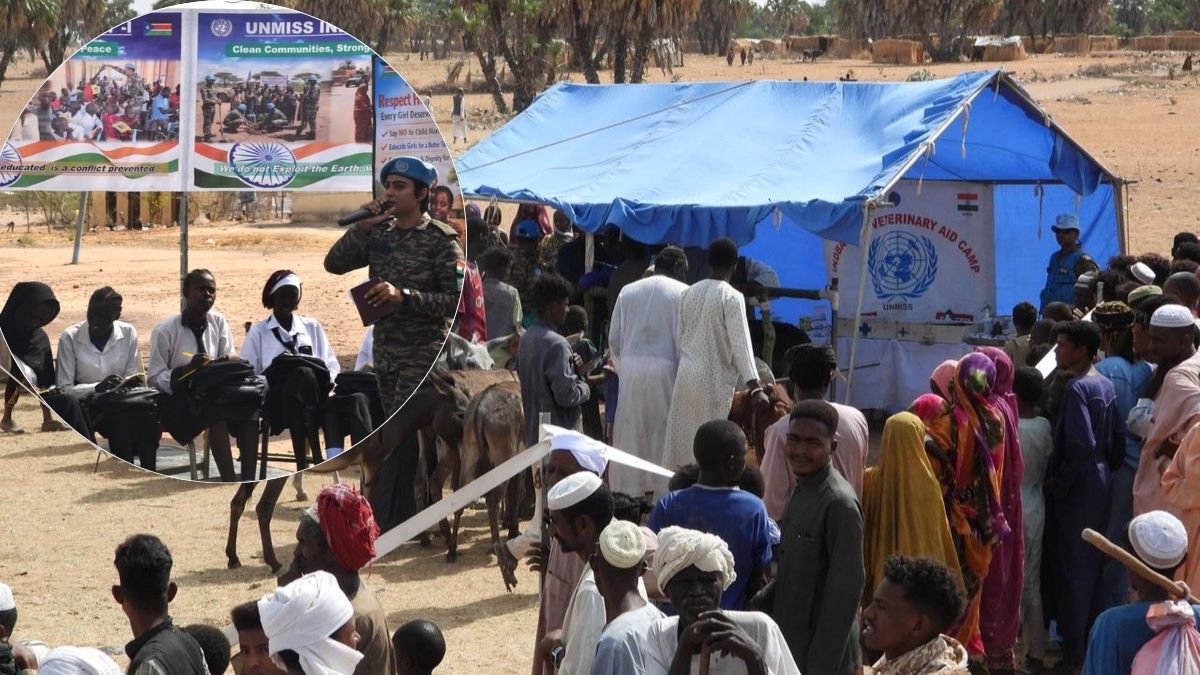
India’s role extends far beyond military deployment. UNMISS highlighted a series of community outreach initiatives carried out by Indian peacekeepers, including veterinary camps in Magera, Geiger and Chemmedi, medical camps in Geiger, and training programmes on child protection and prevention of gender-based violence.
Worth noting here is that India is currently the largest troop-contributing country to UNMISS, with 1,779 personnel deployed as of January 2026. Its contributions are particularly valued because Indian peacekeepers often operate in conflict zones, disaster-affected regions, along with logistically challenging environments.
The success in South Sudan reinforces India’s reputation as a reliable and capable global partner in peacekeeping missions.
Flood crisis in South Sudan
The urgency of the mission becomes clearer in the context of last year’s devastating floods. According to UN estimates, 1.35 million people were affected while nearly 3,75,600 people were displaced across eight states. The destruction of infrastructure, including roads, severely hampered relief efforts, making the reopening of supply routes critical for survival and recovery.