


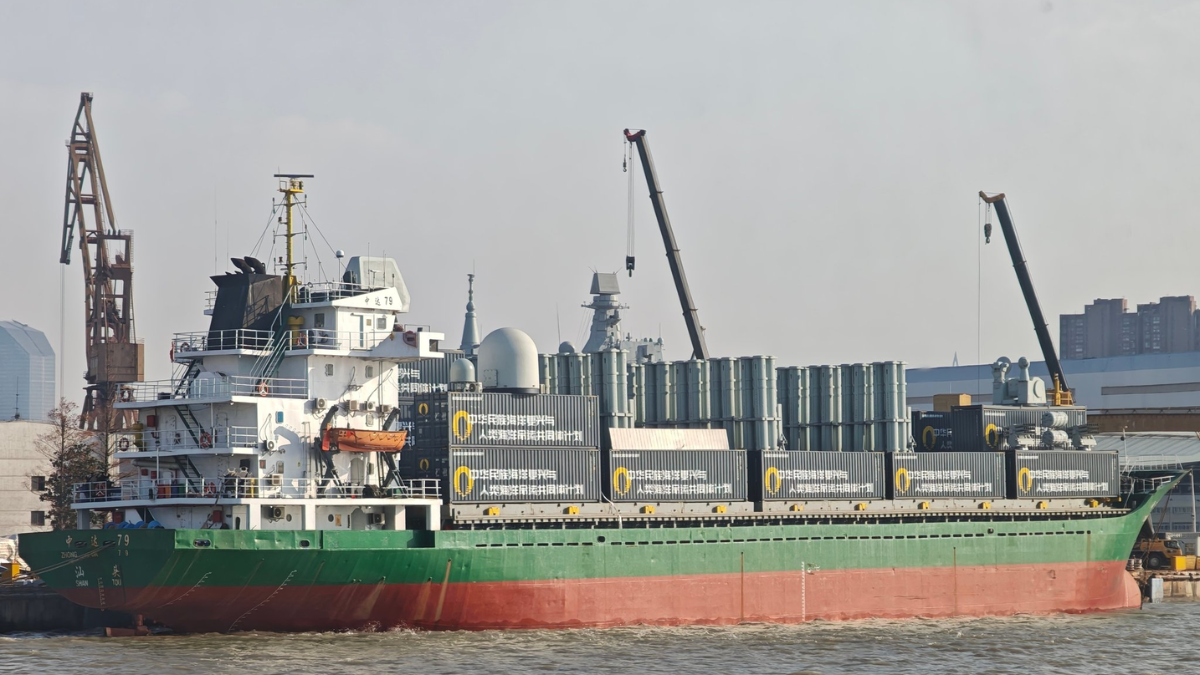
China has taken a significant step towards rapidly expanding its maritime strike capability by converting a 97-metre civilian cargo vessel, Zhongda 79, into an arsenal ship equipped with containerised missile launchers, underscoring Beijing’s growing emphasis on unconventional naval warfare amid rising tensions in the Taiwan Strait.
How does Zhongda 79 conversion close the firepower gap with the US?
Recent satellite and online images, shared by defence-focused outlet Militarnyi, citing Chinese sources, show the Zhongda 79 undergoing extensive modifications at Shanghai’s state-owned Hudong-Zhonghua Shipbuilding shipyard. The vessel is now fitted with containerised vertical launch systems (VLS) capable of carrying up to 60 missiles, including anti-ship, land-attack cruise, hypersonic, and surface-to-air missiles. The conversion highlights the People’s Liberation Army Navy’s (PLAN) push to close the missile firepower gap with the US Navy.
According to the UK-based International Institute for Strategic Studies (IISS), the PLAN crossed a critical threshold on December 20, 2025, by reaching more than 50 per cent of the US Navy’s overall missile firepower, largely driven by the rapid proliferation of VLS-equipped platforms. Converting civilian ships like Zhongda 79 allows China to add missile capacity far faster than building new destroyers or cruisers.
How is China leveraging its commercial shipping fleet for military purposes?
Strategically, the move reflects Beijing’s intent to leverage its massive commercial shipping fleet for military purposes. By fitting ordinary freighters with containerised missile launchers, China gains the ability to generate surge naval firepower for blockades or invasion scenarios without overextending its blue-water combat fleet. This approach has been repeatedly rehearsed in PLA exercises focused on Taiwan contingencies.
Defence analysts see the Zhongda 79 as an evolution of China’s “maritime militia” concept, blurring the line between civilian and military vessels. Such dual-use platforms complicate detection, targeting, and legal responses, particularly under international frameworks like the UN Convention on the Law of the Sea (UNCLOS). In a crisis, these ships could operate in grey zones before rapidly transitioning into overt combat roles.
How does the Zhongda 79 conversion fit into China’s A2/AD strategy?
The conversion also fits squarely within China’s broader anti-access/area denial (A2/AD) strategy. In a cross-strait conflict, missile salvos launched from dispersed and improvised platforms could saturate US, Taiwanese, and allied air and missile defences, increasing the cost and risk of intervention.
Satellite imagery places Zhongda 79 berthed near the new Type 076 amphibious assault ship Sichuan at Hudong-Zhonghua, a yard central to China’s naval modernisation. The Sichuan is believed to have completed its second sea trials earlier this month, highlighting the parallel development of conventional and unconventional naval capabilities.
Additional photographs reported by the South China Morning Post show containers on the freighter emblazoned with slogans referencing “the maritime revival of the Chinese nation” and President Xi Jinping’s concept of building a “community of shared future for mankind,” signalling the political messaging embedded in China’s maritime expansion.
Why does Zhongda 79 continue to retain civilian status?
According to Militarnyi, Zhongda 79 had ceased regular domestic shipping operations before entering refit at a Longhai shipyard between April and August, before moving to Shanghai in August 2025 for final conversion. Despite its transformation, the vessel reportedly retains civilian status and has not yet been formally inducted into the PLAN’s auxiliary fleet—an ambiguity that itself serves China’s grey-zone strategy.
Together, these developments point to Beijing preparing for high-intensity conflict scenarios by 2027, using dual-use innovation to rapidly multiply its naval strike options while complicating adversary responses.