


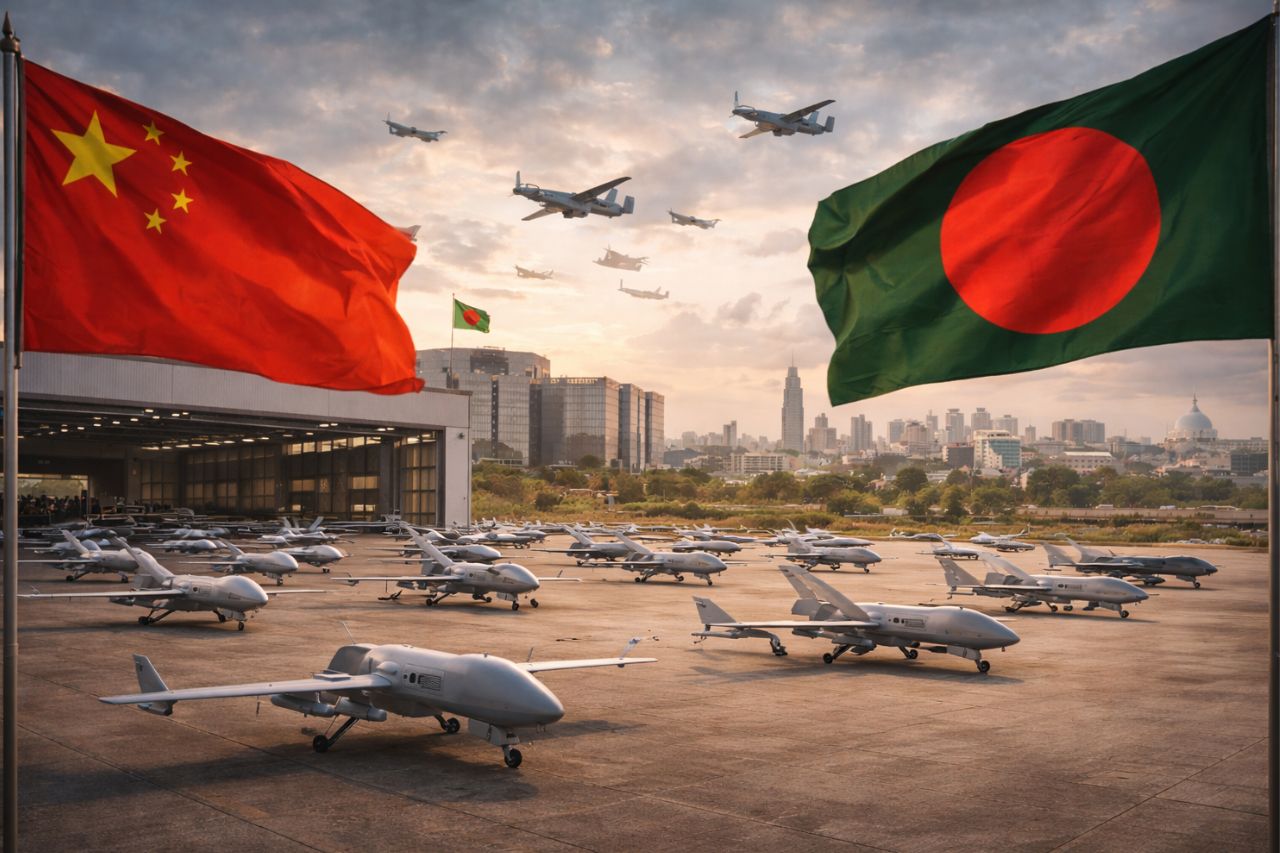
China has waded quickly into India’s neighbour Bangladesh’s defence industrial complex by signing a deal to build an unmanned systems production facilities that poses a further challenge to the already strained diplomatic and military ties between New Delhi and Dhaka.
The China-Bangladesh agreement was signed in Dhaka on Tuesday (Janaury 27, 2026), the same day India signed the ‘mother of all deals’ Free Trade Agreement (FTA) with European Union.
What is the regional implication of the Beijing-Dhaka deal?
The Chinese move in Bangladesh could test India’s strategic comfort in the region and would force New Delhi to make some countermoves to take back its predominant position as the net security provider in the Indian Ocean. Since August 2024, when then Prime Minister Sheikh Hasina was forced to flee Bangladesh due to domestic unrest, India’s relations with its neighbour has come under a severe strain, after she sought and took refuge in New Delhi.
How would Dhaka benefit from the deal with Beijing?
The China-Bangladesh deal is the Chinese bid to further strengthen its military coopeation with the South Asian nation, embedding itself firmly in the Bay of Bengal, a maritime region considered as India’s backyard.
Chinese and Bangladeshi government signed the agreement for technology transfer between the Bangladesh Air Force and China Electronics Technology Group Corporation International, according to reports from Dhaka.
What does the China-Bangladesh agreement bring to the table?
Under the China-Bangladesh agreement, the two sides would jointly set up a modern Unmanned Aerial Vehicles manufacturing and assembly unit.
The agreement also includes technology transfer, capacity building, industrial skills development, and joint technical cooperation, the reports said.
How would the agreement help the Bangladesh military?
The agreement’s implementation would help Bangladesh achieve self-reliance in UAV production in the long run, Bangladesh military officials said.
Dhaka would initially get the capability to produce and assemble medium-altitude, low-endurance UAVs and vertical take-off and landing UAVs, they said.
These UAVs would enhance Bangladesh armed forces’ capability in both military operations and humanitarian aid.