


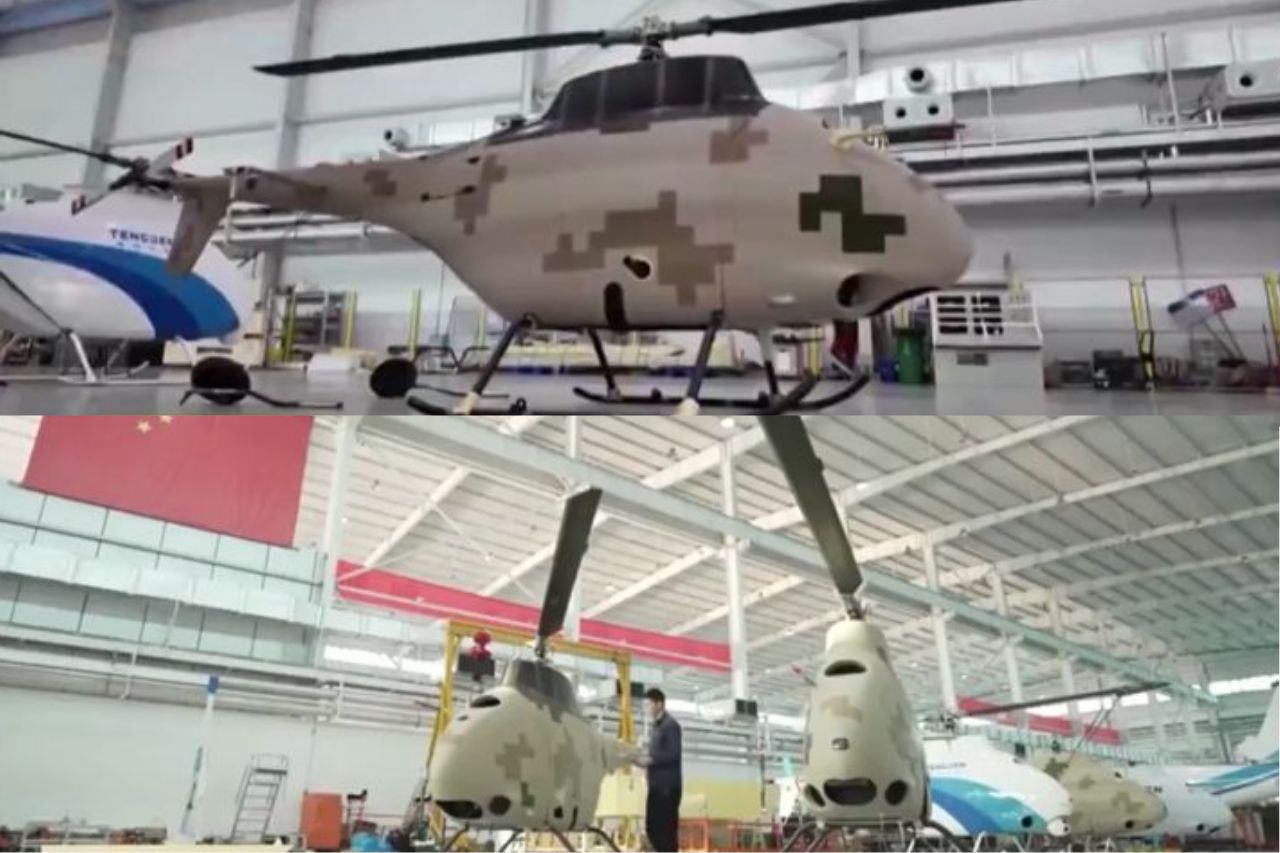
China has pushed its unmanned aviation ambitions another step forward, announcing that its Moyujian reconnaissance-and-strike helicopter, designed specifically for plateau warfare, is now ready for critical combat testing.
The milestone underscores Beijing’s accelerating drive to deploy high-altitude, all-weather drones along sensitive border regions and strategic maritime zones.
What is the Moyujian drone?
The medium-sized multipurpose helicopter was showcased on November 27 at Aero Asia 2025 in Zhuhai, southern China. The biennial event, co-organised by the German General Aviation Exhibition and Airshow China, featured 174 domestic and foreign aircraft this year, highlighting China’s growing push to internationalise its aviation industry.
At the show, developer Sichuan Tengden Technology announced that the Moyujian had entered its next testing phase after completing years of trials in some of China’s harshest environments.
Displayed in camouflage paint, the uncrewed helicopter was accompanied by footage of its first successful high-altitude live-fire test, which developers say marks a major step in validating its plateau-combat reliability.
Tengden revealed that in July the Moyujian fired two missiles in strike trials conducted at more than 4,000 metres, hitting both stationary and moving targets.
The next phase, the company said, will involve satellite-guided missions using beyond-visual-line-of-sight (BVLOS) control at altitudes exceeding 6,000 metres.
What are Moyujian’s capabilities?
With a maximum range of 1,000 km and endurance of nine hours, the platform is engineered for China’s most demanding terrains.
It boasts a service ceiling of 7,200 metres, high-altitude take-off and landing capability, and suitability for reconnaissance, precision strikes, emergency rescue, communications relay, marine patrol, and forest-fire monitoring.
Moyujian, named after a stone-throwing warrior from the classic Chinese novel Water Margin, first flew in 2019 and has since undergone six years of high-altitude, payload, mission-system, and maritime testing.
Why is Moyujian’s deployment potential strategic?
Its deployment potential is unmistakably strategic. China’s Tibetan Plateau, forming the rugged Himalayan frontier with India, sits at elevations of 4,000 to 5,000 metres or more.
Aircraft operating in these thin-air conditions require specialised engineering, making high-altitude drones a critical investment in Beijing’s border-management and military modernisation plans.
The Moyujian’s extended range and resilience in strong winds also make it useful for maritime theatres, including long-distance surveillance in the South China Sea.
How is Moyujian reflecting Chinese advancements?
The testing announcement comes amid a broader wave of Chinese advancements in unmanned platforms. At the September 3 Victory Day parade, China unveiled a suite of autonomous systems—from loyal-wingman drones to robot dogs and unmanned combat vehicles.
In October, it opened a dedicated high-plateau testing centre for unmanned equipment in Ali (Ngari prefecture), while satellite imagery in August and September revealed drone deployments to a military airport in Shigatse, Tibet.
China’s heavy-lift Boying T1400 unmanned helicopter, designed for missions from the Himalayas to the South China Sea, also completed its maiden flight last month.
Earlier this year, the Xinjiang Military Command conducted a logistics drill at 5,300 metres in the Karakoram Range using unmanned ground vehicles and robot dogs, reflecting a shift toward automation in extreme-terrain operations.
As Beijing races to build a comprehensive unmanned ecosystem across air, land, and sea, the Moyujian’s move into combat testing hints at how China intends to fight and deter future conflicts in some of Asia’s most challenging geographies.