


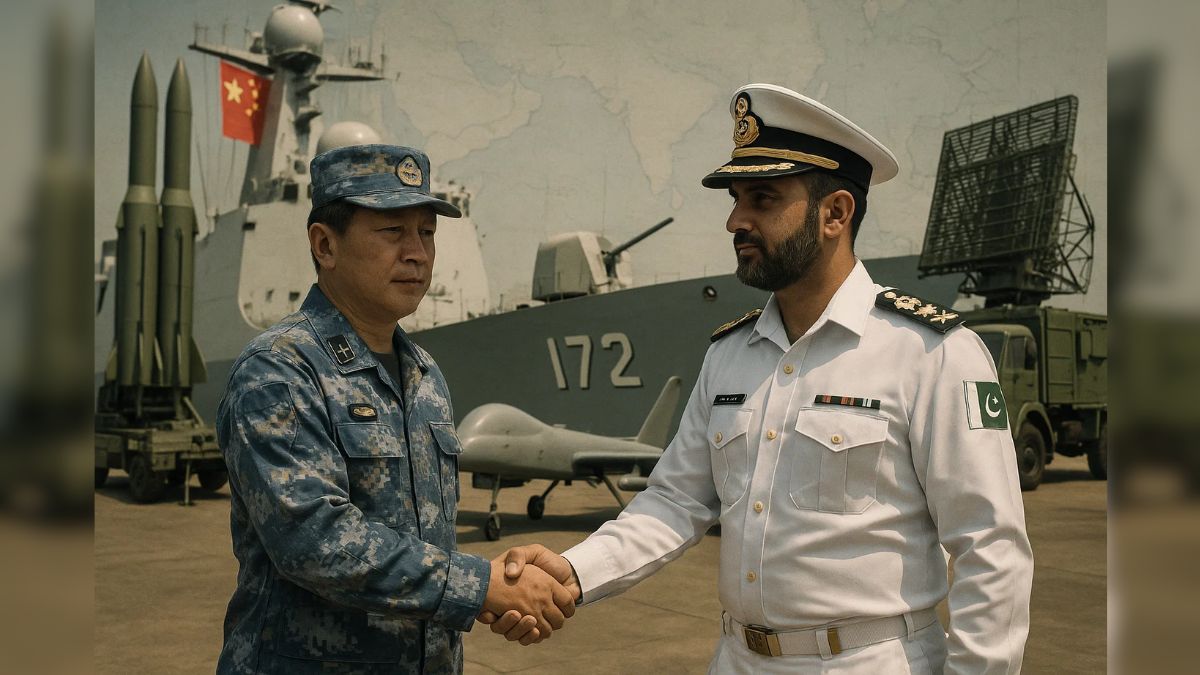
India must prepare for a rapidly evolving regional security environment marked by China’s expanding naval footprint and Pakistan’s accelerated arms procurement following Operation Sindoor, Vice Admiral K. Swaminathan, Flag Officer Commanding-in-Chief of the Western Naval Command, warned on Wednesday (November 26, 2025).
Speaking at a security conference hosted by the Bramha Research Foundation in Mumbai, the senior naval commander said China remains India’s “enduring challenge” as Beijing continues to scale up its military capabilities at an unprecedented pace.
He cautioned that Pakistan’s response after Operation Sindoor, a four-day Indian military campaign in May, has added a new layer of complexity to the subcontinent’s security dynamics.
What was the Indian Navy officer’s warning on China?
Swaminathan noted that China has already built the world’s largest navy and added, in just the last decade, a fleet size equivalent to that of the entire Indian Navy.
The commissioning of the PLA Navy’s third aircraft carrier Fujian, along with demonstrations of fifth and sixth-generation fighter aircraft, is part of “a global strategic narrative and signalling” by Beijing, he said.
“China continues to maintain five to eight ships in the Indian Ocean Region at any given time,” he observed, listing a mix of warships, research platforms, satellite-tracking vessels and fishing fleets.
Such persistent deployment in the IOR, he warned, reflects China’s expanding strategic ambitions well beyond the South China Sea.
What are the Pakistan Navy’s threats?
Turning to Pakistan, the Vice Admiral said Operation Sindoor has reshaped India’s security posture by setting “a new normal” in New Delhi’s response to cross-border terrorism.
The operation was launched after the April terror attack in Pahalgam that killed 26 people, most of them tourists. Indian forces conducted coordinated strikes on terror hubs in Pakistan and Pakistan-occupied Kashmir, and later targeted multiple air bases inside Pakistan.
“It is a very significant departure from how we view Pakistan and the response that Pakistan brings about in whatever happens in the subcontinent,” he said.
However, Pakistan’s reaction to the operation is “worrying,” Swaminathan cautioned. “The Pakistani Army is shopping all around the world for arms and ammunition with scant regard for the economic hardships of its citizens.”
He added that the campaign exposed the depth of operational collusion between Pakistan and China, which was “undeniably overt and in broad daylight.”
Is Turkey posing a challenge for the region?
He also pointed to Turkey’s emergence as an active supporter and supplier to Pakistan during the conflict, a development India must “watch very carefully.”
The Vice Admiral highlighted that Operation Sindoor demonstrated India’s ability to execute tightly coordinated, multi-domain operations at scale.
Air Marshal Rakesh Sinha of the Integrated Defence Staff, who also spoke at the event, said the campaign underscored complete synergy between the Army, Navy, and Air Force, with the IAF showcasing strategic reach and precision targeting.
“India has given a message of a new normal — that nuclear blackmail will not deter decisive action,” Sinha said. He added that Indian drones, supported by a strong Airborne Warning and Control System (AWACS) network, played a key role in the operation.
Both the military leaders emphasised that the regional security landscape has entered a more complex phase, one that demands sustained preparedness, stronger jointness among the services, and a clear-eyed view of emerging geopolitical alignments.