


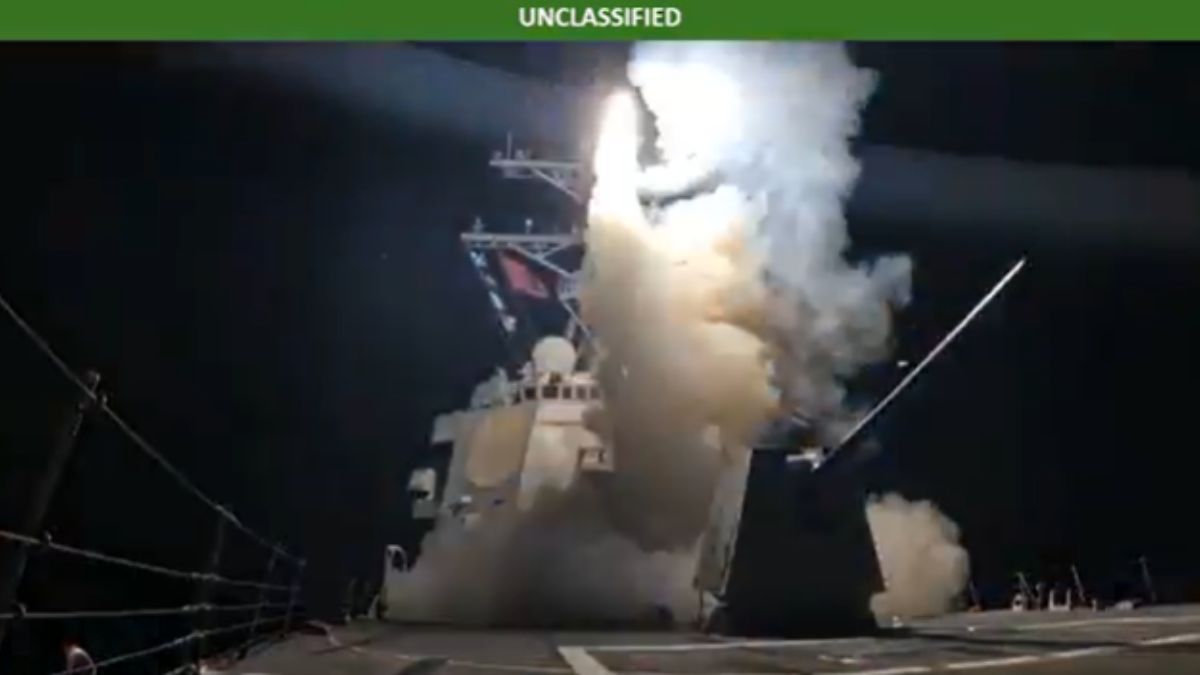
Just around a week after the United States launched a “massive strike” against Islamic State (IS) targets across central Syria, President Donald Trump on Thursday (December 25, 2025) ordered another “powerful and deadly” military strikes against targets linked to the Islamic State (ISIS) in northwestern Nigeria.
While the world was soaking the Christmas spirit, US Africa Command was conducting strikes against ISIS terrorists in Nigeria at the direction of the President Trump and the Secretary of War, The latest strikes mark a major escalation in Washington’s involvement in Nigeria’s long-running battle against Islamist militancy.
According to the US military’s Africa Command (AFRICOM), the operation was conducted at the request of Nigerian authorities and targeted militant positions in Sokoto State, a region that has seen a sharp rise in extremist violence. “The command’s initial assessment is that multiple ISIS terrorists were killed in the ISIS camps,” it said.
US airstrikes in Nigeria: What prompted Washington’s move?
The strikes come after months of warnings from Trump, who has repeatedly described Islamist violence in Nigeria as an “existential threat” to Christianity, a characterisation that Nigeria’s government has publicly rejected.
In a post on his Truth Social platform, Trump said the decision was driven by what he described as systematic attacks on “primarily innocent Christians”, claiming the violence had reached levels “never seen for many years.” “Under my leadership, our Country will not allow Radical Islamic Terrorism to prosper,” Trump said.
Washington also designated Nigeria a “country of particular concern” under the International Religious Freedom Act.
Nigerian government confirms cooperation
Nigeria’s Foreign Ministry confirmed that the US conducted precision strikes on terrorist targets, stressing that Abuja’s actions are guided by the need to protect all citizens, regardless of religion. In a statement, the ministry said terrorism targeting any religious community remains “an affront to Nigeria’s values and to international peace and security.”
“Nigeria reiterates that all counter-terrorism efforts are guided by the primacy of protecting civilian lives, safeguarding national unity, and upholding the rights and dignity of all citizens, irrespective of faith or ethnicity. Terrorist violence in any form whether directed at Christians, Muslims, or other communities remains an affront to Nigeria’s values,” it stated.
Pentagon chief Pete Hegseth said he was “grateful” for Nigeria’s cooperation, underscoring close security coordination between Washington and Abuja.
Religious freedom concerns and US pressure
The military action follows a series of diplomatic and policy steps by Washington. The US State Department recently announced visa restrictions on Nigerian nationals accused of involvement in violence against Christians.
Nigeria has been battling Islamist insurgents and armed bandits across its northern regions for over a decade. According to the National Human Rights Commission, at least 2,266 people were killed by bandits or insurgents in the first half of 2025, already exceeding the total number of such deaths recorded in all of 2024.
ISIS, Boko Haram and splinter factions
While Boko Haram remains one of the most notorious militant groups in Nigeria, its influence has fragmented. A splinter faction, the Islamic State in West Africa Province (ISWAP), has carried out repeated attacks in northeastern Borno State and has also clashed violently with Boko Haram.
In the northwest, militants aligned with ISIS have increasingly concentrated attacks in Sokoto, prompting both Nigerian and US officials to describe the region as a growing front in the fight against transnational jihadist groups.
Broader implications for regional security
The US strikes highlight Washington’s willingness to use military force in West Africa, as concerns mount over extremist groups exploiting weak governance, intercommunal tensions and porous borders. Analysts say the move also signals a tougher US posture linking counterterrorism with religious freedom.
“I have previously warned these Terrorists that if they did not stop the slaughtering of Christians, there would be hell to pay, and tonight, there was. The Department of War executed numerous perfect strikes, as only the United States is capable of doing. May God Bless our Military, and MERRY CHRISTMAS to all, including the dead Terrorists,” Trump noted.