


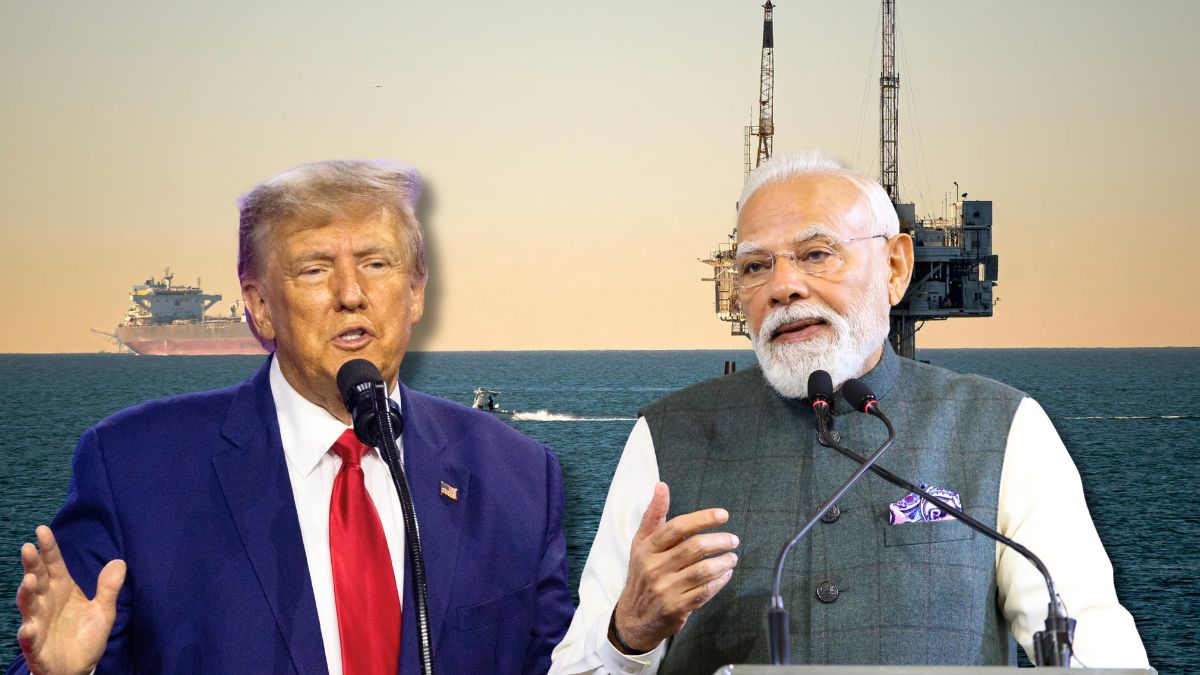
The United States has granted India a 30-day waiver to purchase Russian crude oil, a move Washington says is aimed at stabilising global energy markets amid the ongoing Iran-US tensions and disruptions around the Strait of Hormuz. The temporary reprieve allows Indian refiners to buy Russian oil shipments that are already at sea.
Announced on Friday (March 6, 2026), the move is aimed at preventing disruptions in global supply chains at a time when crude prices have surged due to the Middle East conflict. US President Donald Trump later confirmed the decision, saying the measure was intended to ease pressure on global oil markets.
“If there were some, I would do it just to take a little of the pressure off, the oil pressure,” Trump said while speaking to reporters aboard Air Force One.
‘Just to take pressure off’: Trump on waiver decision
Trump downplayed the geopolitical significance of the waiver, framing it primarily as a market stabilisation step rather than a shift in US policy toward Russia. “But there is a lot of oil, we’ve got a lot of oil. Our country has a tremendous amount,” he said.
When asked about tapping the US Strategic Petroleum Reserve (SPR) to address rising prices, Trump also criticised the previous administration. “Well, I’m the one who built them up. Biden used them so that he could get some extra votes in,” he said.
The waiver comes as the Iran-US-Israel confrontation has heightened fears of energy disruptions, pushing global oil prices sharply higher.
US oil waiver won’t benefit Russia
US Treasury Secretary Scott Bessent, who announced the decision earlier, emphasised that the waiver is deliberately limited. According to him, it only allows transactions involving Russian oil that is already stranded at sea, meaning Moscow would gain little additional financial benefit.
“This deliberately short-term measure will not provide significant financial benefit to the Russian government as it only authorises transactions involving oil already stranded at sea,” Bessent said. He added that the move was necessary because Iran was attempting to “take global energy hostage.”
Bessent also praised India’s role in complying with earlier sanctions. “The Indians had been very good actors. We had asked them to stop buying sanctioned Russian oil this fall. They did,” he said during an interview on Fox Business.
US expects India to increase purchases of American oil
While allowing the temporary waiver, Washington signalled that it expects India to expand its purchases of US energy. “India is an essential partner of the United States, and we fully anticipate that New Delhi will ramp up purchases of US oil,” Bessent said.
Data shows that US crude exports to India have already risen significantly. Between April 2025 and January 2026, India imported $11.6 billion worth of US crude, a 32% increase compared to the previous year. As a result, the US share in India’s oil imports rose to 8% during the period.
India signals it never needed ‘permission’
Indian government officials, however, pushed back against the notion that the country required approval from Washington to buy Russian oil. A senior government functionary said the waiver merely removes temporary friction in the market, rather than defining India’s energy policy.
“India has never needed permission from any country to buy Russian oil,” the official said.
Officials stressed that India continued importing Russian crude even after Western sanctions, primarily because of competitive pricing and domestic energy requirements. “No petrol pump has run dry in 12 years. What certain voices are calling a crisis is proof of preparation,” the functionary added.
What about Russian oil discounts to India?
Even as the waiver allows purchases to continue, analysts warn that India may not get the same steep discounts on Russian oil that it enjoyed earlier. Government sources indicated that China’s increasing demand for Russian crude and shifting global supply patterns could reduce pricing advantages for Indian refiners.
Data already suggests a decline in Russian shipments to India. In January 2026, India imported $1.98 billion worth of Russian crude, the lowest level in 44 months, bringing Russia’s share in India’s oil imports down to 19.3%. By comparison, the share had been 33% in May 2025.
Energy crisis fears as Iran tensions disrupt supply routes
The waiver comes amid growing concerns over energy supply disruptions linked to the conflict involving Iran, the US and Israel. More than 55% of India’s oil imports pass through the Strait of Hormuz, making the country particularly vulnerable to shipping disruptions in the region.
Analysts warn that if Brent crude rises above $90 per barrel, India could face higher import bills, currency pressure and inflation. Financial services firm JM Financial noted that in such a scenario India’s current account deficit could widen to 1.4% of GDP, while the rupee could weaken to around Rs 95 per dollar.
India’s energy stocks remain comfortable
Despite global volatility, government sources said India’s energy supply situation remains stable. Officials indicated that strategic reserves and diversified import routes are helping cushion the impact of the West Asian crisis.
India has also reduced reliance on the Strait of Hormuz, increasing imports from alternative sources. According to officials, 70% of India’s crude imports now come from routes outside the Hormuz corridor, compared with about 60% earlier. Authorities also reassured consumers that petrol and diesel prices will not increase immediately despite global price fluctuations.
Qatar to supply LNG?
In another positive development, Qatar has provided specific guarantees regarding LNG’s supply continuity even as the world continues to grapple with a severe energy crisis amid the ongoing tensions in West Asia. Government sources told ANI, “We are assured by Qatar that they will start supplying to India on the very first minute once the route is open.”
“We have surplus stock of LNG,” officials said, adding that India also ” got offer of LNG from a large number of countries.” The supply route from Qatar is effectively paralysed because the Strait of Hormuz. Sources also gave a positive update on the cargo movements, saying that the “cargo movement near the Strait of Hormuz may start soon.”
Meanwhile, seeing the situation in Iran, the government has successfully reduced its reliance on the volatile Strait of Hormuz by diversifying its import routes. India has redirected a significant portion of its procurement to ensure a steady flow of oil, noting that “India has ramped up 10% of its crude imports from sources other than the Strait of Hormuz.”