


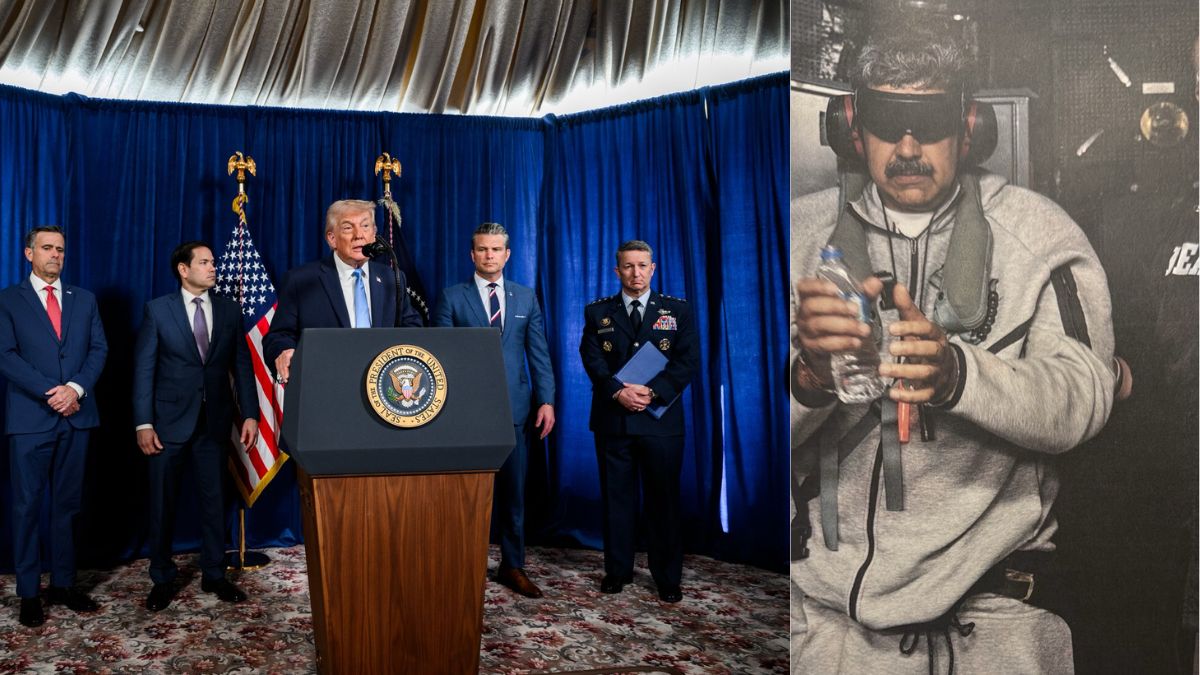
In one of the most dramatic foreign policy moves of his second term, US President Donald Trump confirmed that Venezuelan President Nicolás Maduro was captured by American forces in a high-risk nighttime military operation in Caracas, triggering a political earthquake across Latin America and beyond.
Hours after the operation, Trump posted an image on his Truth Social platform showing a handcuffed and blindfolded Maduro aboard a US warship. The Venezuelan leader, dressed in a grey sweatshirt and sweatpants, was seen wearing large headphones and holding a plastic water bottle, a photograph that quickly went viral.
“Nicolas Maduro on board the USS Iwo Jima,” US President Trump posted.
How was the operation carried out?
According to US officials, the extraction of Maduro followed months of planning and rehearsal and involved an extraordinary level of military coordination. Chairman of the Joint Chiefs of Staff General Dan Caine said more than 150 US aircraft were launched across the Western Hemisphere to execute what he described as an “extraction so precise” that it defied easy explanation.
Maduro and his wife, Cilia Flores, both indicted in the United States, surrendered during the raid and were taken into custody by the US Department of Justice, assisted by American special forces. Some US troops were injured, Trump later acknowledged, but no American lives were lost.
Trump, who said he watched the operation unfold in real time from his Mar-a-Lago residence in Florida, described the raid as “brilliant” and later likened it to something “out of a television show.”
Why did the US target Nicolás Maduro?
US Attorney General Pam Bondi confirmed that Maduro and Flores have been indicted in the Southern District of New York on multiple charges, including narco-terrorism conspiracy, cocaine trafficking, possession of machine guns and destructive devices, and weapons offences directed against the United States.
Trump has long accused the Maduro government of using oil revenues to finance drug trafficking, human trafficking, kidnapping and violence. Venezuela has been under US oil sanctions since 2019 and currently produces roughly one million barrels of crude per day.
What about Venezuela’s future?
In remarks that sent shockwaves through diplomatic circles, Trump said the United States would effectively “run Venezuela” until a “safe, proper and judicious transition” of power could be ensured. He added that US oil giants would be allowed to re-enter Venezuela, invest billions of dollars to repair its shattered oil infrastructure, and revive production.
“The oil business in Venezuela has been a bust for a long time,” Trump said, adding, “We’re going to fix the infrastructure and start making money for the country.”
How has Venezuela responded internally?
As uncertainty spread across Caracas, Venezuela’s Supreme Court moved swiftly to stabilise governance, appointing Delcy Rodríguez as interim president. Rodríguez, who served as Maduro’s vice president since 2018 and oversaw much of the oil economy and intelligence services, was next in the constitutional line of succession.
Backed by the Venezuelan military, Rodríguez assumed office as the de facto leader of the country, even as Washington warned it would continue to apply intense pressure on the new leadership.
What was surprising was Rodríguez signalling openness to cooperation with Washington, a stark contrast to the confrontational posture of her predecessor. In a conciliatory message posted on Instagram, she said Venezuela hoped to build “respectful relations” with the Trump administration and invited the US to collaborate on an agenda of shared development “within the framework of international law.”
Trump, however, issued a blunt warning, saying that if Rodríguez failed to “fall in line,” she would “pay a very big price, probably bigger than Maduro,” adding that Washington wanted full access to Venezuela’s oil facilities and basic infrastructure.
Trump’s Operation Absolute Resolve: How has the world reacted?
The Venezuelan government condemned the raid as an “extremely serious military aggression” and declared a state of emergency. Allies of Maduro, including Russia and Iran, swiftly denounced the US action. Alarm was also evident among Washington’s traditional allies in Europe, with France and the European Union expressing concern over the precedent set by the operation.
Meanwhile, US-backed opposition leader María Corina Machado, who won the Nobel Peace Prize last year, hailed the development as a turning point, declaring, “The hour of freedom has arrived,” and calling for opposition candidate Edmundo González Urrutia to immediately assume the presidency.
Meanwhile, the Venezuela operation marks another major escalation in Trump’s muscular foreign policy during his second term. It follows US strikes on Iranian nuclear sites in June and fresh warnings to Tehran over its handling of domestic protests sparked by economic collapse.