


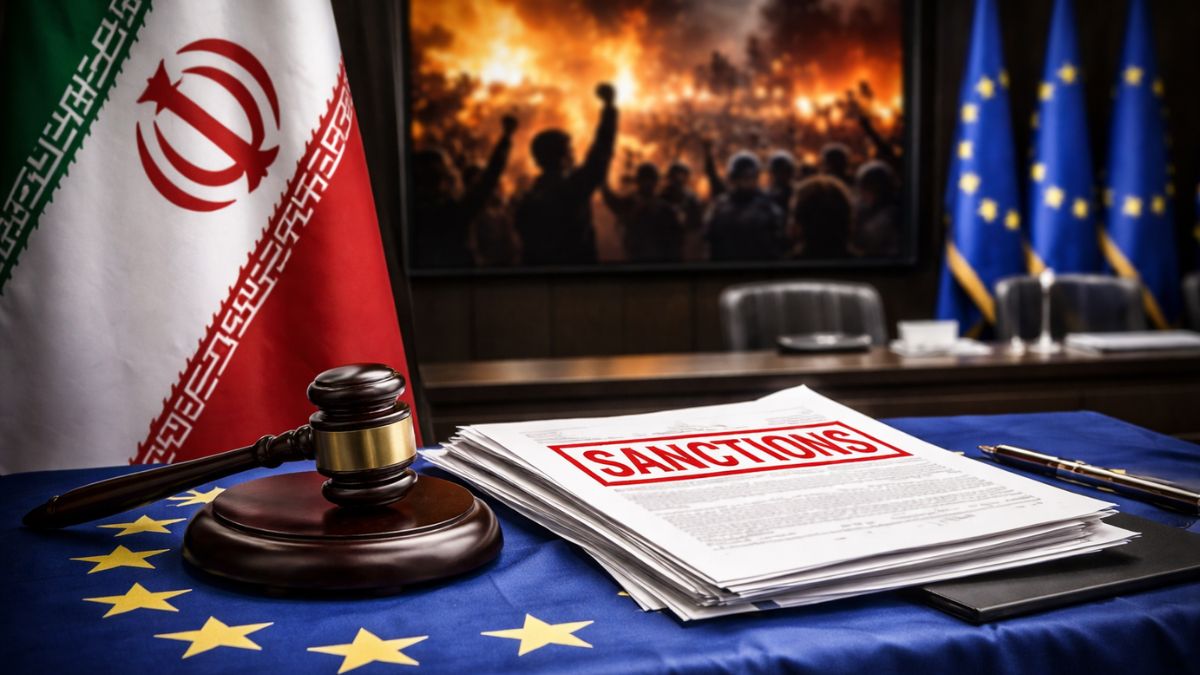
Iran is facing one of the worst protests in the country, and thousands have been killed by Iranian security forces so far since the situation began in late December 2025. Iran admits that over 3,000 people have died during the unrest, while authorities say the majority were either security personnel or bystanders killed by “rioters” and “terrorists.”
Now, in a massive crackdown against the Gulf country over the grim situation, the European Union has taken a toughest step against Iran, adopting a fresh round of sanctions and agreeing politically to designate the Islamic Revolutionary Guard Corps (IRGC) as a terrorist organisation.
The decision marks a politically powerful shift in Europe’s approach to Tehran at a moment when tensions inside Iran are reaching a breaking point.
EU sanctions on Iran: What has the European Union decided?
During a meeting in Brussels on Thursday (January 29, 2026), EU foreign ministers approved new sanctions targeting Iranian individuals and entities accused of involvement in violent repression of protesters, internet censorship, support for Russia’s war in Ukraine. Those sanctioned include members of Iran’s government, judiciary, police, and the IRGC, according to EU diplomats.
More significantly, ministers reached a political agreement to place the IRGC on the EU’s terrorist list, putting it in the same category as al-Qaeda, Islamic State and Hamas.
Why now? What changed in Europe’s calculus?
Momentum for the move surged after a brutal nationwide crackdown on protests earlier this month, which EU officials say killed thousands of demonstrators. “It’s important that we send this signal that the bloodshed and bestial violence against protesters cannot be tolerated,” Dutch Foreign Minister David van Weel said.
EU foreign policy chief Kaja Kallas bluntly stated, “If you act as a terrorist, you should also be treated as a terrorist.”
Sharing the update that the members have decided to designate IRGC as a terrorist organisation, Kallas said, “Repression cannot go unanswered. EU Foreign Ministers just took the decisive step of designating Iran’s Revolutionary Guard as a terrorist organisation. Any regime that kills thousands of its own people is working toward its own demise.”
Who are the IRGC and why are they so central to Iran’s power?
Formed after Iran’s 1979 Islamic Revolution, the IRGC is the ideological backbone of the regime, tasked with protecting the clerical leadership and revolutionary ideals. Over the decades, it has grown into a powerful state within a state, controlling key sectors of the economy, elite military units, Iran’s ballistic missile and nuclear programmes.
Its volunteer arm, the Basij, is widely accused of playing a leading role in suppressing protests, making the IRGC a focal point of public anger inside Iran.
IRGC terrorist organisation: Why does it matter?
While the EU has already imposed financial sanctions on the IRGC and its commanders, the terror designation carries strong political and moral weight. Kallas said the move puts the IRGC “on the same footing as terror groups like al-Qaeda and Islamic State,” sending a clear message to Tehran that systematic violence against civilians has consequences.
German Foreign Minister Johann Wadephul called it “a success for the people of Iran… and for the EU as a community of values.”
Some EU capitals had previously resisted the terror listing, fearing it could endanger European citizens detained in Iran, shut down diplomatic channels. France and Italy, once hesitant, threw their weight behind the move this week.
Kallas sought to reassure skeptics, saying diplomatic channels are expected to remain open even after the listing, despite the heightened pressure.
What is France asking Iran to do next?
French Foreign Minister Jean-Noel Barrot framed the decision as both punishment and appeal, urging Tehran to release thousands of political prisoners, end executions linked to the crackdown, lift an internet blackout imposed to stifle dissent. “There can be no impunity for the crimes committed,” Barrot said.
The EU’s move underscores growing international isolation for Iran’s leadership as domestic unrest, global pressure, and geopolitical tensions converge.