


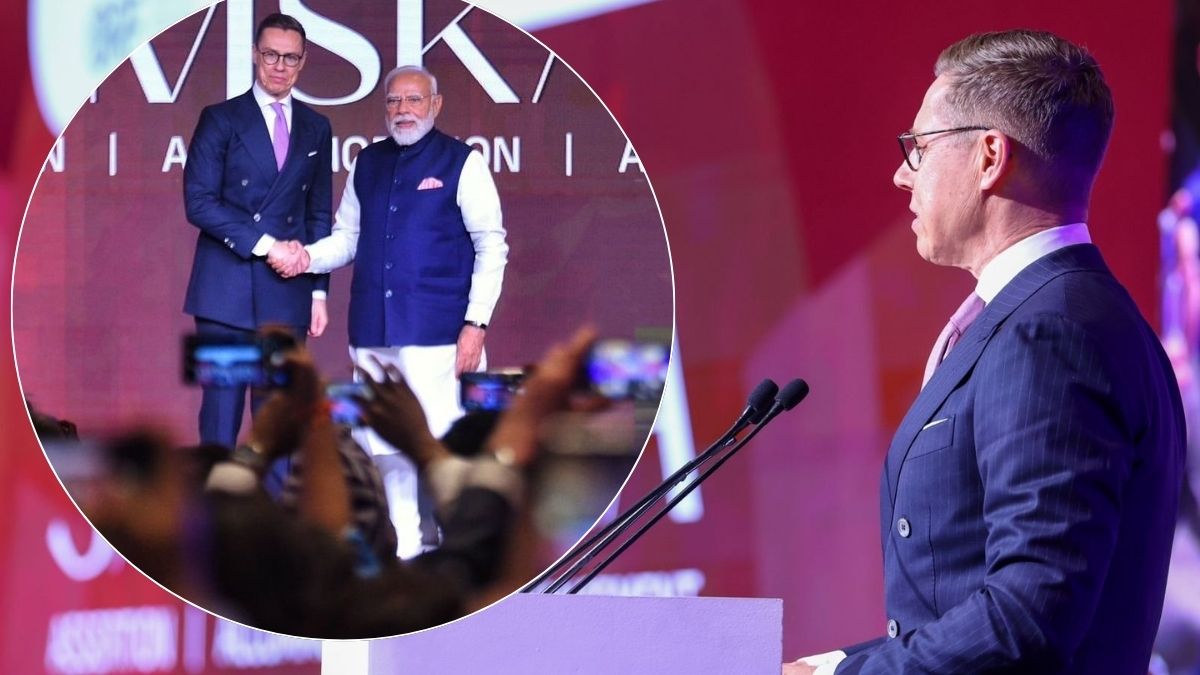
Finnish President Alexander Stubb delivered a striking message at the Raisina Dialogue 2026 in New Delhi, declaring that the era of Western dominance in global politics is coming to an end, with emerging powers, particularly India and the broader Global South, set to shape the future world order.
Speaking at the opening session of the three-day strategic forum, Stubb said the international system is undergoing a historic transition in which decisions made by countries like India will determine whether the global order becomes cooperative or increasingly conflict-driven.
“The era of a Western-dominated world is over. But it will take some time to sink in across the West,” Stubb said. He stressed that the Global South will play a decisive role in shaping the next international order, adding that India’s policy choices would have a major impact on how the evolving system unfolds.
With this, he also voiced strong support for India securing a permanent seat in the United Nations Security Council (UNSC).
How could India shape the next global order?
Finnish President Stubb emphasised that India is uniquely positioned to influence whether the world moves towards “conflictual multipolarity”, a system defined by geopolitical competition and spheres of influence, or a cooperative multilateral order based on institutions, rules and norms.
“I believe the Global South will decide what the next world order will look like, and India will be a major force in deciding the direction it takes,” he said. According to Stubb, the current global system faces deep structural strain, with traditional mechanisms of governance and international cooperation increasingly challenged by rising geopolitical rivalries.
“Without a functioning world order, power vacuums will be filled by raw power and predatory hegemony,” he warned.
Time to be like India
Suggesting that there’s a need to drop the illusion of a perfect order, Stubb specified that to the people in the West, “the change we’re living through has come as somewhat of a shock… Now our holiday from history is over.”Instead of preaching and teaching, it’s time for us to learn from others, and India would be a good starting point. India has been under no illusions. For your entire independence, you have based your foreign policy on a pragmatic and realistic worldview, he stressed.
With this, he complimented India for showing the world what strategic caution and safeguarding autonomy mean, all the while championing multilateralism and global cooperation. “It is time that we all became a little bit more like India,” Stubb noted, underlining that India has invested in its own security and actively developed partnerships in many directions.
Finland backs India’s bid for a permanent UNSC seat?
During bilateral talks with Prime Minister Narendra Modi in New Delhi, the Finnish President voiced strong support for India securing a permanent seat in the United Nations Security Council (UNSC).
Stubb argued that global institutions must be reformed to reflect contemporary geopolitical realities, rather than the power structure that existed after World War II.
“The world is changing. We are living through a transition in the global order, and India together with its friends in the Global South will determine the direction in which this order will go,” he said.
He stressed that granting India a permanent seat on the UNSC would be a crucial step toward making global governance more representative and effective.
What global conflicts dominated the India–Finland talks?
Security challenges and ongoing global conflicts formed a major part of the discussions between Modi and Stubb. The Finnish leader highlighted the Russia-Ukraine war, which he described as a prolonged conflict that needs to end through a peace settlement grounded in United Nations principles.
“For us, Russia’s war of aggression against Ukraine has lasted for too long—four years,” Stubb said, adding that a lasting peace must respect international law and the UN Charter.
PM Modi echoed the call for diplomacy, reiterating India’s consistent position that military confrontation cannot resolve global crises. “India and Finland believe in the rule of law, dialogue and diplomacy. No issue can be resolved through military conflict alone,” Modi said, referring to conflicts in Ukraine and West Asia.
Meanwhile, the Raisina Dialogue, hosted annually in New Delhi, has emerged as one of the world’s leading geopolitical forums, bringing together global leaders, diplomats, policymakers and strategic experts. President Stubb is the chief guest at the 2026 edition, which comes at a time of heightened geopolitical tensions across regions including Europe, West Asia and the Indo-Pacific.