


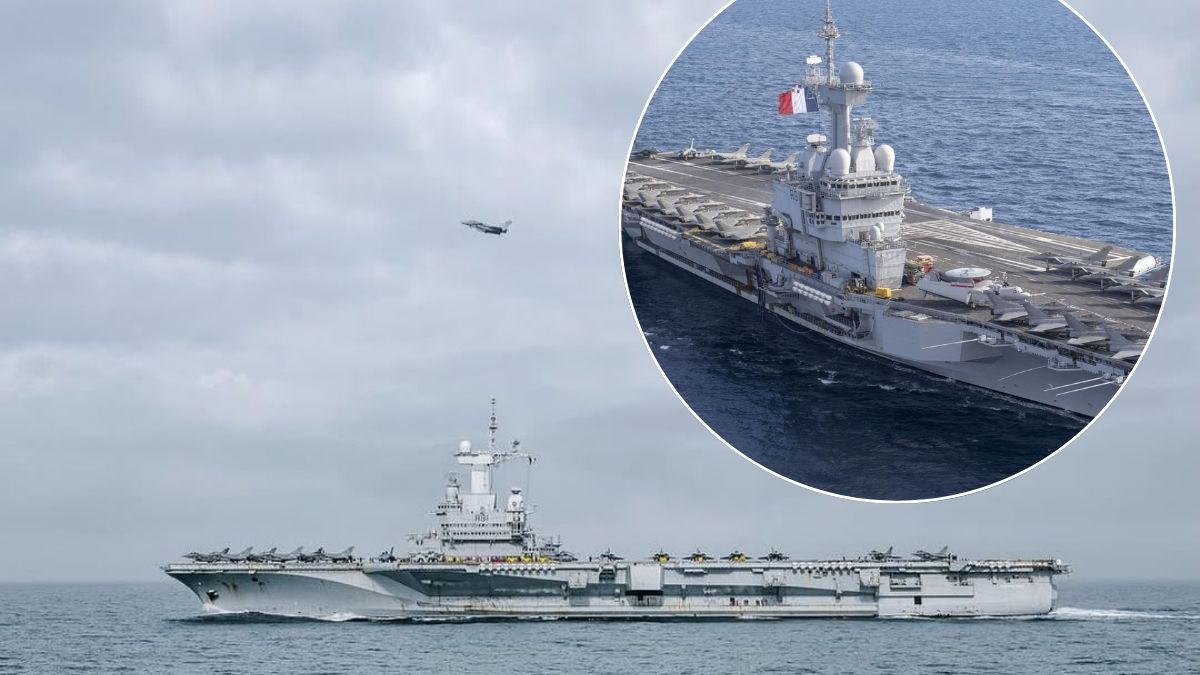
Just a few days after the United Kingdom, Germany and France said they are ready to join US in ‘war’ against Iran, French President Emmanuel Macron has ordered the deployment of nuclear-powered aircraft carrier Charles de Gaulle to the Mediterranean, as Iran war continues to intensify.
As the Israel-Iran war threatens to expand beyond the Middle East, France has moved one of its most powerful military assets closer to the conflict zone. President Macron has ordered the nuclear-powered aircraft carrier Charles de Gaulle to redeploy from the Baltic Sea to the eastern Mediterranean.
The move is aimed at strengthening the protection of allied forces and monitoring the rapidly escalating regional crisis. It marks France’s most significant military repositioning since the conflict erupted, signalling growing European concern that the war could spill over into a broader regional confrontation.
What capabilities does the Charles de Gaulle carrier group bring?
French Navy’s flagship, the Charles de Gaulle, is the only nuclear-powered aircraft carrier outside the United States fleet and represents the backbone of France’s expeditionary military power. The carrier is accompanied by escort frigates and a full carrier strike group, while its air wing includes:
20 Rafale multirole fighter jets capable of air superiority and deep strike missions
Two E-2C Hawkeye airborne early warning aircraft for aerial surveillance and command
Advanced naval air defence systems integrated with allied forces
Macron confirmed that Rafale jets, air-defence systems and airborne radar platforms have already been deployed to the region as part of France’s response. The Charles de Gaulle is expected to take approximately 10 days to reach the eastern Mediterranean.
The aircraft carrier’s presence significantly boosts NATO and allied situational awareness in the eastern Mediterranean, one of the most strategically sensitive maritime corridors.
Has France already been involved in military action?
Yes, albeit in a defensive capacity. Macron revealed that French forces intercepted and shot down drones in the early hours of the conflict, acting in what he described as “legitimate self-defence” to protect allied airspace.
While he did not disclose operational details, the announcement marks France’s first acknowledged military engagement linked to the conflict.
The redeployment was also influenced by a strike on a British air force base in Cyprus, an EU member state and a country with which France recently signed a strategic defence partnership.
Why does the move matter for the wider Iran war?
France’s decision to deploy its aircraft carrier underscores growing fears that the Israel–Iran confrontation could draw in multiple regional actors. Paris maintains defence agreements with several Gulf states, including Qatar, Kuwait, United Arab Emirates. It also has strong security partnerships with Jordan and Iraq.
By moving the carrier group closer to the Middle East, France is seeking to protect allied assets and personnel, strengthen regional air and maritime security, deter further escalation, support potential evacuation or crisis operations.
What is France’s position on the US-Israel strikes on Iran?
While reinforcing its military presence, France has taken a carefully balanced diplomatic position. Macron said Paris “cannot approve” of the US and Israeli strikes on Iran, arguing they were carried out outside the framework of international law. At the same time, he placed responsibility for the regional crisis partly on Tehran.
Macron has accused Iran of developing dangerous nuclear capabilities, expanding its ballistic missile programme, supporting regional militant groups such as Hezbollah, the Houthis, Iraqi militias and Hamas. The French President has called for an immediate de-escalation and a return to diplomatic negotiations.
What is France saying about the Lebanon front?
As fighting spreads to Lebanon, Macron warned that further escalation could destabilise the region even more. He criticised Hezbollah for launching attacks against Israel, saying it endangered Lebanese civilians.
At the same time, he cautioned Israel against launching a ground invasion of Lebanon, calling it “a dangerous escalation and a strategic error.” Macron urged all sides to respect Lebanon’s sovereignty and territorial integrity.
Charles de Gaulle deployment: What does it mean?
Commissioned in 2001, the Charles de Gaulle is widely regarded as the crown jewel of the French Navy. Its nuclear propulsion allows it to operate for extended periods without refuelling, enabling sustained operations far from French shores.
According to a report in France 24, the vessel carries 20 Rafale fighter jets and two E-2C Hawkeye airborne early warning aircraft. The 42,500-tonne carrier measures 261 metres in length and is powered by two K15 nuclear reactors.
With tensions rising across Iran, Israel, Lebanon and the Gulf region, the carrier’s deployment signals that Europe is preparing for a prolonged crisis that could reshape the security architecture of West Asia.