


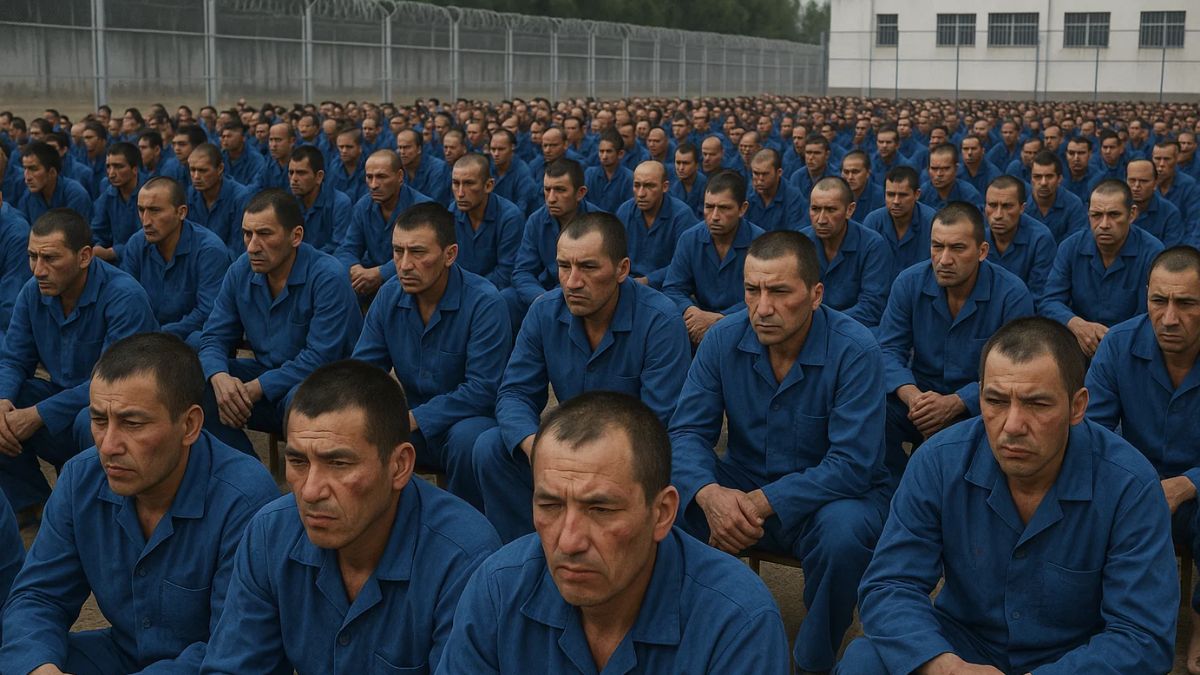
Beijing calls it “ethnic unity.” For the 12 million Uyghurs of Xinjiang, or East Turkestan, as many call their homeland, it has meant the slow dismantling of their identity. Behind China’s slogans of “harmony” and “poverty alleviation” lies one of the world’s most sophisticated systems of repression.
Since 2017, over a million Uyghurs have been locked away in an archipelago of prisons and “re-education” centres. The Chinese government calls them “vocational training facilities” designed to combat extremism. But leaked documents and survivor accounts tell a different story: people are detained for growing a beard, praying, or contacting relatives abroad. Children whose parents are taken away are placed in state-run orphanages under constant surveillance.
Inside the camps, detainees describe being forced to renounce Islam, sing hymns to the Communist Party, and endure hours of indoctrination. Torture, starvation, and sexual violence are routine. Families abroad live in perpetual uncertainty, often not knowing whether their loved ones are alive. China’s idea of unity, for the Uyghurs, has come to mean submission under threat.
How does surveillance turn daily life into a prison?
In Xinjiang, even a glance or a phone call can be enough to draw suspicion. The region has become a testing ground for the Chinese state’s high-tech authoritarianism, where artificial intelligence and human informants work together to enforce obedience. Cameras line every street; software tracks every purchase and online message.
The “Unite as One Family” programme has extended this surveillance into people’s homes. Under this policy, more than a million Han Chinese officials have been stationed in Uyghur households for compulsory homestays, eating, sleeping, and watching over them. Families have no right to refuse. Conversations, prayers, even dietary choices are recorded and reported.
The result is a culture of fear and mistrust, where neighbours spy on neighbours, and silence becomes the only defence. For many Uyghurs, freedom no longer means movement — it means invisibility.
How far will China go to control Uyghur bodies and beliefs?
Control in Xinjiang is not limited to thought — it reaches into the body itself. In recent years, Beijing has reversed its national family planning relaxation and imposed brutal birth restrictions on Uyghur women. Reports and leaked directives show that forced sterilisation, forced contraception, and coerced abortions have become widespread.
Women have testified to being injected with unknown substances that stopped their menstrual cycles. Others were told they would be detained if they refused sterilisation or intrauterine device insertions. Birth rates in Uyghur-majority areas have dropped sharply — an outcome Chinese academics have defended as “necessary for social stability.”
At the same time, Uyghurs are being pressed into forced labour, often inside or near the camps. Many are compelled to work in factories under armed guard, for little or no pay. Others are transferred across China to industrial sites hundreds of miles from home — a deliberate scattering designed to break families and culture.
Is the world willing to call this what it is?
The Simon-Skjodt Center for the Prevention of Genocide has concluded there is a reasonable basis to believe China is committing crimes against humanity against the Uyghurs. The pattern of persecution — mass detention, forced sterilisation, torture, and systematic cultural erasure — may yet meet the threshold for genocide.
Beijing continues to deny the allegations, restrict access to Xinjiang, and punish those who speak out. Yet the evidence — from satellite imagery to survivor testimony — continues to mount. For Uyghurs in exile, East Turkestan Independence Day serves as both remembrance and resistance: a reminder that the fight is not just against imprisonment, but against the rewriting of existence itself.
China calls it “unity.” The world, increasingly, sees it for what it is — a campaign to erase a people under the banner of harmony.