


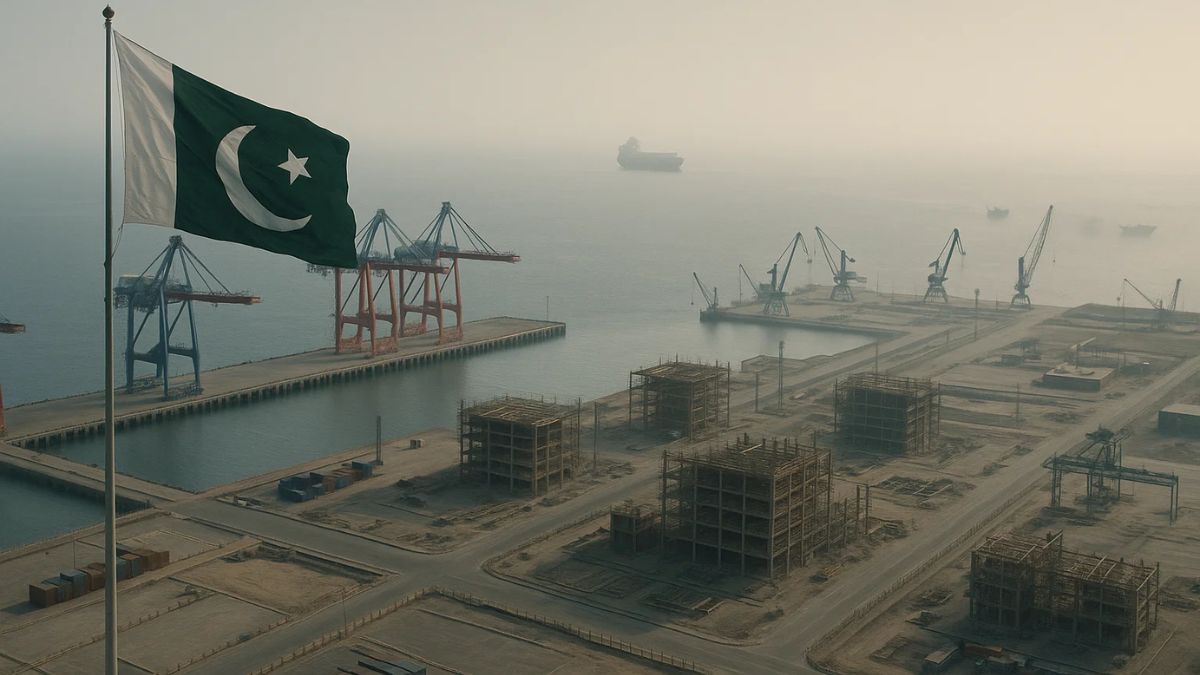
For nearly two decades, Pakistan has presented Gwadar as the crown jewel of the China–Pakistan Economic Corridor (CPEC), a port city set to transform Balochistan’s economy and integrate Pakistan into global trade routes. Yet, despite its promotion as a flagship development site, Gwadar remains largely inaccessible, heavily militarised and perpetually under construction. These same features, which Islamabad attributes to security requirements, have simultaneously created ideal conditions for opaque cargo movement and covert maritime activity.
The result is a port where economic data rarely matches infrastructural claims, where container traffic remains unusually low and where independent scrutiny is almost impossible. This environment has allowed Gwadar to evolve into a zone where illicit consignments, including narcotics, can transit with minimal risk of detection.
Why does Gwadar’s “under construction” status matter for illicit cargo?
The most consistent feature of Gwadar since its inception has been its incompleteness. Despite multiple inauguration ceremonies and repeated announcements of operational capacity, large sections of the port and adjacent free zones remain blocked off, fenced or cordoned under temporary arrangements. This “always developing” status keeps documentation flexible. Cargo can be moved through areas that are technically part of the port but not fully registered under the standard customs workflow.
Frequent re-alignment of roads, restricted access points and changing contractor schedules create gaps where supervision is light and routine verification is absent. In other words, the temporary nature of much of the infrastructure ensures that temporary rules apply. Within these grey spaces, vessels can dock for hours without standard inspection or can move lightly-documented containers into secure zones that civilians cannot enter.
This fluidity benefits smugglers. When physical and administrative structures are constantly shifting, so do the opportunities to bypass oversight.
How do security restrictions create additional blind spots?
Gwadar is one of the most securitised locations in Pakistan. The Pakistan Navy, Pakistan Coast Guards, local police, intelligence agencies and Chinese security contractors all operate within overlapping jurisdictions. Civilian entry is limited, local fishermen face movement restrictions and checkpoints control access in every direction.
Instead of enhancing transparency, this securitisation reduces it. When only military-aligned contractors, authorised port operators and selected logistics firms can move freely, accountability becomes concentrated within a narrow circle. Independent monitoring — either by journalists, local communities or third-party auditors — becomes impossible.
Baloch activists have repeatedly argued that these restrictions serve not just to exclude locals but to conceal what moves through the port. With large parts of Gwadar inaccessible, containers can shift from vessel to warehouse or warehouse to truck without any meaningful public record. Even cargo manifests released for government reporting are minimal and rarely include comprehensive breakdowns.
The more controlled the access, the fewer the witnesses — a dynamic that unintentionally supports illicit flows.
Why do structural features of Gwadar raise questions about narcotics movement?
Gwadar’s declared container traffic remains far below what its infrastructure theoretically supports. This gap between capacity and throughput is unusual for a port that has been under international development for nearly 20 years. Low declared activity combined with extensive infrastructure creates unmonitored surplus capacity. In practical terms, this means cargo can be moved without drawing attention.
Moreover, the logistical chain connecting Gwadar to the Makran hinterland runs through regions identified as key narcotics corridors. Heroin and methamphetamine produced or consolidated inland reach the Makran coast through routes that also supply Gwadar’s labour, construction and commercial footprint. When legitimate and illicit cargo use the same road network and the same storage hubs, differentiation becomes difficult.
China’s role, while not directly linked to trafficking, is relevant. Beijing’s primary interest lies in securing its strategic footprint. That often means deferring to Pakistan’s internal security structures, which run Gwadar as a controlled-access zone rather than a transparent commercial hub. The resulting opacity provides fertile conditions for smugglers, whether or not Beijing is aware of the details.
Gwadar is therefore not an accidental node in maritime narcotics flows. It is a structurally permissive one. Its permanent transition, restricted transparency and fragmented authority create an ecosystem where illicit cargo can move without scrutiny. Until these conditions change, the port will continue to operate with a dual identity — a symbol of development on paper and a blind spot for oversight in practice.