


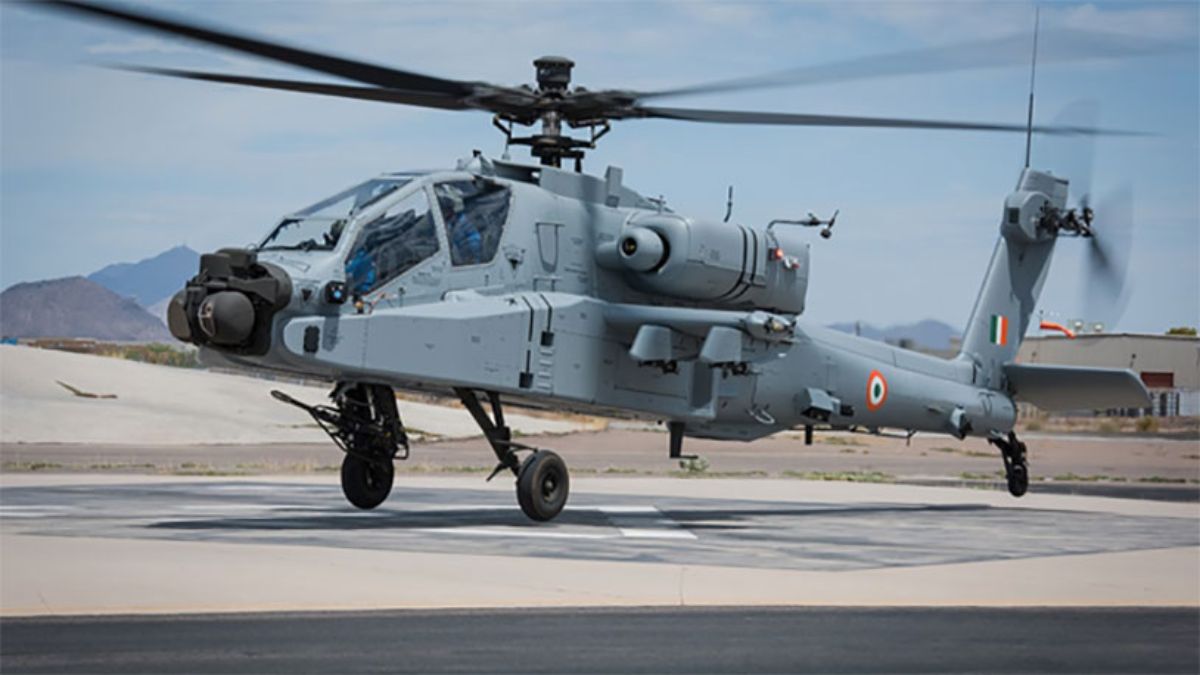
The delivery of the final batch of Apache AH-64E attack helicopters meant for the Indian Army has hit an unexpected geopolitical roadblock, after Turkey refused airspace clearance for a cargo aircraft transporting the machines from the United States.
The denial has forced Boeing, the manufacturer, to redraw the delivery plan and left New Delhi watching yet another diplomatic ripple affect its military modernisation timeline.
What happened to the Apache gunships sent to India?
According to officials familiar with the matter, the episode began on November 1, 2025, when an Antonov AN-124 heavy-lift aircraft (serial number UR-82008) took off from Mesa Gateway Airport in Arizona.
On board were three Apache helicopters — part of the six ordered by the Indian Army in 2020, separate from the 22 already in service with the Indian Air Force.
The aircraft made a scheduled refuelling halt at East Midlands Airport in the United Kingdom. What was supposed to be a brief stop dragged into an eight-day limbo.
Then, on November 8, instead of heading towards India, the Antonov unexpectedly turned back and flew all the way to the United States.
Why did the cargo plane return to the US?
The helicopters were subsequently offloaded at the American airbase from which they had been transported, before the Antonov moved on to its next assignment.
Boeing, responding to media queries, avoided naming the country responsible but signalled that the disruption came from outside its control.
“We remain closely engaged with the US government and the Indian Army, and continue working to execute our contract as expeditiously as possible to meet India’s needs and fleet requirements,” the company said.
It acknowledged that “logistical issues caused by external factors” were delaying the final leg of the delivery.
How is India looking at this disruption?
Sources in India’s defence and security establishment were more direct. They confirmed that Turkey had withheld overflight permission for the Antonov, effectively shutting the door on the most efficient transit route into India.
While alternative routes were evaluated, the aircraft had a pre-scheduled commitment that made it unviable to wait indefinitely in the UK, prompting the return to Arizona.
The move stands in contrast to the delivery of the previous batch of three Apaches in August this year, which arrived in India without incident, using the same aircraft and flying through Turkish airspace.
Is the India-Turkey souring diplomacy responsible?
The latest obstruction comes at a moment of steadily cooling ties between New Delhi and Ankara. Turkey has, in recent months, amplified its support for Pakistan, including during India’s ongoing Operation Sindoor, massive counterterrorism operations centred on Jammu & Kashmir.
Its leadership has also repeatedly criticised India’s positions on Kashmir at global platforms like the UN General Assembly.
In a pointed diplomatic gesture, Indian officials skipped Turkish National Day celebrations at the embassy in New Delhi last month, an unmistakable signal of displeasure.
How do diplomatic winds determine outcomes of routine logistics?
Ankara’s decision to hold up the Apache transit is now seen in New Delhi as an extension of this broader geopolitical posturing.
As Boeing and the US government work to re-route the delivery, India awaits the remaining Apache helicopters that are intended to bolster the Army’s strike capabilities, particularly along sensitive frontiers.
The delay underscores how even routine defence logistics can become collateral in shifting geopolitical winds.