


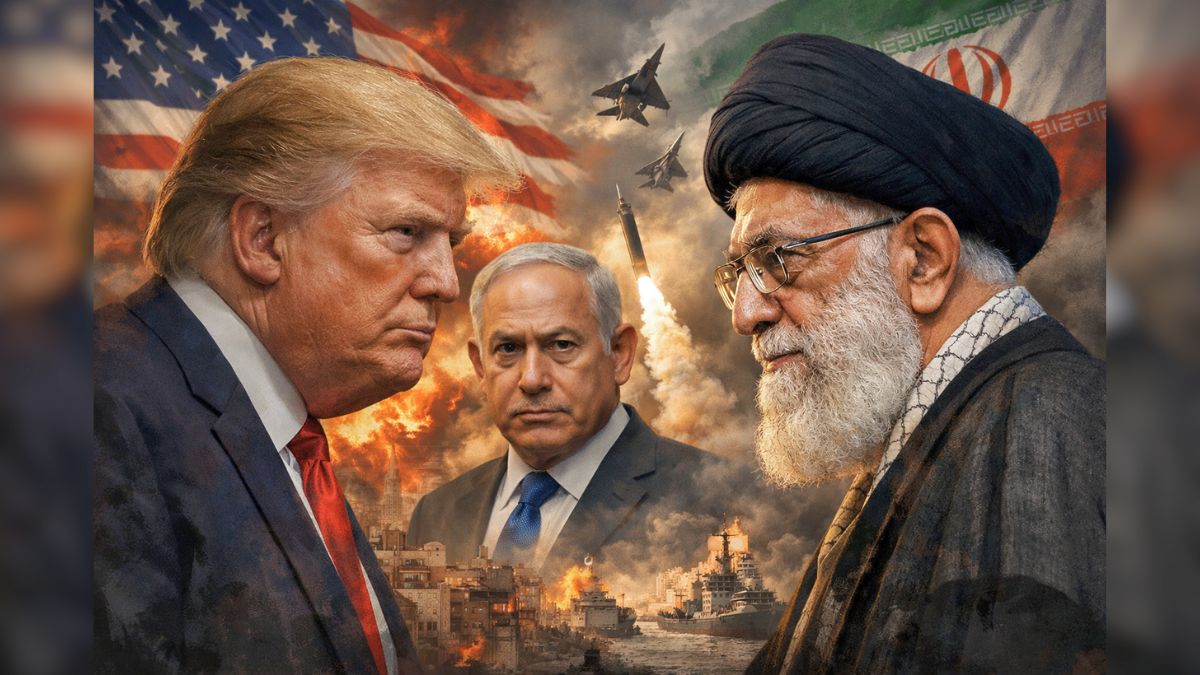
Tensions between the United States and Iran are once again spilling across diplomatic, military and maritime fronts, with Washington issuing fresh navigational warnings in the Strait of Hormuz, President Donald Trump floating the possibility of deploying additional aircraft carriers, and Israeli PM Benjamin Netanyahu heading to the US for urgent talks.
The developments come as indirect US-Iran nuclear talks resume in Oman, even as both sides harden public positions on uranium enrichment and regional security.
The US Maritime Administration has rolled out updated navigational guidance for American-flagged commercial vessels transiting the Strait of Hormuz, urging them to avoid Iranian territorial waters “as far as possible” without compromising navigational safety.
Why has the US issued fresh warnings in the Strait of Hormuz?
Ships traveling eastbound are advised to remain closer to Oman’s territorial waters. The advisory also instructs crews not to forcibly resist if Iranian forces board a US-registered vessel, clarifying that non-resistance does not imply consent.
“If Iranian forces board a US-flagged commercial vessel, the crew should not forcibly resist the boarding party. Refraining from forcible resistance does not imply consent or agreement to that boarding,” the advisory said.
Worth mentioning here is that the Strait of Hormuz, often described by Washington as the “world’s most important oil chokepoint”, handles a significant portion of global energy supplies.
What is driving the latest spike in US-Iran tensions?
The advisory comes shortly after indirect US–Iran talks were held in Muscat, Oman. While Trump described the first round as “very good,” deeper disagreements remain unresolved, with the core sticking point continuing to be uranium enrichment. Iran insists enrichment is its sovereign right under the Nuclear Non-Proliferation Treaty and is demanding sanctions relief in exchange for limits on its nuclear program.
Washington, however, is pressing for zero enrichment and wants Iran to transfer highly enriched uranium out of the country.
Is military escalation back on the table?
Trump has revived hardline rhetoric in recent days, telling Axios he is considering deploying another aircraft carrier to the region. “Either we will make a deal or we will have to do something very tough like last time,” the US President Trump said, referencing past strikes. Several media reports suggest that the USS George Washington and USS George HW Bush are among potential deployment options.
Pentagon could also consider dispatching the USS Gerald R. Ford. Moreover, the US military has already increased its regional posture, particularly after Iran’s Islamic Revolutionary Guard Corps conducted naval drills in the Strait of Hormuz earlier this year. Washington also confirmed it shot down an Iranian drone that approached a US aircraft carrier.
Iran has warned it would respond to any military attack, even if limited.
Israeli PM Benjamin Netanyahu’s US visit: Why is he rushing to the US?
Against this volatile backdrop, Israeli Prime Minister Netanyahu is traveling to the White House for what Israeli media describe as an urgent, three-day visit. Netanyahu said he intends to present Israel’s “vision for the principles of the negotiations” with Iran, emphasizing that Israel’s approach is rooted in ensuring regional peace and security.
The meeting will be the seventh between Trump and Netanyahu since the start of the US president’s second term. Israeli reports suggest the trip was moved forward by a week to influence the ongoing US-Iran talks.
Israel has long viewed Iran’s nuclear program and its support for regional groups such as Hezbollah and Hamas as existential threats.
US-Iran dispute and the shipping lanes
Shipping lanes in the Middle East have historically become flashpoints during periods of US-Iran friction. During the 1980s Iran-Iraq “Tanker War,” both sides targeted commercial shipping. In recent years, attacks by Yemen’s Houthi movement on vessels linked to Israel in the Red Sea have further complicated maritime security.
In 2019, sabotage incidents involving vessels in the Gulf of Oman heightened fears of broader confrontation. Iranian lawmakers have periodically suggested the possibility of closing the Strait of Hormuz in response to external aggression.
Meanwhile, both Washington and Tehran signal willingness to continue talks, but red lines remain sharply defined.