


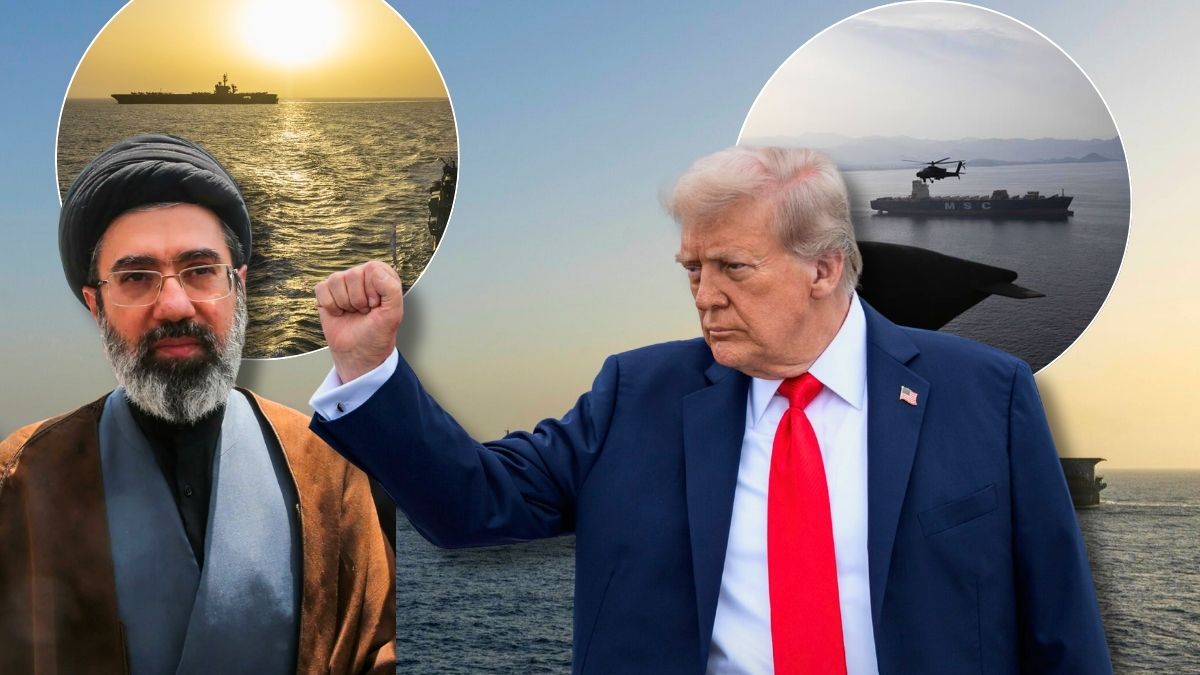
In a dramatic escalation, Iran has walked back its earlier claim that the Strait of Hormuz was “completely open,” reimposing restrictions on the crucial global shipping route after the United States refused to lift its ongoing maritime blockade targeting Iranian ports. About 20% of the world’s oil and liquefied natural gas passes through the narrow strait.
Iranian officials confirmed that the strait has been restored to its “previous status” and is now “under strict management and control by the armed forces,” signalling a sharp U-turn just hours after a brief reopening window.
The move comes amid heightened tensions following US President Donald Trump’s assertion that the blockade would “remain in full force” until a permanent peace deal with Tehran is reached.
Shipping through Strait of Hormuz: What conditions has Iran imposed?
While not fully shutting down maritime traffic, Tehran has imposed strict conditions for vessels transiting the strait. Iran’s Foreign Ministry spokesperson Esmaeil Baghaei clarified that shipping will only be allowed along a pre-determined route, while the Islamic Revolutionary Guard Corps (IRGC) Navy stated that all ships would require prior permission to pass.
Civilian vessels will be allowed only through designated Iranian routes, while military vessels remain barred from transit.
In a strong warning, the IRGC’s navy command said, “As long as the movement of vessels from Iran and to Iran is under threat, the status of the strait of Hormuz will remain as it was previously. Any breach of commitments by the United States will receive an appropriate response.”
What triggered the latest escalation?
The reversal follows Washington’s decision to continue its large-scale blockade of Iranian ports and coastline, despite a temporary ceasefire in the region.
The US Central Command (CENTCOM) highlighted ongoing operations involving significant military deployment. “USS Abraham Lincoln (CVN 72) transits the Arabian Sea as the United States blockades Iran’s ports and coastline. US forces are not blockading the Strait of Hormuz. More than 10,000 American service members, 12 ships, and 100 aircraft have enforced the blockade in regional waters,” CENTCOM said.
The post mentioned the features of the aircraft carrier, stating, “The ship’s embarked carrier air wing includes eight F-35C stealth fighters, F/A-18 fighter jets, EA-18G electronic attack aircraft, E-2D command and control planes, MH-60 helicopters and CMV-22B Ospreys for logistics support.”
US President Trump also defended the operation, stating, “We’re doing very well with the blockade. It’s very routine for us. The Navy’s incredible, and I think the blockade is doing very well. No ship is even thinking about entering. No ship is going past our Navy.”
Have there been fresh incidents in the Strait?
Even as both sides had agreed to a two-week ceasefire a few days back, the situation on the ground has turned volatile. A UK maritime agency reported that IRGC vessels fired on a tanker attempting to pass through the strait. News agency Reuters also reported that an Indian-flagged vessel carrying crude oil had been attacked while navigating the waterway.
The UK Maritime Trade Operations Centre said the tanker was approached and fired upon by “two IRGC gunboats” without prior warning, although the crew was reported safe.
What was Iran’s earlier position and why the sudden shift?
Iran had briefly declared the Strait of Hormuz open following a 10-day ceasefire linked to broader regional negotiations. Foreign Minister Seyed Abbas Araghchi had earlier said that passage for commercial vessels was “completely open.”
However, Iranian leadership quickly contradicted this after the US maintained its blockade posture. Parliamentary Speaker Mohammad Bagher Ghalibaf stated, “With the continuation of the blockade, the Strait of Hormuz will not remain open.”
Deputy Foreign Minister Saeed Khatibzadeh also criticised Washington, saying the US “cannot impose their will to do a siege over Iran, while Iran, with good intention, is trying to facilitate safe passage through the strait of Hormuz.”
What’s next for US-Iran truce talks?
Despite rising tensions, diplomatic channels remain open. A second round of US-Iran peace talks is expected, though no timeline has been confirmed.
Egypt’s Foreign Minister Badr Abdelatty expressed cautious optimism, saying, “We hope to do so [reach an agreement] in the coming days… Not only us in the region, but the whole world is suffering from the continuation of this war.”
The stakes remain high. The Strait of Hormuz handles nearly 20% of global oil shipments, and even brief disruptions have already rattled energy markets worldwide.