


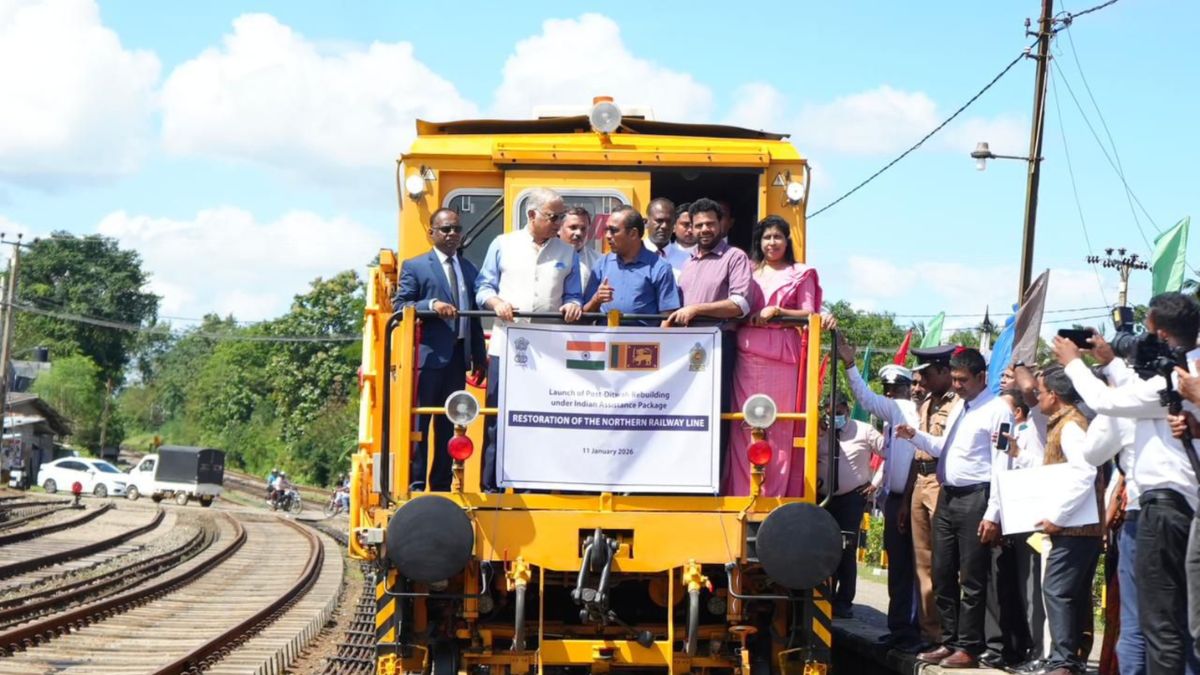
India has formally begun the restoration of Cyclone-battered Sri Lanka’s critical connectivity lifeline of the Northern Railways, taking centre stage in the island nation’s recovery from the natural calamity.
But it is India’s bete noire, China, that is moving in to reassert its position as Sri Lanka’s infrastructure-building partner through fresh investments that could pose a huge challenge for India’s bid to keep its neighbour closer.
These developments are pitting India and China as competitors in winning Colombo’s favour, yet play a complementary role in the post-cyclone reconstruction of the Ditwah-battered regions, as the island nation’s political leadership seeks a balance between New Delhi’s swift aid and Beijing’s assistance scale.
What is the Lankan Railway project that India is rebuilding?
India and Sri Lanka jointly opened the reconstruction of the Mahawa rail junction in the northwestern part of the island nation, using a $5 million grant from New Delhi, Sri Lankan officials said on Monday (January 12, 2026).
The first on-ground project, part of the $450-million aid package from India, aimed to restore rail connectivity between Mahawa and Omanthai, a strategic stretch joining the north with other parts of the island nation for passenger and cargo movement, apart from post-war integration.
Sri Lanka’s Transport Minister noted that the inauguration of the infrastructure work, with Indian High Commissioner Santosh Jha and Transport Minister Bimal Rathnayaka joining the event, was both a political and a diplomatic signalling.
The Mahawa-Omanthai line is targeted to be completed before the Sinhala and Tamil New Year on April 14, 2026, restoring a key trade route, disrupted by the cyclone-related floods, landslides, and infrastructure collapse.
Why does the Northern Railway matter to Lanka?
The November 2025 Ditwah cyclone that hit Sri Lanka devastated the railway infrastructure in the northern parts of the island nation, killing over 600 people and causing soil erosion that extensively damaged the railway tracks, apart from leaving the railway bridges collapsed and signalling systems cut off.
The Sri Lankan government estimates put the reconstruction and restoration work to cost of upwards of $320 million to restore the railway line and its connected infrastructure fully.
The Lankan Northern Rail Line is not just a transportation platform. It is a strategic link that keeps Sri Lanka’s unity and integrity intact. India’s quick response to the Sri Lankan natural disaster helps deliver humanitarian aid and global geopolitical visibility for both nations.
Why did India come to Sri Lanka’s aid after the cyclone damage?
India’s ‘Operation Sagar Bandu’ began on November 28, 2025, with New Delhi delivering relief supplies, apart from recovery assistance. India also deployed its resources to restore connectivity, almost immediately after the cyclone abated.
The Northern Railway line is a tangible symbol of India’s $450-million aid package that External Affairs Minister Dr. S. Jaishankar announced during his visit to Colombo in the aftermath of the cyclone.
The air package included a $100-million in grants for high impact and faster disbursement on the ground in the affected regions, apart from $350-million in a concessional Line of Credit, mostly in the Indian currency, for infrastructure restoration.
The idea behind the aid package was speedy disbursement and reduced debt stress, apart from affordability for Sri Lanka, which has been fighting economic troubles after the financial crisis about half-a-decade ago.
Is India’s help to Sri Lanka qualitatively worthy?
The Indian support also included the IRCON International Limited, a state-run engineering firm under the Indian Railways, carrying out infrastructure projects with Indian technology, expertise, and equipment.
India has been upgrading a 370-km rail corridor since 2019 in phases to support Lanka’s trains to attain speeds of up to 100 kmph. This corridor also goes through wildlife-friendly rail tunnels and bridges in elephant habitats.
In terms of qualitative aid, India’s support to Sri Lanka prioritises immediate utility and on-ground impact, which also provides political reassurances to the Lankan people and government. In quantitative terms, the assistance is modest in USD terms, but its visibility and quick delivery on the ground enable disproportionate advantage and influence to New Delhi in the Lankan recovery story.
How is China wading into the Lankan reconstruction?
The Indian story dominates in terms of emergency and faster response to the recovery needs of Lanka. But China has been insisting that it is in Sri Lanka for the long haul. While Beijing’s humanitarian aid to Colombo is limited, its political and strategic signalling is humongous.
With China’s Foreign Minister Wang Yi landing in Colombo on Monday (January 12, 2026) for a short stopover after he toured the African nations, meeting with President Anura Kumara Dissanayake, Prime Minister Harini Amarasuriya, and Foreign Minister Vijitha Herath.
With the Communist background of the party and leaders in power in Sri Lanka, Wang Yi’s visit signalled a two-track Chinese approach: political messaging through the Communist Party and policy execution through the foreign ministry that Beijing would support Sri Lanka with long-term infrastructure projects.
While Sri Lanka indicated the requirements of road, railway, and connectivity infrastructure to kick-start reconstruction of the cyclone-hit regions of the island nation, Wang assured China’s full support to these efforts, and expressed confidence in the recovery of the ravaged nation under the present poliical leadership.
How did China lay the groundwork for its Lankan involvement?
The Chinese involvement in Sri Lankan recovery was seeded in an earlier visit by its senior Communist Party leader Wang Junsheng last year, immediately after Ditwah hit the island nation. Wang Junsheng conveyed his nation’s readiness to help Sri Lanka in large-scale rebuilding.
The two visits by Chinese party and government leaders point to a deliberate and coordinated Chinese strategy, unlike India’s short-term cash-and-grant-heavy model of rehabilitation aid to Sri Lanka. Chinese support would now focus on concessional financing, technical cooperation, and a flagship infrastructure programme, continuing its long-term, established approach towards Sri Lanka, which has always been a debt-trap strategy.
What does India’s and China’s aid race mean for Sri Lanka?
From the Lankan point of view, it is only a win-win for the nation in its efforts to recover from the double whammy it has had in the form of financial crisis and natural disaster.
While India offers speed, proximity, and political reassurance, China brings scale, engineering depth, and long-term money. Both India’s and China’s offerings are most welcome for the Sri Lankans, as Colombo’s post-crisis strategy is to strike a balance between New Delhi and Beijing.
Sri Lanka can leverage India for urgent reconstruction requirements, while engaging China in a long-term development trajectory. As India’s help fits neatly into its Neighbourhood First policy and its stated position as the first responder to a crisis in South Asia, China, by contrast, is patiently playing the long game in its Global South messaging and debt diplomacy.