


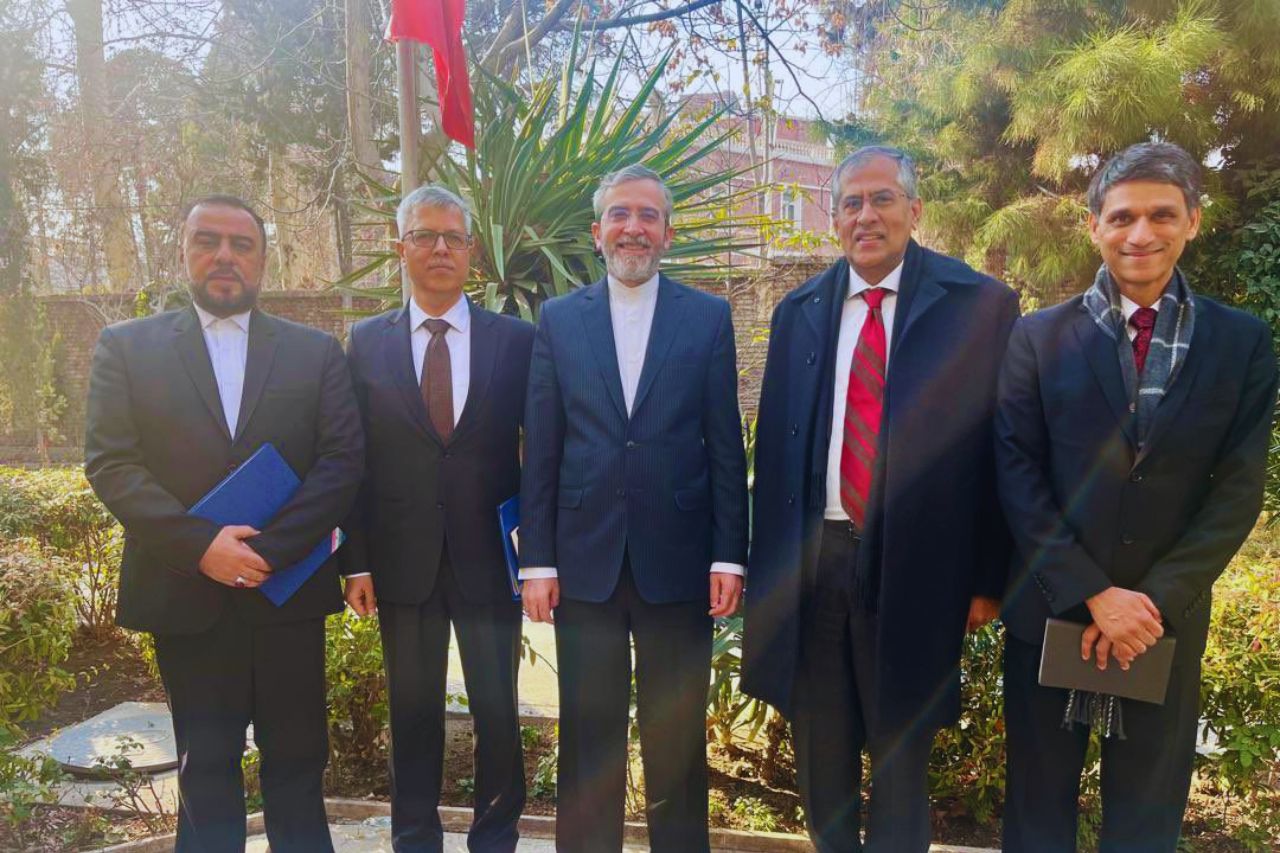
With US and Iran blowing hot over the former’s threat to militarily intervene in the latter’s domestic unrest, India made a diplomatic bid to assess the situation, with its Deputy National Security Adviser Pavan Kapoor visiting Tehran for consultations.
Kapoor was in Tehran on Wednesday (January 28, 2026) to meet up with his Iranian counterpart Dr. Ali Bagheri Kani, the Deputy for International Affairs at SNSC, apart from calling on SNSC Secretary Dr. Ali Larijani.
What did India talk with Iran on regional security?
“Deputy National Security Advisor Pavan Kapoor visited Tehran on 28 January 2026 for consultations with his Iranian counterpart Dr. Ali Bagheri Kani, Deputy for International Affairs, SNSC. He also called on Secretary, SNSC Dr. Ali Larijani,” Indian Embassy in Tehran posted on the microblogging site X.
The Indian Deputy NSA’s visit to Iran came against the backdrop of the citizen protests in that country, and American President Donald Trump warning of a US military intervention in support of the protestors.
What was US warning to Iran on domestic unrest?
In a social media post on Truth Social, Trump said, a US naval deployment larger than a previous fleet sent toward Venezuela was moving quickly to West Asia. He described the deployment as “quickly, with great power, enthusiasm, and purpose.”
The force was “ready, willing, and able to rapidly fulfil its mission, with speed and violence, if necessary,” he added.
Trump said he hoped Iran would “quickly” come to the negotiation table for a fair and equitable deal — for no nuclear weapons that is good for all, warning that the time was running out.
How did Iran respond to US threats on military actions?
Iran, on Wednesday (January 28, 2026), said through its United Nations mission, that it was ready to talk to the US “based on mutual respect and interests.”
On Thursday (January 29), a US carrier strike force led by aircraft carrier USS Abraham Lincoln along with allied warships, was deployed in West Asia.
Meanwhile, Trump was briefed on “aggressive” options against Iran, US media reports said. The options were for causing deeper damage to Iran’s nuclear and missile infrastructure to weaken the West Asian nation’s leadership.
What were the US military measures under consideration?
The measures included those beyond those that were under consideration two weeks ago, to stop Iranian administration from cracking down on civilians.
Now, the US was considering placing American forces directly inside Iran, such as targeted raids against key nuclear and military facilities.
US War Secretary Pete Hegseth also delivered a serious threat to Iran on Trump’s forceful military position, as American maritime forces were being deployed in West Asia.
Hegseth cautioned Tehran against pursuing nuclear weapons, asserting that “they should not pursue nuclear capabilities, and we will be prepared to deliver whatever this president expects of the War Department.”
Why did Hegseth refer to Venezuela in Iran’s context?
He pointed to the American military operations in Venezuela against President Nicolas Maduro and his wife, describing it as unparalleled in scale and execution.
“No other military in the world could have executed the most sophisticated, powerful raid — not just in American history — I would say in world history,” Hegseth said.
What did Iran discuss with Turkey on US threats?
In response, Iran stated it was ready to defend itself against the US forces. Iranian Foreign Minister Abbas Araghchi met with his Turkish counterpart Hakan Fidan in Istanbul on Friday (January 30, 2026).
The two leaders discussed the escalating tensions amid the ongoing US threats and military build-up in the region.
In a press meet, Araghchi said his country remained ready to return to negotiations with the US, insisting diplomacy was the only path to resolving tensions.
“We will never give up diplomacy,” he said, emphasising that talk was the preferred option over a conflict, and the process must be based on “justice and (international) law.”
What did Azerbaijan say about its territory’s use against Iran?
In the region, after UAE, Azerbaijan said it would never allow its airspace and territory to be used for an attack on neighbouring Iran.
Azerbaijan’s Foreign Minister Jeyhun Bayramov, on Thursday (January 29, 2026), had a phone call with his Iranian counterpart Araghchi.
Bayramov said the recent regional tensions was a matter of concern, and mentioned that his nation was consistent on the parties refraining from escalating the conflict, and to focus on regional stability.
What was Arab League’s warning on US-Iran tensions?
In New Delhi, Arab League Secretary General Ahmed Aboul Gheit warned any attack on Iran would have serious repercussions in the region and beyond.
“If such an event happens, it will be negative for the region and for everyone else. It will be a disaster for world peace,” he said.
Why did Arab League dismiss US military deployments in West Asia?
Responding to a question on Trump’s naval deployment in West Asia, Aboul Gheit said the US Fifth Fleet was in Bahrain from 1995, maintaining a regional presence since 1945.
“The presence of the American troops in the Gulf, Bahrain, the Red Sea and the Mediterranean is not a new development,” he said. The change, was in the US “the politics and policies.”
The former Egyptian foreign minister said, “I am not taken in by [the] declarations of Americans. Yes, they want to settle from that point of view, thinking that Iran is a nuclear country.”