


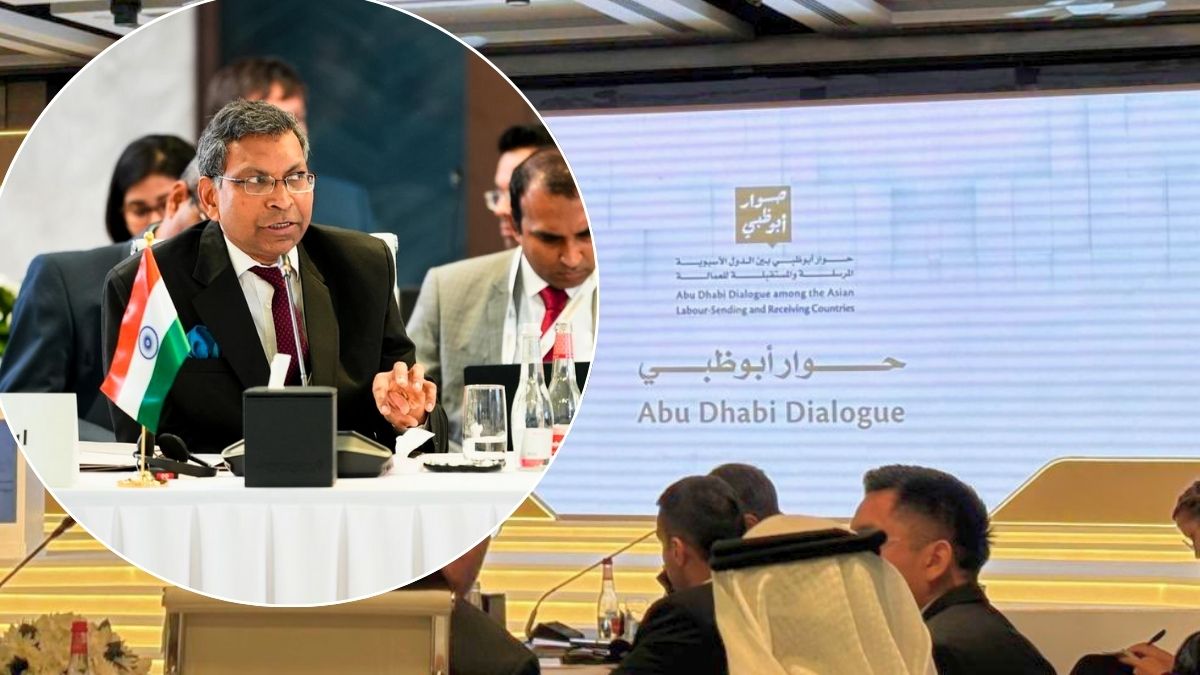
India has reaffirmed its commitment to the welfare of overseas workers and safe labour mobility by leading discussions at the 8th Ministerial Consultations of the Abu Dhabi Dialogue (ADD), held in Dubai from January 31 to February 1, against the backdrop of deepening India-UAE strategic relations.
India and the United Arab Emirates (UAE) established diplomatic relations in 1972 and both sides are striving to further strengthen these ties for mutual benefits. India-UAE trade, valued at $180 million per annum in the 1970s, reached $85 billion in 2022-23 making UAE, India’s third largest trading partner for the year 2022-23.
Who represented India at the Abu Dhabi Dialogue?
The Indian delegation was led by Prashant Pise, Additional Secretary (Emigration Policy & Welfare), Ministry of External Affairs. According to the MEA, India’s participation reflected its continued engagement with regional platforms focused on labour mobility and migrant worker protection.
The Indian Embassy in Dubai confirmed the participation, noting that the consultations brought together key labour-sending and destination countries.
What is the Abu Dhabi Dialogue and why does it matter?
Established in 2008, the Abu Dhabi Dialogue is a regional, voluntary and non-binding consultative mechanism comprising 11 Asian countries of labour origin and seven destination states. The platform facilitates cooperation on contractual labour mobility, sharing of best practices, and policy coordination to ensure ethical recruitment and worker welfare.
India has been an active participant since the inception of the ADD, given its large migrant workforce across the Gulf region.
How do these talks reflect India-UAE relations?
India and the UAE share a close and multi-dimensional partnership, with people-to-people ties forming its backbone. The UAE hosts one of the largest Indian expatriate communities globally, making labour welfare a key pillar of bilateral engagement.
During the consultations, Indian officials held bilateral meetings with senior UAE counterparts from the Ministry of Human Resources and Emiratisation, focusing on steps taken by both governments to safeguard the rights and welfare of Indian migrant workers.
8th Abu Dhabi Dialogue: What issues were discussed?
The discussions covered labour mobility frameworks, skills development initiatives and the deployment of technological solutions to streamline recruitment and employment processes. Officials also reviewed measures aimed at improving transparency, grievance redressal and worker protection mechanisms.
The talks highlighted ongoing cooperation to ensure safe, orderly and legal migration between India and the UAE. People-to-people connections, driven largely by the Indian diaspora in the UAE, remain central to the relationship and continue to shape policy priorities on both sides.