


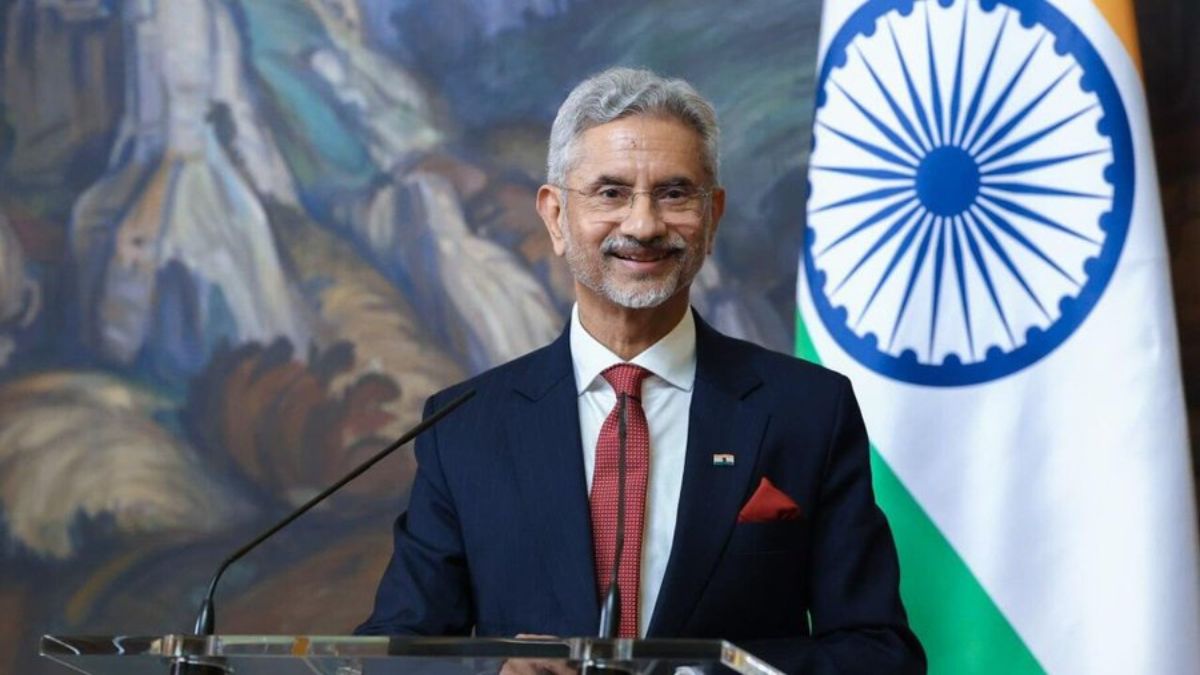
Even as several vessels have been stuck owing to the Strait of Hormuz crisis amid the US-Israel-Iran war, 2 Indian-flagged gas tankers passed through the strait on Saturday (March 14, 2026) after discussions progressed between Delhi and Tehran. However, External Affairs S Jaishankar has clarified that there has been no blanket arrangement with Tehran.
While India has already received 2 vessels via the Strait of Hormuz since the war began late last month, 22 Indian-flagged vessels are still waiting for clearance to pass through the channel. As the war in Iran intensifies and tensions ripple across West Asia, India is carefully balancing diplomacy to protect its energy lifelines and citizens in the region.
EAM Jaishankar has confirmed that New Delhi is actively engaging with Tehran and regional partners, even as Indian-flagged vessels continue to pass through the volatile Strait of Hormuz, one of the world’s most critical oil chokepoints.
Indian gas tankers cross Strait of Hormuz despite risk
In a significant development, two Indian-flagged liquefied petroleum gas (LPG) carriers – Shivalik and Nanda Devi – successfully passed through the Strait of Hormuz, carrying around 92,712 metric tonnes of LPG bound for India. The vessels are expected to arrive at Mundra and Kandla ports in Gujarat.
This comes just a few days after Saudi oil tanker Shenlong Suezmax docked in Mumbai, marking first arrival since West Asia conflict began on February 28, 2026.
Transit of the LPG carriers came even as Iran had earlier threatened to block oil exports through the strategic waterway, which handles nearly one-fifth of the world’s oil shipments.
‘No blanket arrangement’ with Iran, says Jaishankar
Speaking to the Financial Times, Jaishankar highlighted that diplomacy played a role in allowing the ships to move. “Certainly, from India’s perspective, it is better that we reason and coordinate and get a solution than we don’t,” he said.
However, the External Affairs Minister clarified that India has not reached any broad deal with Iran regarding the movement of its ships. “Every ship movement is an individual happening,” Jaishankar said, dismissing speculation of a wider arrangement with Tehran. He also rejected suggestions that India offered concessions in exchange for safe passage.
“It’s not an exchange issue. India and Iran have a relationship, and this is a conflict that we regard as very unfortunate,” he added. EAM Jaishankar further emphasised that direct engagement remains the most effective way to manage the crisis, noting that his ongoing talks with Iranian leaders have already produced some results.
Four calls with Iran’s Foreign Minister amid Hormuz tensions
Diplomatic efforts between New Delhi and Tehran have intensified since Iran closed the Strait of Hormuz, disrupting oil and fuel shipments worldwide. Jaishankar revealed that he has spoken four times with Iranian Foreign Minister Abbas Araghchi in recent days.
In a post on X on Friday (March 13, 2026), he shared, “Had another conversation with Iranian FM @araghchi yesterday night. Discussed bilateral matters as also BRICS-related issues.” The minister added that more Indian vessels remain in the region, meaning negotiations and coordination will continue.
“These are still early days. We have many more ships there… there is continuing conversation because there is continued work on that,” he said.
Global oil shock as Strait crisis deepens
The standoff around the Strait of Hormuz has already rattled global markets. Iran has vowed to block regional oil exports to its enemies, declaring it would not allow “even a single litre” to pass through. The resulting disruption has pushed oil prices above $100 per barrel, sparking fears of renewed inflation worldwide.
The International Energy Agency (IEA) has warned that the fighting has triggered the largest supply disruption in the history of the global oil market.
India continues diplomatic outreach across the Gulf
Amid the rapidly evolving situation, India has also stepped up consultations with key regional partners. Jaishankar on Sunday (March 15, 2026) held a telephonic conversation with UAE Foreign Minister Abdullah bin Zayed Al Nahyan, discussing the unfolding crisis. “Exchanged views on various aspects of the regional situation,” he shared on X.
The UAE remains a critical partner for India, given the large Indian diaspora and the country’s role as a major energy and trade hub.
Meanwhile, the wider Gulf region continues to face escalating security threats. The UAE said its air defence systems intercepted four ballistic missiles and six drones launched from Iran on March 15. According to the UAE Ministry of Defence, since the beginning of Iranian attacks, its air defences have intercepted 298 ballistic missiles, 15 cruise missiles, 1,606 drones.
The strikes have resulted in six deaths and 142 injuries, affecting people from several nationalities including Indians.
US signals possible talks with Iran
The geopolitical situation remains fluid, with US President Donald Trump saying Iran has approached Washington for a potential deal, though he said the terms offered so far were “not good enough”.
Meanwhile, Western military activity has increased in the region. The UK Ministry of Defence confirmed sorties by Typhoon and F-35 fighter jets across multiple Middle Eastern locations, including Qatar, Cyprus, UAE, Jordan and Bahrain, to protect allied interests.