


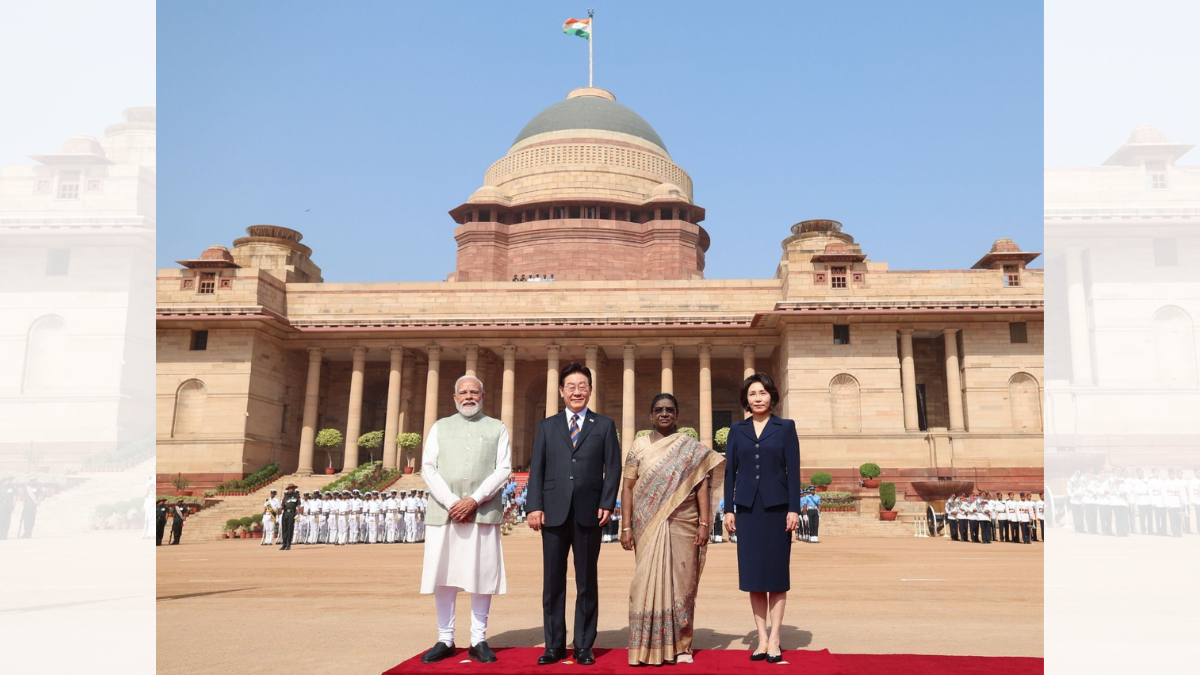
India and South Korea are deepening their cooperation in shipbuilding, shipping, and maritime logistics, even as Prime Minister Narendra Modi and South Korean President Lee Jae-myung decided to double their bilateral trade to $50 billion by 2030.
These decisions were taken at a bilateral summit meeting between the two leaders in New Delhi on Monday (April 20, 2026) when they signed a slew of agreements aimed at boosting their technological cooperation and trade.
The decisions were part of the broader comprehensive framework that they agreed upon during Lee’s visit to India, which was aimed at strengthening strategic and economic ties between the two Indo-Pacific partner nations.
Modi and Lee held their one-on-one discussions before the delegation-level talks in New Delhi, while Indian President Droupadi Murmu hosted her South Korean counterpart during a reception at the Indian Presidential House.
In a joint press briefing with Lee, Modi outlined the future of a win‑win partnership between the two countries with collaborations in sectors ranging from semiconductors to shipbuilding and entertainment and culture.
Modi said the two countries would set up the India-South Korea Digital Bridge to work jointly on artificial intelligence (AI).
Lee, in his remarks, framed it as a mutually beneficial arrangement in which India’s human resources would join hands with South Korea’s digital infrastructure.
Modi listed steel, shipbuilding, film, animation, and gaming as areas of focus for trade and investment in the coming years.
Lee announced that the setting up of a Mumbai-Korea centre, which will become the centre for K-pop in India. He said he wanted the centre to bring Bollywood and K-pop together.
In a media briefing on the talks, India’s Ministry of External Affairs (MEA) Secretary (East) P Kumaran provided a technical blueprint for the “new voyage” between India and South Korea, revealing that the partnership has moved into a high-gear industrial phase.
The collaboration, he noted, is shifting from high-level diplomacy to granular, long-term capacity building aimed at revolutionising India’s shipbuilding and port infrastructure.
Kumaran highlighted that the private sector is already anchoring these diplomatic goals. A significant milestone in this effort is a non-binding Memorandum of Understanding (MOU) involving HD Korea Shipbuilding & Offshore Engineering (HD KSOE) and domestic stakeholders.
“Several initiatives have been taken as part of this at the level of industries, too. One includes a non-binding MOU between the Korean shipbuilder HD Korea Shipbuilding & Offshore Engineering (HD KSOE), the identified cluster developer and facilitator,” he said.
“Overall, the emphasis is on upgrading existing shipyards, including developing block fabrication facilities and setting up a new dry dock to construct large and specialised vessels,” he added.
Modi and Lee also unveiled an ambitious roadmap to elevate bilateral ties into a “futuristic partnership,” setting a target to nearly double trade to $50 billion by 2030 while expanding cooperation across critical and emerging sectors.
Modi described Lee’s visit, the first at the presidential level in eight years, as a “defining moment” in the relationship, anchored in shared democratic values, market economy principles, and a common Indo-Pacific vision.
Bilateral trade, currently at $27 billion, is set for a significant push, with both sides announcing a series of institutional mechanisms to drive economic engagement.
These include the launch of an India-Korea Financial Forum, an Industrial Cooperation Committee, and a new Economic Security Dialogue aimed at strengthening collaboration in critical technologies and resilient supply chains.
In a bid to boost Korean investments, India will establish a dedicated Korean Industrial Township, particularly targeting small and medium enterprises, while both countries agreed to upgrade the existing trade agreement within a year.
Against the backdrop of global instability, both leaders struck a conciliatory tone, emphasising peace and stability.
Modi noted that India and South Korea share a commitment to a “peaceful, progressive and inclusive Indo-Pacific,” welcoming Seoul’s decision to join the International Solar Alliance and the Indo-Pacific Oceans Initiative.
The two sides also called for reforms of global institutions to better address contemporary challenges, underlining their intent to play a more proactive role in shaping global governance.