


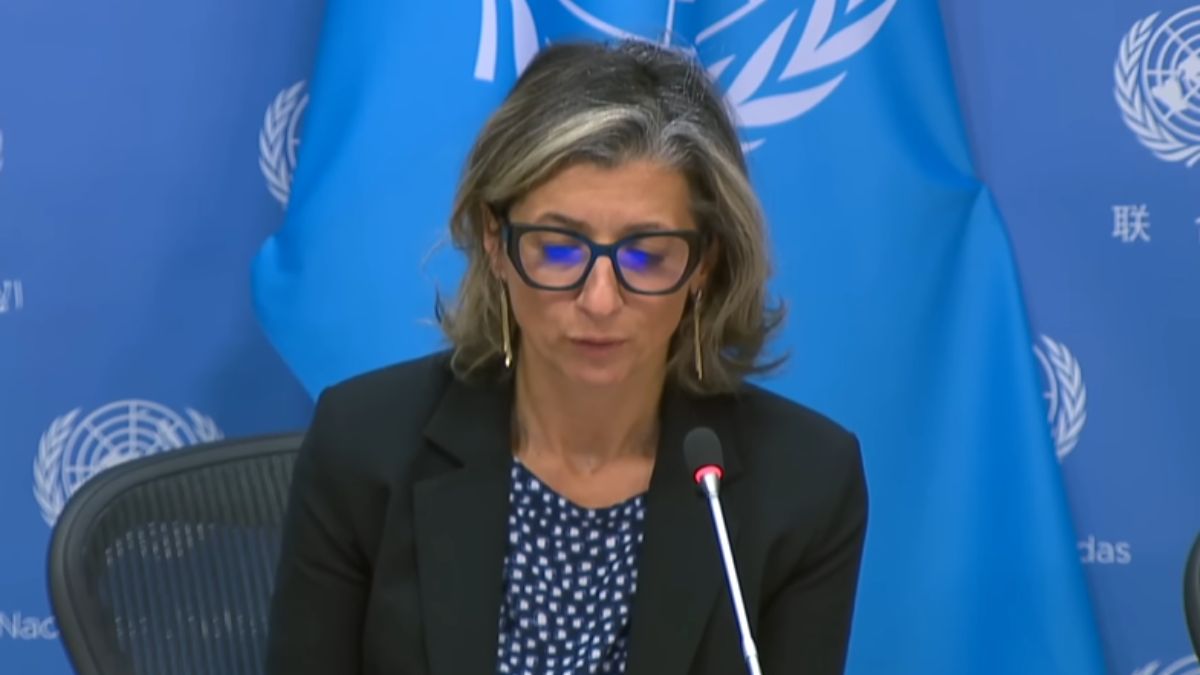
It has been years into the Gaza conflict, with civilians and children suffering a fate they were never perhaps destined to witness. Amid an intensifying global scrutiny, UN Special Rapporteur on the Occupied Palestinian Territories Francesca Albanese has raised sharp questions about India’s legal and moral position, warning that New Delhi’s engagement with Israel could amount to a violation of international law.
Speaking after presenting her report “Torture and Genocide” at the 61st session of the UN Human Rights Council last month, Albanese outlined what she described as a systemic pattern of abuse against Palestinians, while also turning the spotlight on countries, including India, that continue to maintain or deepen ties with Israel.
Francesca Albanese’s report on conditions in Gaza and detention centres?
Like the case is with any conflict, Albanese’s report also paints a grim picture, stating that since October 2023, Israel has used systematic torture against Palestinians in detention centres and across Gaza, which she described as a “vast torture camp.” The findings document over 18,500 arrests, including 1,500 children, and more than 4,000 enforced disappearances.
Calling her report “the last nail in the coffin,” Albanese said it demonstrates why the violence “aims at the destruction of the Palestinians as a people.”
“What Israel is doing in the dark, away from the public eye and public scrutiny, tells all about its intentions,” she told The Hindu in an interview, adding that Palestinians have been “brutalised, burned, and amputated without anaesthesia,” with many developing infections while being tortured.
Albanese alleged that torture is no longer incidental but “central to a system… aiming to destroy the Palestinians as individuals and as a people.”
Gaza conflict: How does she view the scale of arrests and alleged abuses?
Highlighting the scale of detentions and disappearances, Albanese said it reflects a deeper intent. “As I said, the purpose is to destroy the Palestinians as such,” she remarked, describing a system where detainees have allegedly been beaten, starved, and left to die through medical neglect.
During the interview, she also referred to reports of sexual violence and degrading treatment, stating, “All of this has been tolerated… this has been normalised.” According to her, even sections within Israeli society acknowledge the problem, though dissenting voices face backlash.
What is India’s legal responsibility under international law?
Albanese was unequivocal in her assessment of India’s legal obligations. “The legal responsibilities are clear,” she said, pointing to the International Court of Justice (ICJ), which has declared the occupation illegal and imposed an obligation on states “not to trade, not to transfer weapons, not to buy weapons” from a state maintaining such an occupation.
“So, India is violating its obligations under international law and might even be facing responsibility,” she said, adding that in an “ideal world,” governments supporting Israel despite these rulings, including India’s, could face legal scrutiny.
“There is also criminal liability for individuals who authorise this kind of endeavour,” she underlined, citing legal actions initiated in countries like Italy.
Is there also a moral dimension to India’s stance?
Beyond legal arguments, Albanese stressed what she called India’s “moral responsibility.” She suggested that India’s current position marks a departure from its historical legacy rooted in anti-colonial struggles and contributions to international law.
“It seems to me that there is a betrayal of that past in India’s association with Israel,” she said, noting that global legal frameworks were shaped in part by leaders from decolonised nations like India. At the same time, she acknowledged domestic challenges, saying ordinary citizens often struggle to engage with global issues due to economic pressures.
“They have made us, individual, ordinary citizens, so vulnerable that we cannot stand up for one another,” she observed.
India-Israel ties in the current context
Albanese’s remarks come against the backdrop of Prime Minister Narendra Modi’s visit to Israel in February, where ties were upgraded to a “Special Strategic Partnership”, and two days after which Israel launched strikes on Iran, in coordination with the United States (US).
She argued that such engagements risk enabling what her report describes as a broader system of violence. “India and Israel… have one thing in common, their territorial formations have been shaped by British colonial rule,” she said, adding that both nations, as UN members, must uphold international norms.
“It seems to me that in the present, India and Israel are contributing to the decay of the international system that our forefathers… built,” she remarked.
Moreover, Albanese also warned that continued support for Israel by multiple countries risks normalising violations of international law. She argued that powerful actors are “twisting the arm of the system, making lawlessness so widespread and systemic that it has become contagious.”
Reflecting on the conditions in Gaza, UN Special Rapporteur on the Occupied Palestinian Territories said the level of suffering has reached a point that “should not be possible in 2026,” adding that the territory is experiencing extreme restrictions on movement, residence, and basic freedoms.