


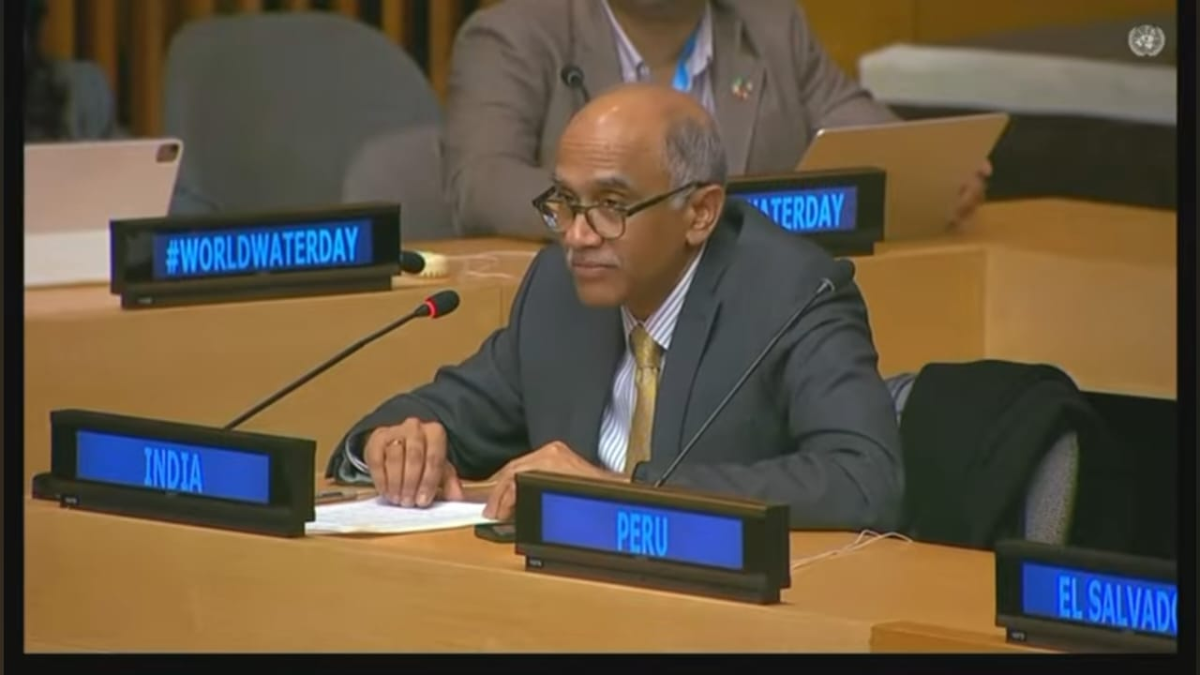
India on Friday hit back at Pakistan at the United Nations, accusing it of misusing a multilateral forum on World Water Day to push a divisive bilateral agenda and strongly defending its decision to hold the Indus Waters Treaty (IWT) in abeyance.
Speaking at the UN event marking World Water Day, India’s Permanent Representative to the United Nations, Harish Parvathaneni, said he was compelled to respond after Pakistan raised the bilateral water dispute in what was meant to be a constructive global forum on sustainable development.
“It was not my intention to comment on a bilateral issue in this forum, but I am compelled to respond to Pakistan, as it has chosen to misuse today’s meeting for its divisive agenda,” Parvathaneni said.
Why India Put the IWT in Abeyance
India’s decision to suspend the 1960 Indus Waters Treaty came after decades of what New Delhi describes as Pakistani bad faith.
Speaking at the UN, Parvathaneni said, “India entered into the Indus Waters Treaty 65 years ago in good faith, in the spirit of goodwill and friendship. Pakistan violated this spirit, waging three wars and thousands of terror attacks on India.” He added that tens of thousands of Indians became victims of Pakistan’s sponsored terror attacks. “Our patience and magnanimity did not change Pakistan’s behavior. Eventually, we were compelled to announce that the treaty will be held in abeyance until Pakistan—the global epicenter of terror—credibly and irrevocably ends its support for all forms of terrorism,” Parvathneni said.
Additionally, significant changes over 65 years—including new dam technologies, growing clean energy demands, and climate and demographic shifts—warranted amendments to the treaty, all of which Pakistan refused to discuss.
“Pakistan must unconditionally abandon terrorism as an instrument of its state policy. It must uphold the sanctity of its commitments before talking of upholding the sanctity of treaties,” Parvathaneni said.
India has declared the treaty will remain in abeyance until Pakistan credibly and irrevocably ends its support for all forms of terrorism.
India’s Broader Water Agenda
Beyond the sharp exchange, Parvathaneni outlined India’s commitment to global water goals, pointing to the Jal Jeevan Mission as one of the world’s largest programmes for providing clean drinking water to rural households. He highlighted India’s model of decentralized water governance through Jan Shakti, or people’s power, with village water committees, many led by women, at its core.
India also expressed its intent to engage actively in upcoming global milestones, including the 2026 UN Water Conference and the High-Level Political Forum reviewing SDG6.
“India remains committed to working with partners to advance inclusive, nationally driven, and gender-responsive approaches to water management for the benefit of all,” he said.