


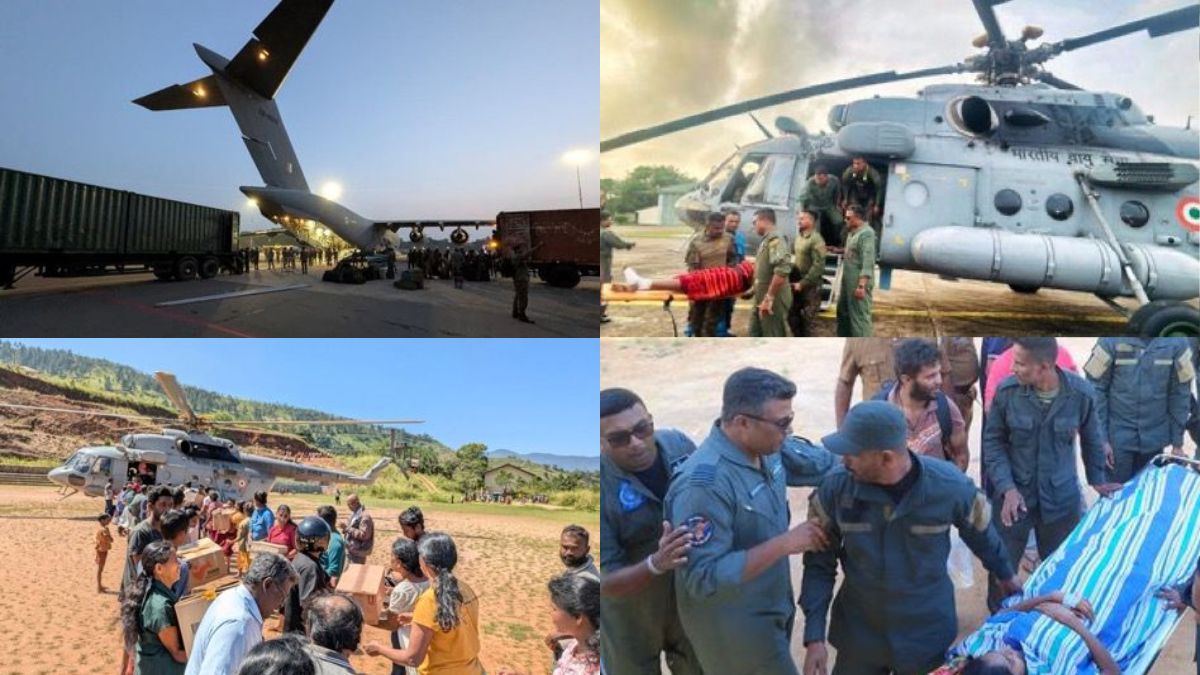
India has emerged as Sri Lanka’s fastest and most dependable first responder after Cyclone Ditwah unleashed one of the island nation’s worst natural disasters in decades.
From massive air evacuations to restoring a key communication lifeline, Indian armed forces are playing a decisive role in saving lives and rebuilding critical systems across the country.
How did India’s air force respond to Ditwah?
In a 10-day high-intensity humanitarian mission codenamed Operation Sagar Bandhu, the Indian Air Force’s Southern Air Command deployed its elite 109 Helicopter Unit, famously known as “The Knights.”
Operating Mi-17 V5 helicopters in treacherous weather, the unit flew 100 rescue sorties, evacuating 264 stranded people, including women, children, and elderly residents trapped by flash floods and landslides.
What relief materials did IAF deliver to Sri Lanka?
The IAF crews also air-dropped 50 tonnes of relief material, ranging from medical supplies to tents, shelters, and telecommunications equipment required to reconnect devastated districts.
Despite low visibility, recurring storms, and rapidly shifting flood zones, the Knights conducted vital medevac missions and reconnaissance flights that provided Sri Lankan authorities with real-time situational awareness.
Officials said the air bridge established between India and Sri Lanka dramatically accelerated the delivery of life-saving relief.
How did the Indian Army restore vital communication lines?
While the IAF rescued people from the skies, the Indian Army restored a communication lifeline on the ground. An Integrated Task Force from the Shatrujeet Brigade, one of the Army’s most elite formations, was rushed to Mahiyanganaya, near Kandy, after Cyclone Ditwah snapped a major Optical Fibre Cable (OFC) route, plunging the region into a communication blackout.
Responding to an urgent request from Sri Lanka Telecom PLC, Indian Army signallers navigated fallen trees, blocked roads, and heavy rain to reach the damaged segment near the Indian Army Field Hospital’s BTS tower.
Using advanced OFC-splicing techniques, they restored connectivity to both civilian and operational networks, re-establishing the primary communications ring for the region.
How did Sri Lanka respond to Indian assistance?
Senior Sri Lankan health officials, including Deputy Minister Dr. Muditha Hansaka Wijemuni and Secretary Dr. Anil Jasinghe, also visited the Indian Army Field Hospital to review ongoing medical outreach and emergency care efforts, expressing deep gratitude for India’s support.
With rescue missions, medical assistance, and infrastructure restoration underway, India has reaffirmed that it will stand firmly with Sri Lanka until the humanitarian crisis stabilises and recovery is complete.