


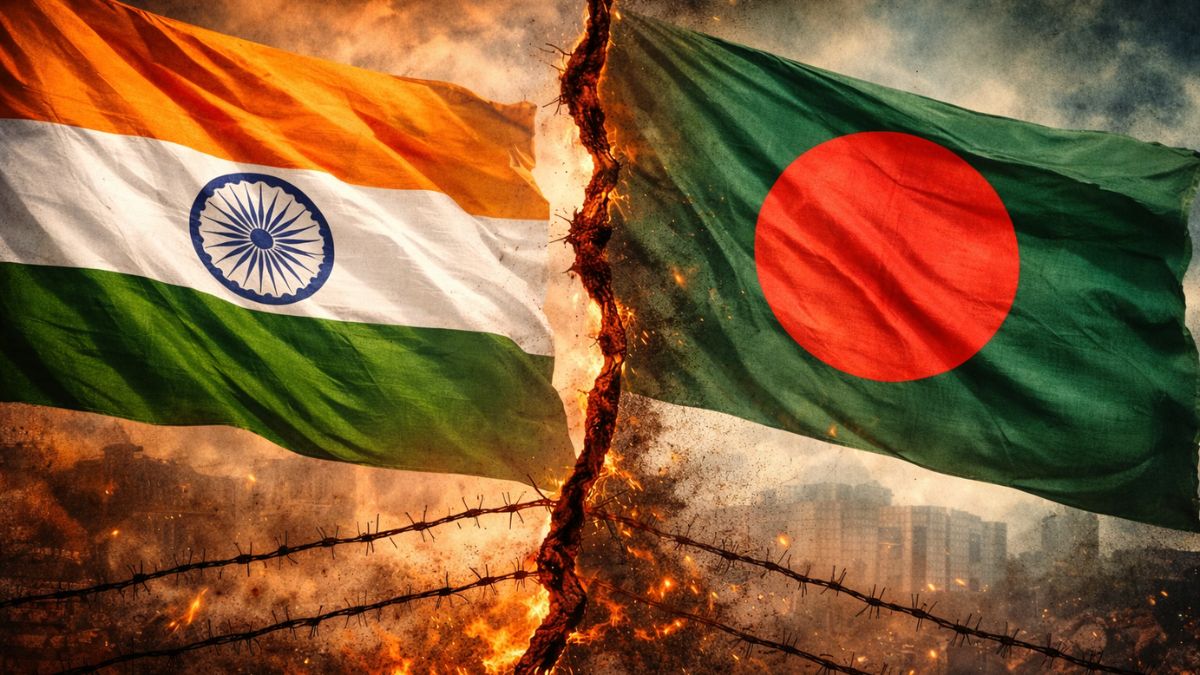
Intelligence assessments and political developments in Bangladesh are raising fresh concerns in New Delhi as a coordinated propaganda campaign allegedly driven by Pakistan’s Inter-Services Intelligence (ISI) and Bangladesh’s Jamaat-e-Islami converges with escalating anti-India rhetoric from student-led political groups ahead of the February 12 national elections.
Analysts warn that the twin pressures could strain India-Bangladesh relations at a critical moment and destabilise the region’s delicate geopolitical balance. India reacted to the developments on Wednesday (December 17, 2025), summoning the Bangladeshi envoy in New Delhi and warning the interim government of Mohammed Yunus not to vitiate the domestic political climate.
What is the ISI-Jamaat propaganda against India?
According to intelligence sources and Bangladesh watchers, the ISI-Jamaat campaign seeks to portray India as interfering in Bangladesh’s electoral process, a charge New Delhi has categorically denied.
The narrative is being amplified through political rallies, social media messaging, and street mobilisation, with the stated aim of shaping public opinion against parties perceived as friendly to India.
Observers say the campaign is expected to intensify as polling day approaches, turning the election into a focal point for information warfare.
What’s the political context of the ISI-Jamaat propaganda?
The political context has heightened sensitivities. Following the ouster of Sheikh Hasina, Nobel laureate Muhammad Yunus was appointed caretaker head of an interim government, a transition that analysts say has given external actors greater insight into Bangladesh’s political dynamics.
With the Awami League barred from contesting the polls, the electoral contest is largely between the Bangladesh Nationalist Party (BNP) and Jamaat-e-Islami, raising the stakes for influence operations.
Why is ISI-Jamaat opposed to Khaleda Zia’s party?
Analysts note that the ISI and Jamaat view a BNP victory as undesirable because of the party’s traditionally pragmatic relationship with India.
The BNP’s decision not to ally with Jamaat-e-Islami is widely seen as a strategic move to shed its earlier pro-radical image and project itself as a moderate, development-focused alternative.
Undermining the BNP through anti-India sentiment, experts say, would open space for more radical forces aligned with Pakistan’s strategic interests.
How are people of Bangladesh largely pro-India?
While the propaganda push is significant, officials and observers stress that a large section of Bangladeshi society remains broadly pro-India.
Millions of Bangladeshis depend on India for education, healthcare, employment, and trade, reinforcing historically deep people-to-people ties.
This underlying interdependence, analysts argue, may blunt the long-term impact of the disinformation campaign.
How have Bangladesh student leaders threatened India?
Parallel to these developments, sharp anti-India rhetoric from leaders of the student-led National Citizen Party (NCP) has added a volatile dimension.
NCP leader and chief organiser for the southern region, Hasnat Abdullah, warned at a Dhaka rally that any destabilisation of Bangladesh would have spillover effects across borders.
Referring to India’s northeastern states, collectively known as the Seven Sisters, he threatened that Bangladesh could “give refuge” to separatist elements if provoked, a statement that has alarmed security analysts.
What was Abdullah’s rhetoric against India?
Abdullah accused unnamed “vultures” of seeking to control Bangladesh even decades after independence and warned India against allegedly sheltering forces hostile to Bangladeshi sovereignty.
His remarks were echoed by NCP convener Nahid Islam, who called for nationwide “resistance rallies” on Victory Day to protest what he described as Indian interference and hegemony.
How have other student networks attacked India verbally?
The rally, organised by Inqilab Mancha, a platform emerging from student protest networks linked to the July uprising, brought together a wide ideological spectrum, including representatives from the BNP, Jamaat-e-Islami, and other parties.
It followed the attempted assassination of Sharif Osman Hadi, a spokesperson for the group and an independent parliamentary candidate, an incident that Islam described as an attack on the broader protest movement.
Islam later alleged, without providing evidence, that India and the Awami League may have links to the attack, claiming the Awami League was operating from exile in New Delhi to reassert influence within Bangladesh.
In response, Bangladesh’s Foreign Ministry urged India to prevent suspects from crossing the border and ensure extradition if they do.
Why did India summon the Bangladeshi envoy?
India’s Ministry of External Affairs firmly rejected the allegations, reiterating that New Delhi supports free, fair, and inclusive elections in Bangladesh and has never allowed its territory to be used for activities inimical to the interests of the Bangladeshi people.
As elections near, the convergence of propaganda, populist rhetoric, and regional rivalries underscores how Bangladesh’s domestic politics are increasingly entangled with wider South Asian geopolitics.
In a statement on Wednesday (December 17, 2025), the MEA said it summoned Bangladesh’s High Commissioner to India, Riaz Hamidullah, to convey New Delhi’s strong concerns over the deteriorating security situation in Bangladesh, particularly threats posed by extremist elements.
Why has India pointed out anti-India rhetoric within Bangladesh?
The Indian side drew attention to announcements by certain groups indicating plans to create a security situation around the Indian Mission in Dhaka, a development New Delhi described as a matter of serious concern.
India also rejected what it called a “false narrative” being promoted by extremist elements in connection with recent incidents in Bangladesh, expressing disappointment that the interim government has neither carried out a thorough investigation nor shared substantive evidence with India so far.
How are India-Bangladesh ties rooted in the 1971 liberation?
Reiterating that India’s ties with Bangladesh are rooted in the 1971 liberation struggle and reinforced through close developmental and people-to-people cooperation, the MEA underlined New Delhi’s support for peace, stability, and free, fair, and inclusive elections in Bangladesh.
India further stressed that it expects the interim government in Dhaka to ensure the safety and security of diplomatic missions and personnel in line with its international obligations.