


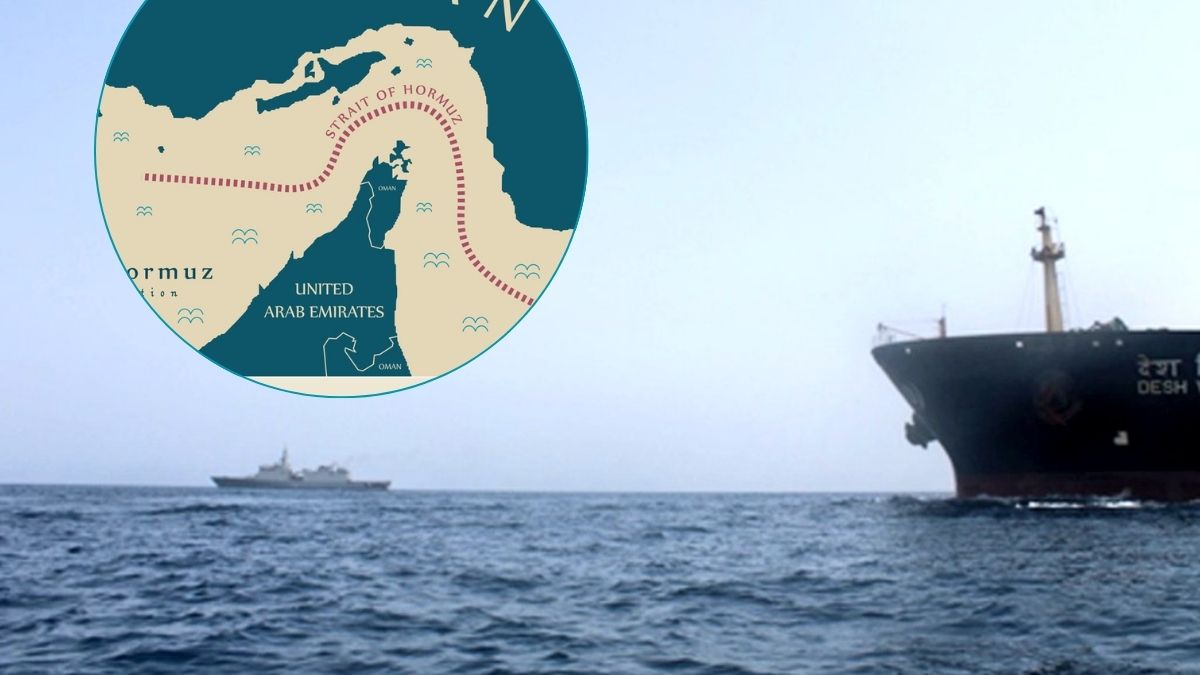
India has taken a serious view of a dangerous escalation in the Strait of Hormuz, where soldiers of Iran’s Islamic Revolutionary Guard Corps (IRGC) opened fire on two Indian-flagged cargo vessels on Saturday (April 18, 2026), prompting urgent diplomatic intervention from New Delhi.
The incident has raised fresh concerns over the safety of Indian ships and seafarers navigating one of the world’s most critical maritime trade routes.
According to official inputs and maritime reports, two Indian-flagged vessels came under fire from IRGC units while transiting through the Strait of Hormuz. The United Kingdom Maritime Trade Operations (UKMTO) confirmed that captains of three vessels in the area, including two Indian ships, reported attacks on April 18.
In one instance, an Indian-flagged oil tanker was approached by two Iranian military gunboats that opened fire without prior warning or radio communication. The crew escaped unharmed. In a separate incident near the coast of Oman, another Indian vessel, reportedly a supertanker, was hit by an unidentified projectile.
While the ships did not suffer major structural damage, some sections reported shattered glass panes. Sources quoted by News18 indicated that the firing may have stemmed from a communication gap between Iranian authorities and a local IRGC unit, though the situation remains sensitive.
How did India respond to the incident?
Acting swiftly, New Delhi initiated urgent diplomatic steps and summoned Iran’s Ambassador to India Dr. Mohammad Fathali. The envoy was called in for a meeting with Foreign Secretary Vikram Misri, who conveyed India’s “deep concern” over the firing incident and underscored the need to ensure the safety of Indian vessels operating in the region.
MEA spokesperson Randhir Jaiswal on Monday (April 20, 2026) confirmed the government’s response, stating, “Upon receiving information regarding the firing incident, the Government of India took serious diplomatic initiatives in the matter. The Iranian Ambassador to India was summoned, and Foreign Secretary Vikram Misri conveyed to the Ambassador that India is deeply concerned by this incident.”
He added, “We remain in constant contact with Iranian authorities regarding the safety of Indian vessels. We are continuously engaging with Iran to ensure safe passage for our ships.”
What assurances has India sought from Iran?
During the meeting, Misri highlighted the importance India attaches to the safety of merchant shipping and mariners, and recalled that Iran had earlier facilitated the safe passage of several India-bound vessels. He also urged the Iranian side to resume the process of facilitating safe transit across the Strait of Hormuz at the earliest and prevent any recurrence of such incidents.
The Iranian Ambassador, in response, undertook to convey India’s concerns to authorities in Tehran.
Strait of Hormuz crisis: How vulnerable are Indian ships and nationals?
The incident has put a spotlight on India’s exposure in the conflict-hit region. At least 14 Indian-flagged vessels remain anchored in the Strait of Hormuz, including three large oil tankers and one LPG carrier, even as efforts continue to secure their safe movement.
Additionally, a significant number of Indian nationals are present in Iran, making their safety a top priority for New Delhi. Since tensions escalated in West Asia on February 28, India has already evacuated 10 Indian-flagged LPG and oil tankers from the region.
Why is the Strait of Hormuz so critical for India?
The Strait of Hormuz is one of the world’s most vital energy corridors, handling a significant share of global oil and gas shipments. Any disruption in this narrow waterway has immediate implications for global energy markets, and for India, which relies heavily on imports to meet its energy needs.
Meanwhile, India continues to press Iran diplomatically to guarantee secure movement of its vessels and ensure that such incidents are not repeated.