


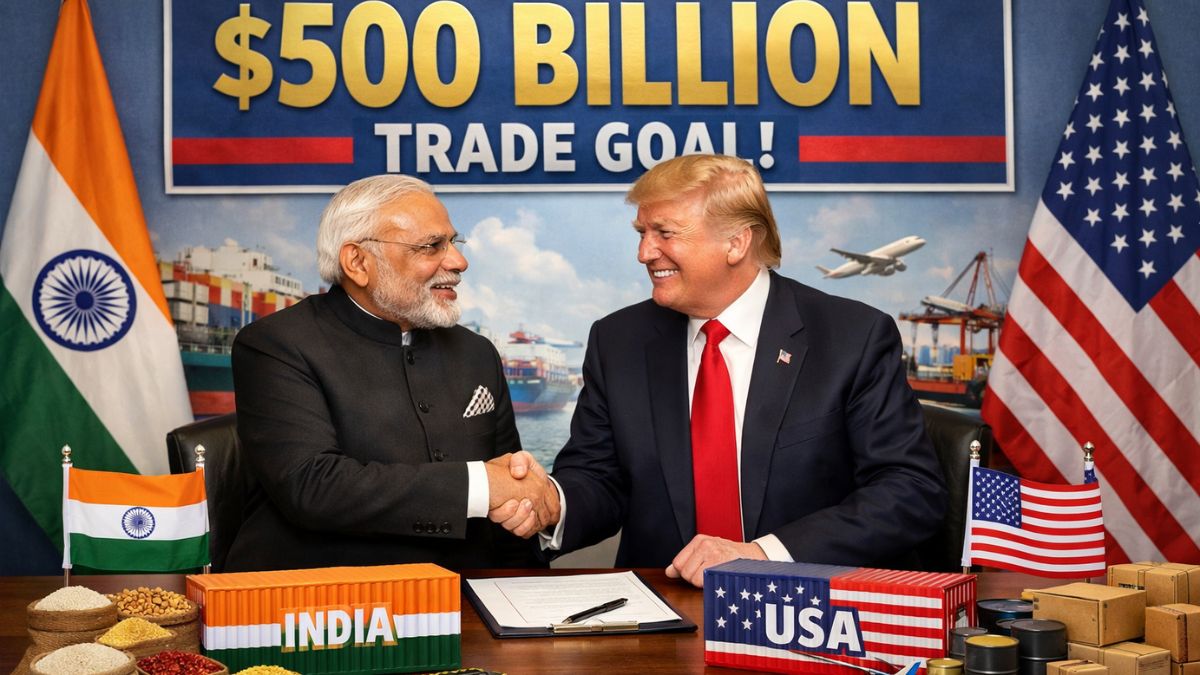
While the proposed meeting of their chief negotiators might have been rescheduled, India and the United States seem to have high hopes from the trade deal, announced by President Donald Trump late last month. The US and India are navigating a complex but ambitious trade reset, with both sides reaffirming a bold goal to raise bilateral trade to $500 billion.
Both the sides are eyeing a healthy trade deal that delivers, even as tariff uncertainty in Washington slows the pace of negotiations. Fresh comments from senior US and Indian officials underscore both the promise and the policy turbulence shaping one of the world’s most consequential economic partnerships.
The meeting between negotiators from sides was rescheduled following the US Supreme Court’s ruling on President Trump’s tariffs, which struck them down.
India-US trade deal: What is the $500 billion trade target?
During a congressional hearing, US Under Secretary of State for Economic Affairs Jacob Helberg confirmed that Prime Minister Narendra Modi and US President Trump set a target to increase total bilateral trade flows to $500 billion. Helberg expressed strong confidence in the trajectory of ties, citing a slew of factors.
These include historic Indian purchases of US energy, iIncreased cross-border investment, expanded economic cooperation under a new trade framework.
“The trajectory of the US-India relationship is incredibly strong,” Helberg said, pointing to progress under the broader Bilateral Trade Agreement (BTA) negotiations launched on February 13, 2025. The target represents a significant leap from current trade levels and signals a strategic effort to deepen supply chain integration between the two economies.
What is the interim trade framework?
Washington and New Delhi recently agreed on a framework for an Interim Agreement on reciprocal and mutually beneficial trade. Key elements include India reducing or eliminating tariffs on selected US industrial goods, food and agricultural products, the US applying a reciprocal 18% tariff on certain Indian-origin goods, with scope for removal once a final agreement is concluded.
They also agrred on some commitments to expand market access, efforts to build more resilient supply chains. The Interim Agreement is designed as a stepping stone toward a comprehensive Bilateral Trade Agreement.
However, implementation now faces new uncertainty due to developments in US tariff policy.
How did the US Supreme Court complicate matters?
In a major ruling, the US Supreme Court struck down most of Trump’s sweeping tariff measures imposed under the International Emergency Economic Powers Act (IEEPA) of 1977. In a 6–3 decision, the Court ruled that the administration exceeded its authority, stating that the power to levy taxes resides primarily with Congress.
In response, US President Trump announced a new 10% global tariff on all countries under Section 122 of the Trade Act of 1974. He later raised it to the legally permissible 15% level, effective immediately, and described the move as a temporary import surcharge (up to 150 days) to address balance-of-payments concerns.
Why are India-US trade talks paused?
Union Commerce and Industry Minister Piyush Goyal indicated that New Delhi will resume negotiations “as soon as there’s more clarity” on the US tariff front. A scheduled meeting between chief negotiators in Washington, intended to finalise the interim pact text, was recently postponed.
The delay reflects India’s preference to wait for greater legal clarity on US tariff authority, stability in American trade policy, predictability in reciprocal tariff commitments. Despite the pause, officials on both sides have signalled continued commitment to the broader trade agenda.
What about sanctions and Russia?
Helberg also referenced the administration’s “maximum pressure” policy on Russia aimed at ending the war in Ukraine. He acknowledged that secondary sanctions had impacted certain Indian interests, but suggested that the bilateral trade statement helped address concerns through dialogue.
Parallel to trade talks with Washington, India is reviewing its investment screening regime under Press Note 3, introduced during the pandemic to prevent opportunistic takeovers. The rule mandates government approval for investments from countries sharing land borders with India, including China.
Goyal indicated the government is consulting domestic industry, open to calibrated, step-by-step changes, seeking to accelerate approval processes, considering ways to attract better technology and value-chain integration.
Despite short-term tariff turbulence, both governments appear committed to expanding economic ties. The $500 billion trade target, if realised, would position India as one of America’s most significant economic partners.