


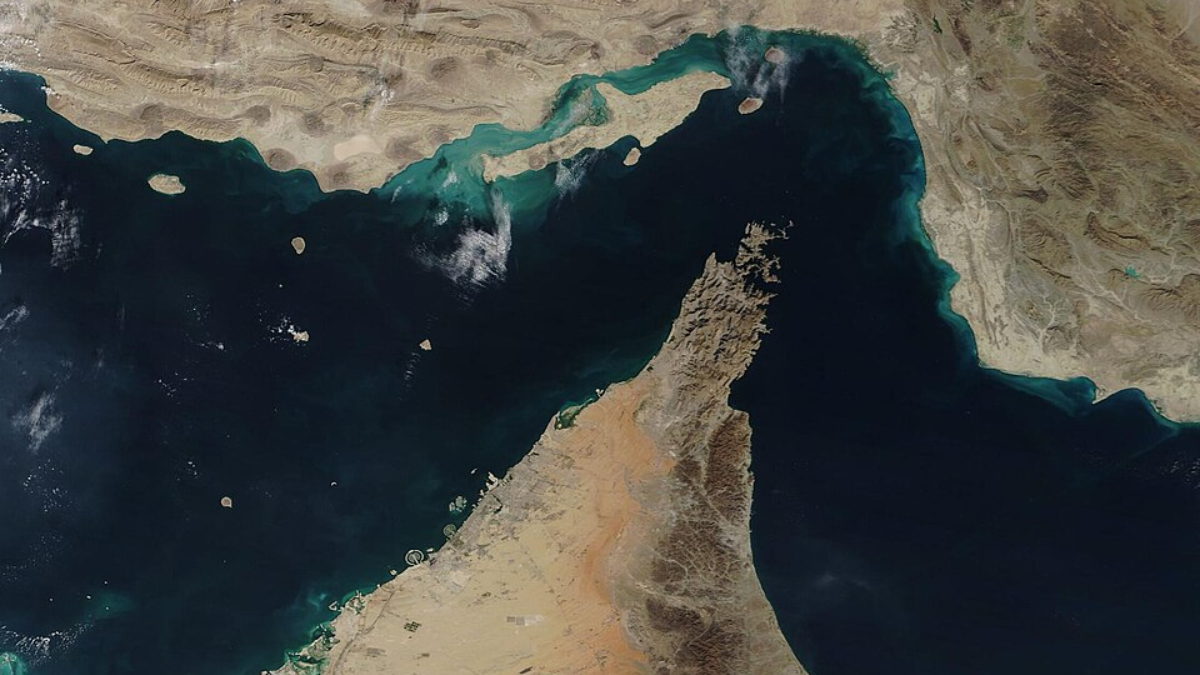
Iran on Sunday (March 22, 2026) said the Hormuz Strait remained open to all maritime traffic but “enemy-linked’ ships should keep away.
The United Kingdom, on the other hand, rejected an American ultimatum to Iran to open the Hormuz Strait within 48 hours, even as it refused to be drawn into the West Asian war.
Meanwhile, the International Atomic Energy Agency, a UN body, warned that the world could face its worst energy crisis due to the West Asian war, compared to what was witnessed in the Russia-Ukraine military conflict over the last four years.
How Iran Warned ‘Enemy’ Ships to Keep Off Hormuz
The Iranian media quoted Tehran’s representative to the UN maritime agency on Sunday (March 22) as saying that the Hormuz Strait, a narrow water body in West Asia seen as the bloodline for oil and gas supply worldwide, was open to all maritime traffic, except for Iran’s enemies.
Iran had announced a blockade of the Hormuz Strait on February 28 following airstrikes by the US and Israel that killed its Supreme Leader, Ayatollah Ali Khamenei, in his office compound in Tehran.
Iran’s Islamic Revolutionary Guards Corps (IRGC) had threatened to hit all shipping traffic after taking control of the Hormuz Strait immediately after the February 28 airstrikes by the US and Israel.
A few shipping vessels passing through the Hormuz Strait immediately after the start of the West Asian war came under Iranian missile strikes, killing sailors and damaging cargo vessels.
The Iranian blockade and attacks on cargo ships have disrupted oil and gas supply chains globally, threatening the energy security of nations across continents.
Iran’s representative to the International Maritime Organisation (IMO), Ali Mousavi, conveyed Tehran’s willingness to cooperate with the UN agency to improve the safety of shipping and the protection of seafarers in the Gulf region.
“Diplomacy remains Iran’s priority. However, a complete cessation of aggression as well as mutual trust and confidence are more important,” Mousavi said, adding that Israeli and US attacks against Iran were at the “root of the current situation in the Strait of Hormuz”.
Why UK Rejects US Call for Involvement in West Asian Crisis
Meanwhile, the United Kingdom’s Secretary of State for Housing, Communities, and Local Government, Steve Reed, said on Sunday (March 22) that his nation would not be drawn into the West Asia war, but was ready to safeguard its national and regional interests there.
Responding to media questions on US President Donald Trump’s 48-hour ultimatum to Iran on opening the Hormuz Strait, Reed said UK’s focus was on security and de-escalation.
“Well, I think you need to ask President Trump about the things that President Trump is talking about. What we’re doing is we have in place the necessary equipment and security structures to keep British nationals and British interests across the region and beyond safe,” Reed said.
“We’re not going to be dragged into the war, but we will protect our own interests in the region. We will work with our allies to de-escalate the situation because we know that the best way to protect our security and indeed the economic interests that we have is to bring this conflict to a close as quickly as we can,” he said.
Trump had posted on Truth Social that the US would target and “obliterate” Iranian power plants if it didn’t “fully open” the Hormuz Strait within 48 hours.
“If Iran doesn’t FULLY OPEN, WITHOUT THREAT, the Strait of Hormuz, within 48 HOURS from this exact point in time, the United States of America will hit and obliterate their various POWER PLANTS, STARTING WITH THE BIGGEST ONE FIRST!” Trump’s post read.
On Trump’s criticism of the US allies as “cowards,” Reed said, “Well, I think Donald Trump, as the President of the United States, can speak for himself and the language that he chooses to use.”
How IAEA Warned of World’s Worst Energy Crisis
The same day, the IAEA warned that the West Asian war was the world’s worst energy crisis in decades.
IAEA Executive Director Fatih Birol said the global oil losses now exceed 11 million barrels per day, surpassing the combined shocks of the 1970s.
Birol called the situation “very severe,” cautioning that no nation would be spared if the oil and gas supply chain disruptions continued.
He said the IAEA was consulting Asian and European governments on the release of stockpiled oil “if necessary” due to the West Asian war.
“We look at the conditions, we will analyse, assess the markets and discuss with our member countries,” Birol said.
Earlier, on March 11, IAEA members agreed to release a record 400 million barrels of oil from their strategic stockpiles to combat the crude price rise, expected to be around 20% of the global stocks.
Currently in the Australian leg of his world tour, Birol said, “A stock release will help to comfort the markets, but this is not the solution. It will only help to reduce the pain in the economy.”
He also warned that the general public needed to understand the “depth of the problem” facing the world due to the West Asian war.
At the Australian National Press Club in Canberra, Birol addressed the situation, calling it “very serious”, more than the two oil crises in 1973 and 1979, and even more so than the gas crisis triggered by the Russia-Ukraine war since 2022.
“At that time, in each crisis, the world lost about 5 million barrels per day, and together 10 million barrels per day. And after that, we all know that there were major economic problems around the world. And today we lost 11 million barrels, so more than two major oil shocks put together,” he said.
“Plus, after the Russia-Ukraine war, the gas markets, especially in Europe, lost about 75 billion consumer metres (BCM). And as of now, as a result of this (West Asia) crisis, we have lost about 140 BCM, almost twice.
“So the situation is, if we want to put in context, this crisis, as it stands now, two oil crises and one gas crash put all together,” he said.
Birol was of the view that the West Asian crisis was also having a severe impact on other “vital arteries of the global economy”, including the petrochemicals and fertilisers, which would have lasting impacts.