


Southern Lebanon once again echoed with explosions on Wednesday (November 19, 2025) as Israeli airstrikes intensified across multiple villages, underscoring a campaign that Israel insists is aimed at preventing Hezbollah from rebuilding military infrastructure near the border. The strikes hit Deir Kifa, Chehour, Aainata and Tayr Filsay, sending dense smoke curling into the sky.
Civilians scrambled to evacuate after receiving online warnings from the Israeli military. Israel, on the other hand, stated that the targeted structures housed weapons belonging to Hezbollah’s rocket units, accusing the group of embedding these sites “in the heart of the civilian population.” Further, the Israeli military also accused Hezbollah of working to rebuild capabilities in another village.
Lebanon’s health ministry reported one fatality in Al-Tiri earlier in the day, while Israel claimed it had neutralised a Hezbollah operative working to “re-establish the group’s readiness in the area.” A Hezbollah official rejected the allegations, calling them “false claims to justify continued attacks.”
Israel-Hezbollah tensions: What’s behind the latest escalation?
Tensions escalated further after a strike on Tuesday (November 18, 2025) killed 13 people in the Ain al-Hilweh Palestinian refugee camp near Sidon, in one of the deadliest Israeli attacks in Lebanon since last year’s war. Israel stated the strike targeted a Hamas compound; Hamas dismissed the claim as “pure fabrication,” saying no militants were present.
Under the US and France-brokered truce, Lebanon’s armed forces were tasked with confiscating unauthorised weapons in zones south of the Litani River. But disagreements over the interpretation of the agreement, coupled with mutual accusations of violations, have weakened its enforcement. Lebanon accuses Israel of continuing to occupy positions in its south, while Hezbollah argues that restrictions apply only below the Litani.
Netanyahu’s Syria visit: What signal was he sending?
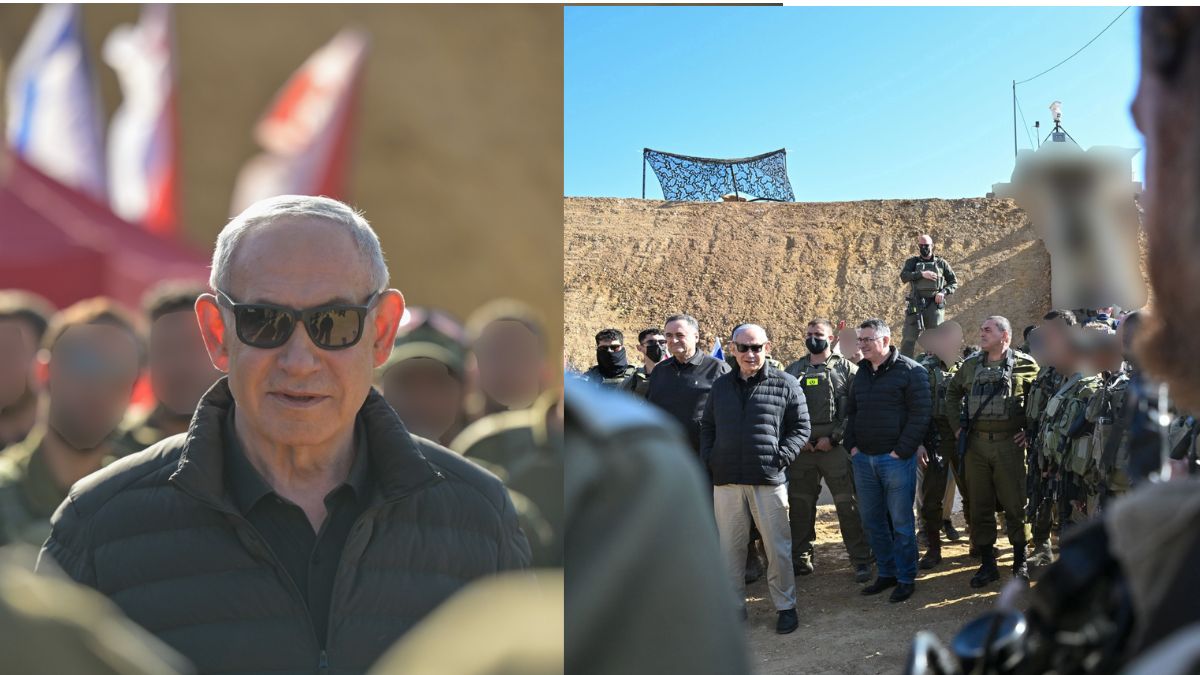
Even as strikes pounded Lebanon, a different message was being broadcast from Israel’s northern frontier. Israeli Prime Minister Benjamin Netanyahu made a highly publicised visit to troops stationed inside Syria, beyond the internationally recognised ceasefire line in the Golan Heights.
Flanked by his foreign and defence ministers, the army chief, and the head of the Shin Bet, Netanyahu addressed soldiers in the UN-patrolled buffer zone, emphasising both the defensive and offensive importance of their presence. He warned them that their mission “can develop at any moment,” signalling Israel’s readiness for rapid escalation amid regional instability.
The visit drew immediate condemnation from Damascus. Syria’s foreign ministry denounced it as a “serious violation” of its sovereignty and territorial integrity, branding it an attempt to impose a new reality contrary to UN Security Council resolutions. The backlash extended to the United Nations, where Secretary-General António Guterres called Netanyahu’s visit “very public” and “concerning.”
Guterres urged Israel to respect the 1974 disengagement agreement that governs military positions in the Golan.