


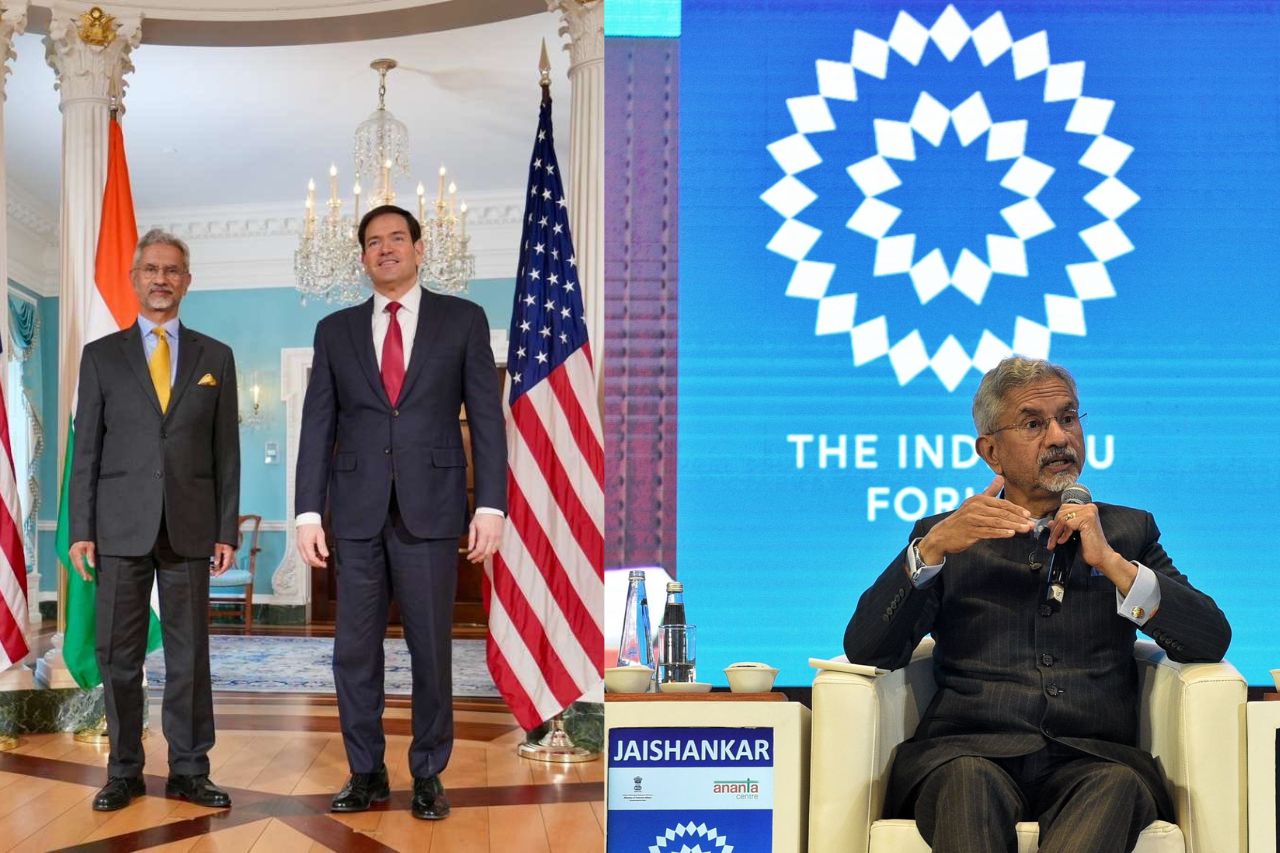
India is on the verge of clinching a trade agreement with the United States, and the deal would be done “very soon,” External Affairs Minister Dr S. Jaishankar has said.
His comments came just days after US President Donald Trump and Indian Prime Minister Narendra Modi announced that the two sides have reached a consensus on the trade agreement and that the American penalising tariff on India would be reduced.
Jaishankar said the trade deal would bring in a new phase in the India-US bilateral ties, and that the trade agreement discussions were being handled by his cabinet colleague and Commerce Minister Piyush Goyal, who would know the timelines for the deal.
The External Affairs Minister was in Washington for a critical minerals ministerial conference, on the sidelines of which he also met with US Treasury Secretary Scott Bessent and Secretary of State Marco Rubio to discuss the trade deal and economic ties between the two nations.
“Concluded a productive and positive visit to the US…The historic India-US trade deal is in the final stages of detailing that will be completed very soon. It opens up a new phase in our bilateral ties, with vast possibilities for the relationship,” Jaishankar said in a social media post.
“Our critical mineral cooperation is also advancing rapidly. Expect engagement on strategic issues, defence and energy in the coming days. Overall, a strong momentum is evident,” he said, indicating the bettering of ties between the two nations after eight months of bitterness over trade and tariffs.
Meanwhile, In New Delhi, External Affairs Ministry spokesperson Randhir Jaiswal referred to the Trump-Modi phone call to clarify that the final tariff on Indian goods is 18%.
“This trade agreement, as we see it, will give a major boost to our exports to the US. It will be a major boost to the labour-intensive industries here in India, create new job opportunities, growth and prosperity for our people,” Jaiswal said.
Indian officials noted that the 18% tariff would be applied once the first instalment of the trade deal was completed.
During their meeting, Jaishankar and Bessent discussed ways to advance the bilateral economic partnership and strategic cooperation.
With Rubio, the Indian External Affairs Minister focused on trade, energy, and cooperation in nuclear, defence, critical minerals and technology.
India and the US agreed on early meetings of various mechanisms to advance shared interests, Jaishankar said on social media.
It was unlikely that Indian tariffs on US goods would go to zero, and the Indian side had ensured adequate safeguards in sensitive sectors such as agriculture and dairy, according to Indian officials.
They said the recent India-US interactions, including those by American Ambassador to India Sergio Gor was to set the bilateral ties on all areas of cooperation on the right track.
Meanwhile, on Friday (February 6, 2026), Jaishankar also hailed the recent India-EU Free Trade Agreement as a “game changer.”
He was addressing the inaugural India-EU Forum of think tank Ananta Centre in partnership with the Ministry of External Affairs.
“Addressed the inaugural India-EU Forum this morning. Highlighted that the FTA has been a game changing development for our partnership. Also flagged other dimensions that hold great potential, including security, defence, climate, technology and talent flows,” Jaishankar said in an X post.
“Hope that the India-EU Forum promotes more conversations and creates greater convergences between India and the EU,” he added.
With a combined market estimated at over Rs 2091.6 lakh crore (USD 24 trillion), the FTA delivers preferential market access for more than 99 per cent of India’s exports by trade value.
Bilateral merchandise trade between India and the EU stood at approximately Rs 11.5 lakh crore (USD 136.54 billion) in 2024-25, with India exporting roughly Rs 6.4 lakh crore (USD 75.85 billion) to the EU. Trade in services reached Rs 7.2 lakh crore (USD 83.10 billion) in 2024.
India has secured preferential access across 97 per cent of tariff lines, covering 99.5% of trade value. Notably, 70.4% of tariff lines covering 90.7% of India’s exports will see immediate duty elimination in labour-intensive sectors such as textiles, leather and footwear, tea, coffee, spices, sports goods, toys, gems and jewellery, and certain marine products.
Another 20.3% of tariff lines will achieve zero duty over three and five years, while 6.1% will benefit from tariff reductions or tariff rate quotas (TRQs) for products including cars, steel, and certain shrimp/prawn items.