


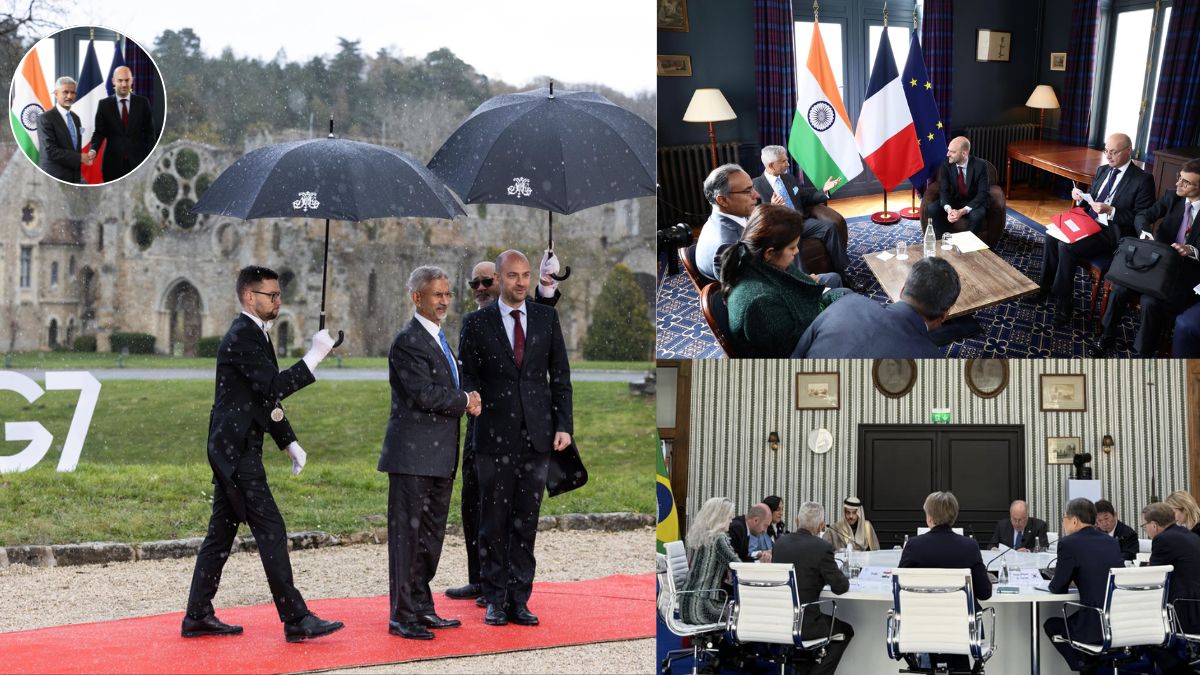
India’s External Affairs Minister Dr. S. Jaishankar on Thursday (March 26, 2026) held “in-depth” discussions with his French counterpart in Paris, even as Prime Minister Narendra Modi plans to visit Paris in June this year.
At the ongoing G7 foreign ministers’ meeting in France, Jaishankar also pressed for an urgent reform of the United Nations Security Council, streamlining of the UN peace-keeping operations, and strengthening humanitarian supply chains.
The Indian External Affairs Minister arrived in France on a two-day visit to represent India as a partner country at the Foreign Ministers’ Meeting of the G7 (Group of Seven) advanced economies.
On the sidelines, he met his French counterpart Jean-Noël Barrot in Abbaye des Vaux-de-Cernay on Thursday (March 26, 2026), when the two leaders discussed “in depth” the West Asian war, according to a French readout of the meeting.
They “agreed to continue their close coordination with a view to working jointly towards ensuring the security of the Strait of Hormuz,” the readout said.
The French government said Jaishankar’s participation in the G7 meeting indicated “the importance France attaches to closely associating India, currently holding the BRICS presidency, with its G7 presidency.”
The Ministers welcomed Prime Minister Narendra Modi’s participation in the G7 Summit, scheduled for June 15-17 in Évian, France.
French President Emmanuel Macron paid an official visit to India from February 17 to 19 and participated in the Artificial Intelligence Impact Summit 2026.
During the visit, Macron and Modi jointly inaugurated the 2026 India-France Year of Innovation in Mumbai on February 17, apart from agreeing to elevate relations to a “Special Global Strategic Partnership” to guide bilateral cooperation in the coming decades.
Jaishankar and Barrot underscored India’s contribution to the G7’s work on addressing major macroeconomic imbalances and improving international partnerships.
In the G7 foreign ministers’ meeting, the grouping would discuss the West Asian war in detail and the impact of the Gulf military operations on the global energy markets and economy.
The foreign ministers would discuss the ongoing Russia-Ukraine war, too, and reforms in global organisations.
“We will work to bring about a new international order and to build a more balanced and fairer system, underpinned by a renewed multilateralism.
“Reforming global governance and combatting cross-cutting threats require a collective commitment which extends beyond G7 members alone,” Barrot said in a statement.
In the first session of the G7 foreign ministers’ meeting, Jaishankar emphasised the urgency of UN Security Council reforms. India, along with several other countries, has been seeking a permanent seat on the UNSC with veto powers.
India has long maintained that it deserved a permanent seat at the UNSC high table with veto rights. At present, the permanent members of the UN body are the US, Russia, France, the United Kingdom, and China.