


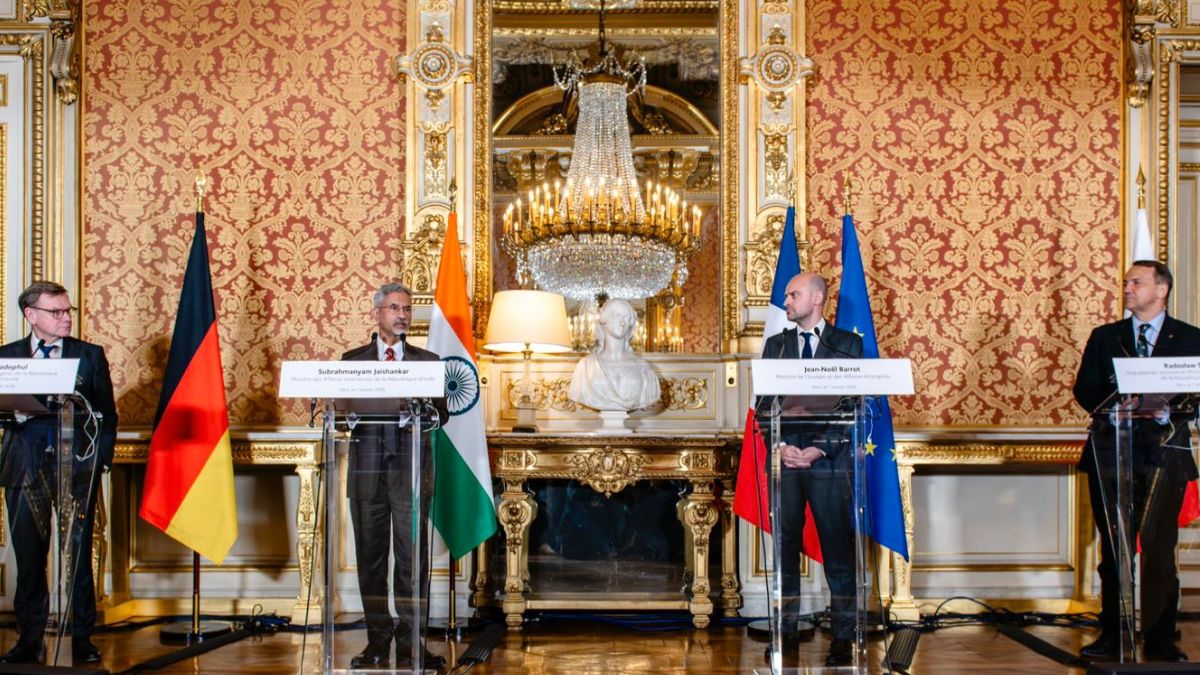
External Affairs Minister Dr. S. Jaishankar has kicked off India’s diplomatic calendar for 2026 with a deliberately chosen European outreach, signalling a decisive push to elevate India–Europe ties at a time of mounting global uncertainty, friction with Washington, and shifting power balances.
Beginning his first official visit of the year in Paris and Luxembourg, Jaishankar framed Europe not merely as a partner, but as a critical pillar in India’s effort to stabilise the global economy and reshape geopolitical norms.
What did Jaishankar say regarding India-Europe ties?
Speaking in Paris after India’s unprecedented participation in the Weimar Triangle meeting, alongside France, Germany and Poland, Jaishankar said India’s relationship with Europe represented its “greatest unrealised potential.”
The decision to start 2026 in Europe, he stressed, was intentional. As global politics reels from the ongoing Russia–Ukraine war, uncertainty over the transatlantic alliance under US President Donald Trump, and Washington’s dramatic capture of Venezuelan President Nicolás Maduro, New Delhi sees Europe as a space where strategic autonomy and dialogue still matter.
Why is India’s inclusion in Weimar Triangle significant?
India’s inclusion in the Weimar Triangle, traditionally a Europe-only format formed in 1991 to advance European integration and security, was itself a diplomatic signal.
French Foreign Minister Jean-Noël Barrot noted it was the first time a non-European country had been invited at the foreign minister level, underscoring India’s growing weight in European strategic thinking.
France’s current G7 presidency and India’s leadership of BRICS provided additional rationale, alongside the nearing conclusion of the long-negotiated India–EU Free Trade Agreement.
How will these Indo-European momentum continue?
The momentum is expected to accelerate through 2026. European Commission President Ursula von der Leyen and European Council President António Costa are expected in India later this month for Republic Day, with an FTA announcement firmly on the agenda.
Commerce Minister Piyush Goyal’s parallel visit to Brussels for talks with EU Trade Commissioner Maroš Šefčovič underlines the economic spine of the renewed engagement.
Germany’s Chancellor Friedrich Merz is due in Ahmedabad and Bengaluru next week, while French President Emmanuel Macron will travel to New Delhi in February for the India-hosted AI Impact Summit.
How is Jaishankar’s talks with Macron add value to the ties?
Jaishankar’s Paris visit also spotlighted India’s deepening bilateral partnerships, particularly with France and Poland. In meetings with President Emmanuel Macron, Jaishankar conveyed Prime Minister Narendra Modi’s greetings and discussed global shifts driven by trade, technology, energy and finance.
Addressing France’s Ambassadors’ Conference, he highlighted India–France cooperation as a cornerstone of multipolarity and strategic autonomy, calling the partnership vital not just bilaterally but for global stability.
How is Poland becoming a key political supporter of India?
Poland emerged as a key political supporter for India amid its increasingly tense standoff with Washington over Russian oil imports.
Polish Foreign Minister Radosław Sikorski publicly backed India while acknowledging New Delhi’s gradual reduction in Russian crude purchases, an issue that has triggered sharp US tariff threats, including potential punitive duties of up to 500 per cent.
Sikorski’s remarks, and his planned visit to India next week, signal Warsaw’s willingness to engage India pragmatically even as Europe remains divided on energy sanctions.
How are India-Europe views converging on critical matters?
The outreach comes as Europe itself grapples with US unpredictability: from wavering support for Ukraine to renewed American claims over Greenland.
French officials openly questioned the idea of a “collective West,” instead arguing that sovereign nations should work together to defend international law. That framing aligns closely with India’s long-held emphasis on strategic autonomy.
Energy remains a delicate balancing act. While India continues to be one of Russia’s largest oil buyers, recent data indicate a noticeable decline in Russian crude imports, driven partly by new US sanctions and refiners pausing their purchases.
The trend offers New Delhi diplomatic space as it recalibrates without abandoning its core economic interests.
How India’s outreach to Europe isn’t routine diplomacy?
Taken together, Jaishankar’s Europe tour marks more than routine diplomacy. It reflects India’s bet that 2026 will see a qualitative upswing in India–EU relations, anchored in trade, technology, security dialogue, and shared discomfort with a volatile global order.
As pressure from Washington intensifies, New Delhi appears intent on building durable European bridges, positioning itself not within old blocs, but as a central player in an increasingly multipolar world.