


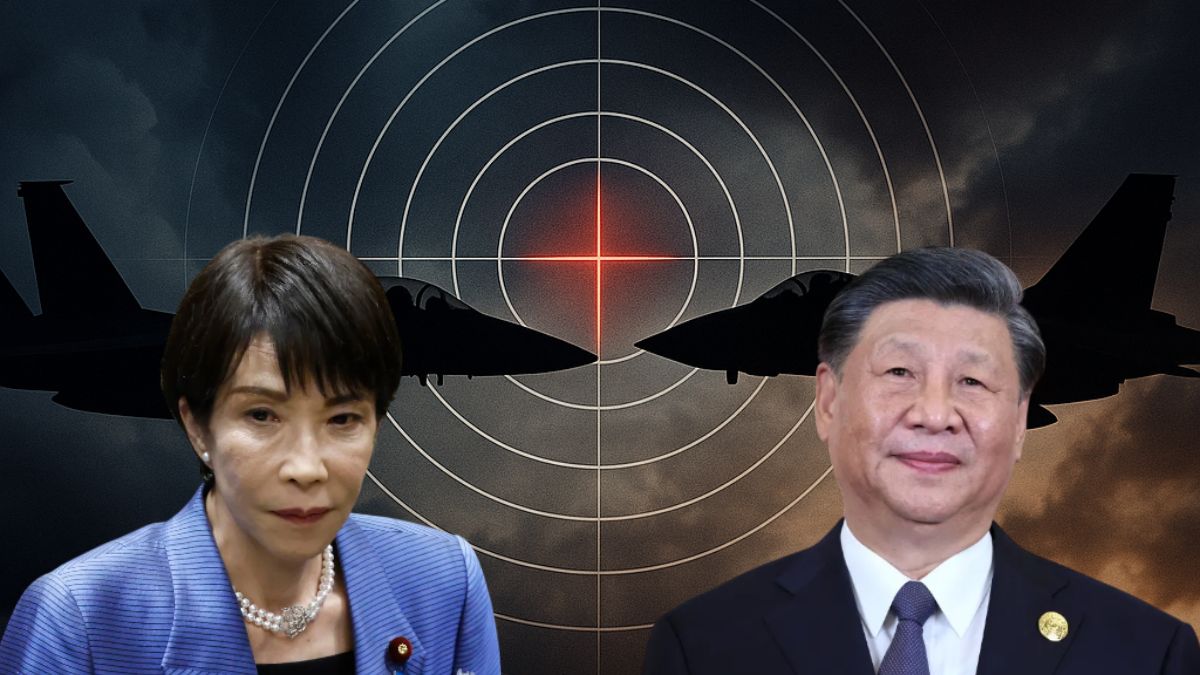
Tensions between Japan and China flared dramatically over the weekend after Tokyo accused Chinese fighter jets of locking their fire-control radar onto Japanese F-15s near the Okinawa islands, an act considered one step short of an attack in military aviation.
Japanese Prime Minister Sanae Takaichi vowed a “calm but resolute” response, signalling that Tokyo will boost maritime and airspace surveillance around its southwest island chain.
Japan’s foreign ministry also summoned Chinese Ambassador Wu Jianghao, issuing what officials described as a “strong and serious protest”.
How did the radar lock episode unfold?
The incident unfolded southeast of Okinawa, where the People’s Liberation Army (PLA) Navy’s aircraft carrier Liaoning was conducting far-sea training operations. Japan’s defence ministry said it recorded nearly 100 fighter jet sorties from the vessel.
According to Tokyo, two of the carrier’s J-15 fighters locked their fire-control radar, a signal used to guide missiles, onto Japanese F-15s at 4:32 pm and again two hours later on Saturday (December 6, 2025).
No damage or injuries were reported, but the act was immediately labelled “dangerous and extremely regrettable” by Defence Minister Shinjiro Koizumi.
A radar lock is widely considered one of the most provocative moves short of firing a weapon, as it forces targeted aircraft to take evasive measures. This is the first time Japan has publicly disclosed such an incident involving Chinese warplanes.
How did China react to Tokyo’s claims?
China, however, has blasted Tokyo’s claims as “completely inconsistent with the facts” and launched a full-throated counteroffensive.
Senior Colonel Zhang Xiaogang of China’s defence ministry accused the Japanese Self-Defense Forces of “maliciously following and harassing” the Liaoning group inside clearly demarcated training zones.
PLA Navy spokesperson Wang Xuemeng further escalated Beijing’s response, saying Japanese jets repeatedly disrupted fighter launch drills east of the Miyako Strait, posing a “serious threat” to safety.
Japan, he said, was engaged in a smear campaign and must “rein in its frontline forces”. China warned that it would take “necessary legal measures” to defend its security interests.
How have China-Japan ties deteriorated recently?
The radar lock dispute comes on the heels of a steady deterioration in Japan–China ties. Relations have spiralled since Prime Minister Takaichi suggested last month that a Chinese attack on Taiwan could trigger Japanese military involvement under the country’s right to collective self-defence.
Beijing considers such statements inflammatory, and its state media has amplified criticism of Japan’s constitutional reinterpretation.
China has since tightened economic and diplomatic pressure, including reinstating a ban on Japanese seafood, while stepping up military and coast guard patrols around the Senkaku Islands and Okinawa’s outer isles.
At the same time, Chinese commentators have resurrected old claims questioning Japan’s sovereignty over the Ryukyu island chain.
How was China’s latest reaction belligerent?
Beijing’s latest warning was unusually sharp. Zhang, the defence ministry spokesperson, accused Japan of “provocation”, claiming that “the guilty party is filing the complaint”.
He added that Japan’s military posture had become “increasingly aggressive”, warning that any return to “militarism” would lead Tokyo into an “abyss of no return”.
For now, both sides continue to stand firm. Japan insists that its pilots were threatened by a hostile act. China claims Tokyo is fabricating a crisis to play the victim.
With military aircraft already operating within close range over contested waters, analysts fear that the latest radar confrontation could be a precursor to more dangerous encounters in the months ahead.