


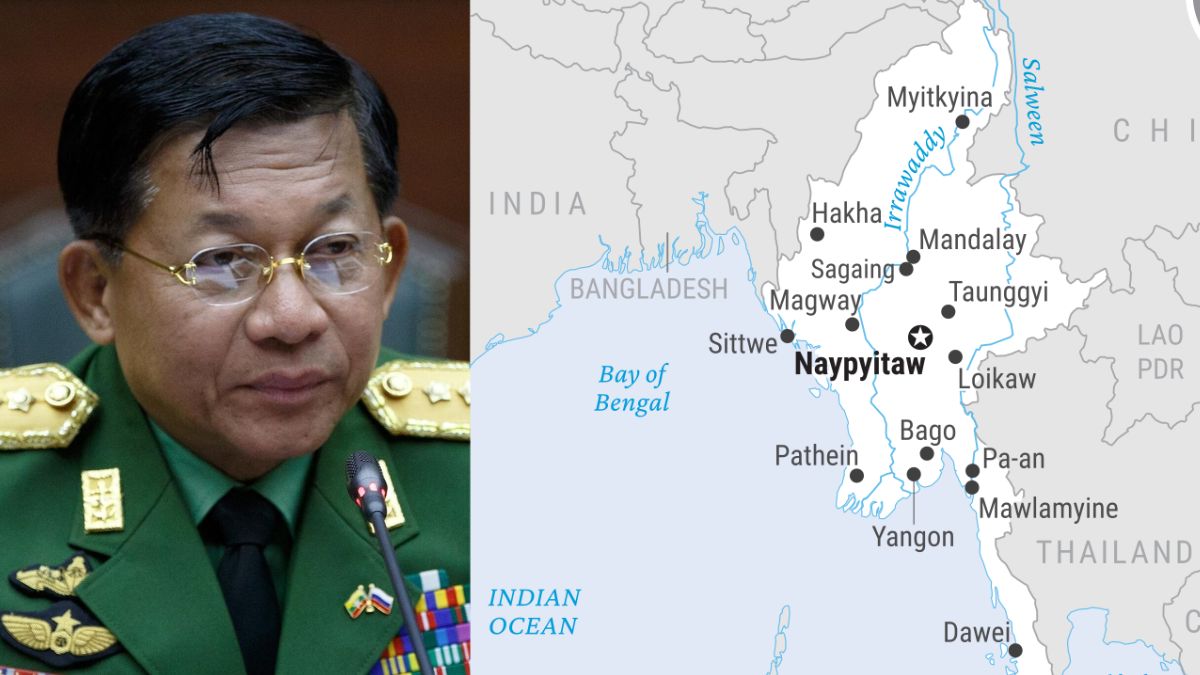
Myanmar’s Junta regime has imposed martial law in 60 townships across the country, in a bid to tighten security in regions still facing domestic conflict.
Myanmar’s Junta leader and newly appointed President Min Aung Hlaing on Friday (April 24, 2026) ordered new emergency ordinances to cover 60 townships across Kachin, Kayah, Kayin, Chin, Shan, and Rakhine provinces, along with Saging, Magway, and Mandalay regions, where the military enforced restrictions and curfews during the 2021 coup.
The official announcement cited the need to “end armed terrorism” and restore “the rule of law” as the main reasons for the 90-day emergency, reported the official state media.
The order transferred all executive and judicial authority in these regions and townships to Myanmar’s new military chief, Ye Win Oa, for three months, according to another notification, as reported by the Myanmar publication Global New Light.
The ordinances marked the first major move by the Myanmar President to tighten his control over the war-ravaged territories since he took office in April after a widely criticised election won by a military-based political party.
Myanmar plunged into a domestic conflict in 2021 after the Junta removed the civilian government led by Nobel laureate Aung San Suu Kyi, triggering nationwide protests that sparked an armed resistance against the military coup.
After the military takeover in 2021, the Junta had imposed an emergency across Myanmar, which was extended several times before it held elections in December 2025 and January 2026, that was criticised for being neither free nor fair.
The President’s Office said the emergency measures giving sweeping powers to the military now are aimed at suppressing armed unrest, restoring stability, and enforcing the rule of law.
The military commander-in-chief subsequently delegated the powers to regional commanders, granting them direct control over security operations in affected areas. These regional commanders were given the powers to delegate their role to subordinate officers depending on exigencies on the ground.
Under such provisions, military tribunals may try civilians, with penalties ranging from long-term imprisonment to the death sentence in severe cases.
Earlier this week, Myanmar’s President set a 100-day deadline for peace talks with anti-government armed groups and invited both signatories and non-signatories of the Nationwide Ceasefire Agreement (NCA) to participate in the talks. The agreement was signed with eight armed groups in October 2015.