


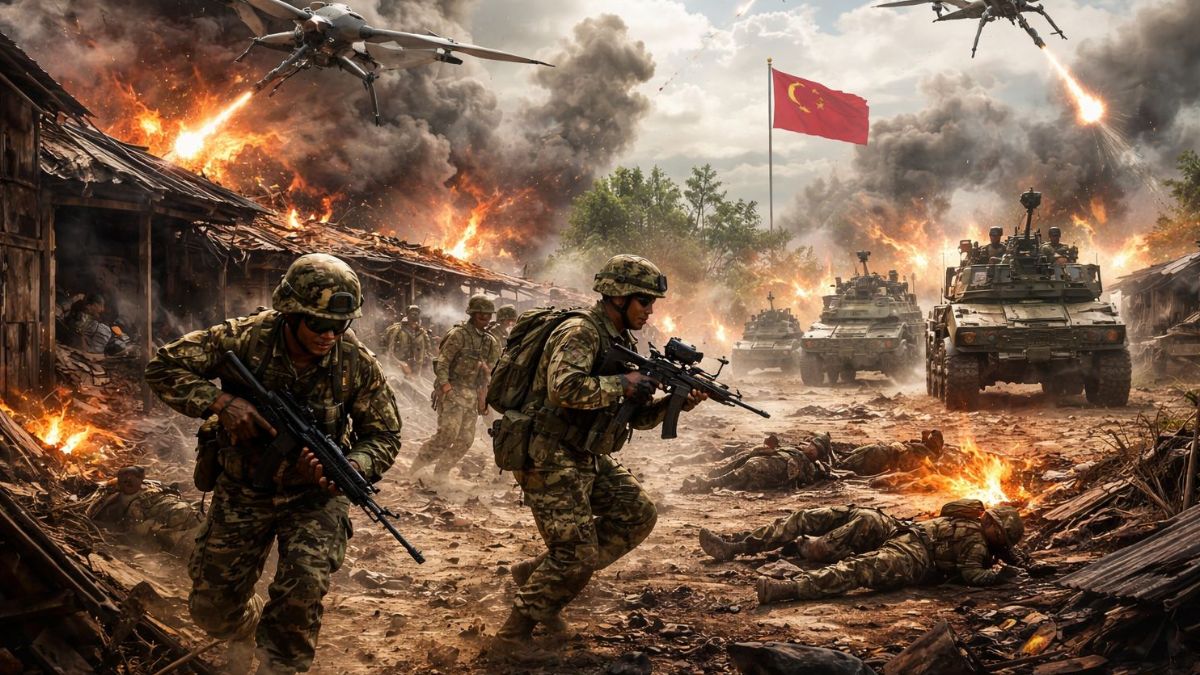
Myanmar’s military junta has begun clawing back territory after years of setbacks, reshaping the balance of the country’s brutal civil war through mass conscription, expanded drone warfare, and renewed backing from China, according to rebel fighters, analysts, and conflict researchers.
The shift was starkly evident in October during intense fighting in central Myanmar, where veteran rebel Khant and his comrades held their positions for seven days under relentless artillery barrages, drone strikes, and repeated infantry assaults.
How did the battle for a village become a turning point?
The battle for Pazun Myaung village, strategically located between Myanmar’s largest city, Yangon, and the political capital Naypyidaw, marked a turning point.
“It was essentially an offensive using all the power they could muster,” said Htike, another rebel fighter present at the clashes. After a week of mounting casualties, resistance forces were forced to retreat.
How has the Junta adapted and regained momentum?
Two years after a sweeping rebel offensive pushed the military out of large swathes of border regions, the junta has adapted and regained momentum, international media interviews with rebel fighters and security analysts indicate.
The military’s comeback has been uneven but significant, with gains reported in at least three states, according to a November briefing by Singapore’s ISEAS–Yusof Ishak Institute.
What is the Junta’s strategy for reviving fortunes?
Central to the junta’s revival is manpower. In February 2024, months after rebels battered the army during “Operation 1027,” the generals imposed mandatory military service.
Since then, an estimated 70,000 to 80,000 recruits have entered the ranks through around 16 rounds of conscription, with about 5,000 people called up at a time, according to defectors and analysts.
Although the armed forces remain far smaller than before the 2021 coup — about 134,000 troops compared with roughly 400,000 previously — the influx has reinforced depleted units.
How did the rebel forces adapt to the Junta’s strategy?
Rebel fighters also report new and more ruthless battlefield tactics. They said they witnessed “human wave” assaults, with junta soldiers repeatedly advancing to overwhelm defences despite heavy losses.
“After one soldier died, another one came up to take his place,” Khant recalled, adding that some troops appeared to be threatened by their commanders to keep moving forward. Such behaviour marks a departure from earlier phases of the war, when soldiers often fled after sustaining casualties.
Why is the Junta also inducting technology?
The military has paired manpower with technology. It has rapidly expanded its unmanned aerial vehicle fleet, now operating access to around 19 different drone models sourced from China, Russia, and Iran, according to the Armed Conflict Location & Event Data Project (ACLED).
While conventional airstrikes remain the junta’s most common tactic in 2025, analysts say they are increasingly guided by surveillance drones, making attacks more precise. Resistance groups, though they use drones themselves, lack jamming systems and air defences, leaving them vulnerable.
How did the Junta overhaul the military command structures?
Command structures have also been overhauled. After the shock of Operation 1027, when rebels captured about 150 military outposts in a month, the junta replaced inexperienced or patronage-appointed officers with seasoned commanders, analysts said.
Lower-level commanders have been granted greater autonomy to call in air support, enabling coordinated strikes ahead of ground assaults.
Why is China’s involvement increasing?
China forms the third pillar of the junta’s resurgence. While Beijing maintains ties with some ethnic armed groups, it has long viewed Myanmar’s generals as guarantors of regional stability.
Chinese officials helped broker ceasefires in 2024 and 2025 and applied diplomatic and financial pressure on resistance groups to halt fighting.
How have these changes helped the Junta?
In northeastern Myanmar, such pressure helped return the key town of Lashio to junta control. Beijing has also reportedly restricted arms flows by leaning on groups like the United Wa State Army, further weakening resistance forces.
“We will see more armed clashes and more attempts from the military to retake territories in the coming three years,” said Min Zaw Oo of the Myanmar Institute for Peace and Security, underscoring that the war is entering a more dangerous and prolonged phase rather than nearing resolution.
What’s the problem with the upcoming elections in Myanmar?
These battlefield shifts come as the junta prepares for a general election beginning December 28, 2025, an exercise the United Nations and rights groups say will be neither free nor fair.
With opposition leader Aung San Suu Kyi still detained and major anti-junta groups boycotting the vote, analysts warn that military gains could embolden further offensives.