


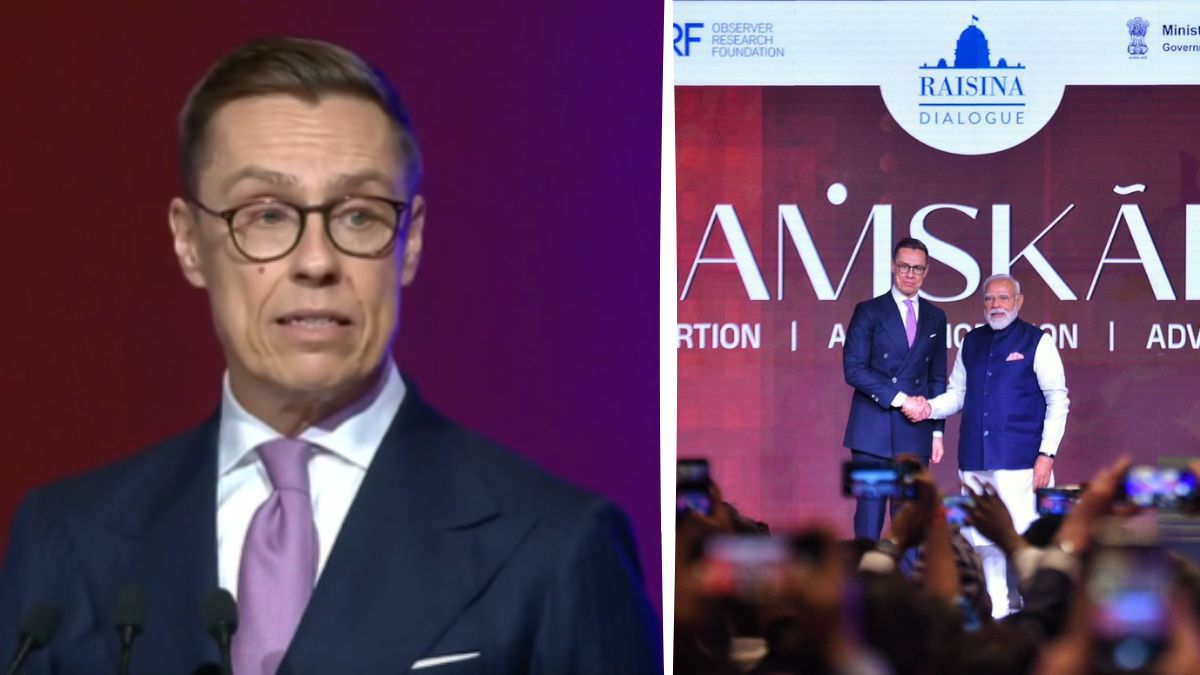
Finnish President Alexander Stubb has strongly endorsed India’s growing global influence, declaring that “the future is Indian” as the country’s demographic strength, economic expansion and historical trajectory position it to shape the next international order. Stubb echoed similar views at Raisina Dialogue 2026, when he suggested that India will play crucial role in deciding next world order.
Explaining why he thinks that the future is India, the Finnish President cited demography, economy and history as working in favour of the country. “First of all, I think the future is Indian. And I don’t say this only because I’m in India, and I’m not trying to be openly diplomatic,” he said.
Speaking during an interview with ANI while on his state visit to India, Stubb said the global balance of power is shifting and India will play a decisive role in determining the direction of the evolving world order. His remarks came during a visit that included high-level talks with Prime Minister Narendra Modi, participation in the Raisina Dialogue 2026.
India-Finland ties: 3-hour meeting with PM Modi on expanding ties
President Stubb described his engagement with Prime Minister Narendra Modi as “wonderful”, noting that the two leaders held extensive discussions lasting nearly three hours. “It has been wonderful. I felt very warmly welcomed. I spent three hours with PM Modi and then spoke at the Raisina Dialogue and had meetings with political leaders,” he said.
The discussions focused on strengthening India-Finland relations, expanding economic cooperation, and exploring opportunities in emerging sectors such as technology, innovation and skilled workforce mobility. Several memoranda of understanding (MoUs) were also discussed to improve labour mobility and exchanges between the two countries.
“I think these MoUs will help us have better exchanges when it comes to labour mobility. I think it is going to be a two-way street,” Stubb said.
Raisina Dialogue: India’s role in changing global order
During his participation at the Raisina Dialogue, India’s premier geopolitical forum, Finnish President Stubb emphasised that the international system is undergoing a major transition. He noted that the post-World War II global structure is gradually evolving, and countries of the Global South, led by India, will have a major say in shaping the next phase of global governance.
“A world order changes ever so often. And I think we’re now seeing a transition of the world order,” he said.
Stubb added that while the emerging system may contain elements of multipolar competition, he hopes it will ultimately remain rooted in multilateral institutions, rules and global cooperation. “Reality is probably going to be somewhere in between,” he observed.
Greater global leadership role for India
The Finnish leader also urged Western nations to recognise India’s rising influence and grant it a greater role in global decision-making institutions. “I am happy that the largest democracy in the world, India, is taking the lead,” Stubb said.
He argued that global governance institutions must reflect present-day realities rather than the geopolitical balance of 1945. “We don’t live in a world of 1945, so the institutions should not reflect that either. They should reflect the world of 2026,” he said.
Stubb reiterated his support for India securing a permanent seat in the United Nations Security Council, saying such reforms are essential for maintaining global multilateralism. “That’s why I have called, for instance, for a permanent seat in the UN Security Council for India,” he added.
India’s transformation since 2013 visit
Reflecting on his previous trip to India more than a decade ago, Stubb said the scale of the country’s transformation was striking. “The last time I was here was in 2013. Now just seeing the development, the infrastructure, the roads and the buildings, it is always nice to be back in India,” he said.
He highlighted India’s rapid economic growth, infrastructure development and expanding global role as key factors strengthening its international standing.
During his visit to Mumbai, President Stubb also paid tribute to the victims of the 2008 Mumbai terror attacks at the Taj Palace Hotel. Calling the attacks horrific, he emphasised the global need to combat terrorism. “Terrorism is always a menace everywhere. The attacks on 26 November 2008 were horrific,” he told the news agency.
India and the Global South’s decisive role
Stubb also linked India’s rise to the growing influence of the Global South, which he believes will play a decisive role in shaping the future global order.
Drawing from his book ‘The Triangle of Power – Rebalancing the New World Order’, he argued that the direction of international politics will be determined not solely by Western or Eastern powers, but increasingly by emerging nations.
“I really think that the Global South is going to decide where we’re going to go, and India leads it,” he said.