


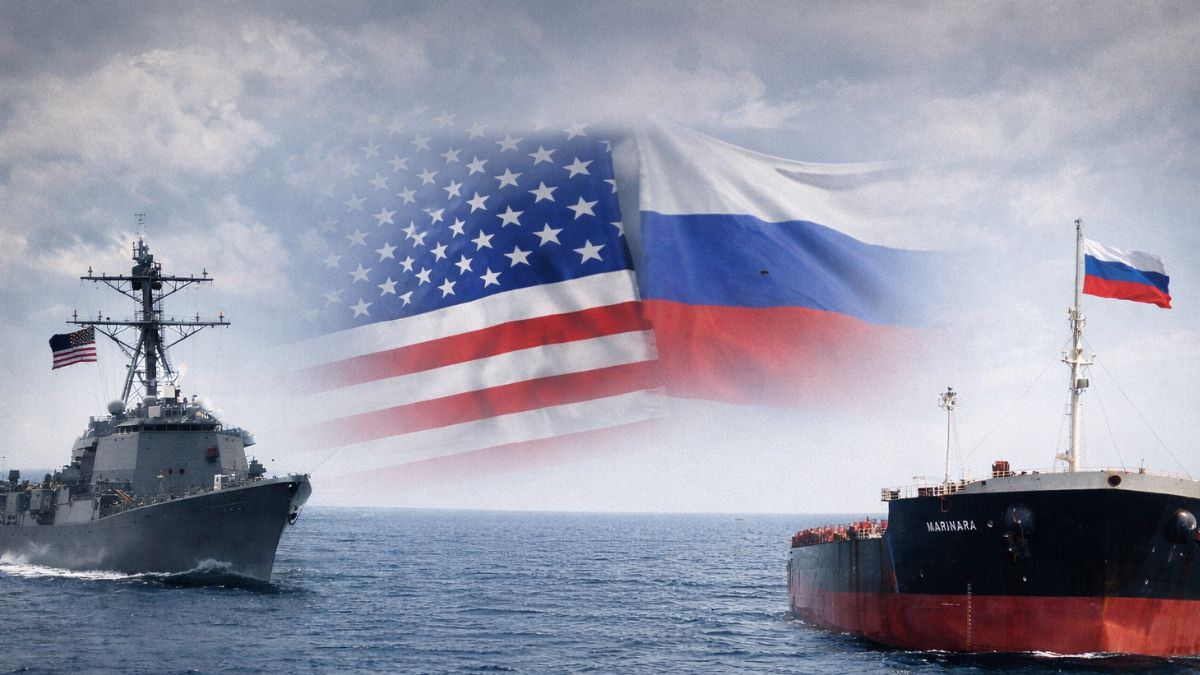
As the world’s last remaining nuclear arms control agreement nears collapse, escalating US-Russia tensions are no longer confined to diplomacy and doctrine.
From Washington’s readiness to let the New START treaty expire, to open nuclear threats from a Russian lawmaker and the seizure of a Russian-flagged tanker carrying three Indian crew members, multiple crises are converging into a single, dangerous flashpoint for global security.
What is the US position on the last nuclear treaty?
At the heart of the uncertainty is New START, the 2010 treaty that caps deployed strategic nuclear warheads at 1,550 each for the United States and Russia.
With the pact set to expire on February 5, 2026, US President Donald Trump has signalled he is willing to let it lapse, despite a Russian proposal to voluntarily maintain the limits. “If it expires, it expires,” Trump said, adding that Washington would pursue a “better agreement.”
How does the expiry of the New START treaty impact arms control?
Arms control experts warn that the end of New START would remove the last legal restraint on the world’s two largest nuclear arsenals, which together account for nearly 87% of all nuclear warheads globally.
With verification mechanisms already suspended since 2023 amid the Ukraine war, the treaty’s collapse could open the door to unchecked deployments and a renewed arms race.
How is the US pulling China into the nuclear talks?
Trump has argued that any successor deal must include China, whose nuclear arsenal is growing rapidly.
Beijing has rejected the proposal, calling it “unreasonable and unrealistic” given the vast gap between Chinese stockpiles and those of the US and Russia.
Analysts say this stalemate makes a near-term replacement for New START highly unlikely.
How are the US-Russia tensions growing now?
Against this backdrop of strategic instability, a maritime confrontation has sharply escalated tensions. US military forces this week seized a Russian-flagged oil tanker, Marinera, in the North Atlantic after weeks of pursuit linked to alleged sanctions violations connected to Venezuela.
Moscow has condemned the action as illegal and a violation of international maritime law, arguing the vessel was peacefully transiting international waters under the Russian flag.
Why has the incident at sea escalated to a likely military response?
The incident took a far more alarming turn when Alexei Zhuravlev, first deputy chairman of Russia’s State Duma defence committee, publicly called for a military response.
Describing the seizure as “outright piracy,” Zhuravlev suggested Russia should sink American Coast Guard vessels involved in the operation and explicitly referenced Russia’s military doctrine allowing the use of nuclear weapons in response to attacks on national interests.
His remarks marked one of the most explicit nuclear threats from a senior Russian lawmaker in recent months.
How have foreign seafarers on board the seized oil tanker compounded the crisis?
Compounding the crisis is the presence of foreign nationals on board the seized tanker. According to Russian officials, the Marinera’s crew includes 17 Ukrainians, six Georgians, two Russians, and three Indian citizens.
Their detention has brought India indirectly into a rapidly escalating US-Russia confrontation, highlighting how geopolitical power struggles can endanger civilians far removed from strategic decision-making.
Moscow has demanded humane and dignified treatment of the crew and called for their immediate release, stressing that unilateral US sanctions cannot justify the seizure of civilian vessels on the high seas.
What does this crisis mean for India?
The Russian Foreign Ministry has accused Washington of “neo-colonialist” behaviour and insisted it repeatedly informed US authorities of the ship’s Russian registration and civilian status.
For India, the involvement of its nationals underscores the broader risks posed by the erosion of global arms control and international norms.
As tensions sharpen between nuclear-armed states, commercial shipping, multinational crews, and neutral countries increasingly find themselves exposed to the fallout of great-power rivalry.
How do the present US-Russia tensions threaten global peace?
Security analysts warn that the coincidence of New START’s impending expiry, explicit nuclear threats, and a live maritime standoff represents a troubling new phase in US-Russia relations.
Even during the Cold War, Washington and Moscow maintained dialogue and crisis-management mechanisms to prevent miscalculation. Today, with inspections halted, talks frozen, and rhetoric escalating, the margin for error is shrinking.
As February 5 approaches, the fate of the last US-Russia nuclear treaty — and the safety of civilians like the three Indian sailors caught in this dispute — has become a stark reminder that the breakdown of arms control is no longer theoretical. It is unfolding in real time, with consequences that extend far beyond Washington and Moscow.