


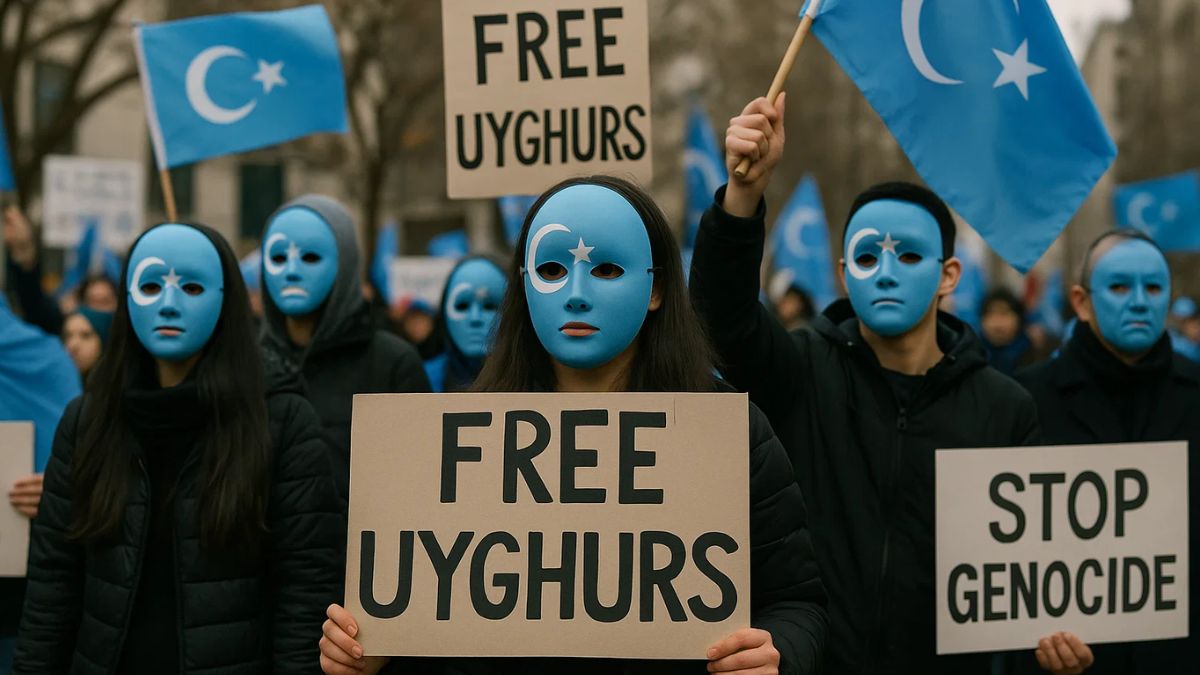
This Wednesday (November 12, 2025) will mark East Turkestan Independence Day— a date that recalls the brief 1933 republic declared in Kashgar and a vision of self-rule that Beijing has spent decades trying to erase. For Uyghurs around the world, this anniversary is not about nostalgia; it is about survival under a system that equates identity with sedition.
In the Xinjiang Uyghur Autonomous Region, which Uyghurs call East Turkestan, the Chinese state’s idea of “ethnic unity” has come to mean assimilation by force.
Since 2017, up to three million Uyghurs have been detained in what Beijing terms “re-education centres.” Behind those euphemisms lie accounts of torture, electric shocks, sexual violence, and forced medication. People have been punished for speaking their own language or failing to memorise patriotic songs. Women have described being injected with unknown substances that halted their menstrual cycles, while men recall being shackled into metal suits for hours.
Outside the barbed-wire camps, repression takes quieter forms: bans on beards and veils, the erasure of traditional Muslim names, and Mandarin-only schooling. The message is clear — loyalty to the Chinese Communist Party must come before faith, language, or memory. What China calls “unity” has, for Uyghurs, become the vocabulary of occupation.
Can a culture survive systematic erasure?
Yet Uyghur identity endures. From exile, communities are rebuilding what Beijing tries to dismantle. In the San Francisco Bay Area, parents have opened weekend schools where children learn Uyghur language and literature — books now vanished from shops in Kashgar or Hotan. Music, poetry, and calligraphy once banned as “separatist” are being revived at diaspora gatherings. Each class and song is an act of defiance against the cultural amnesia the Chinese state is engineering.
For Uyghur women, preserving tradition has also meant confronting trauma. Survivors of the camps have turned testimony into a political weapon, recounting sexual abuse and sterilisation as part of a state policy to control reproduction. Despite the risks, activists like Rushan Abbas, Jewher Ilham, and Reyhan Asat continue to speak publicly, often while their own family members remain imprisoned in China. “Our voices are all we have left,” Abbas has said in previous remarks.
In a region where mosques are razed and language is criminalised, the endurance of song and story among exiles signals a truth Beijing cannot rewrite: cultural annihilation breeds resistance.
Does the spirit of East Turkestan still live on?
For those who mark November 12, the answer is yes. The republic that lasted only months in 1933 lives on as an idea stronger than China’s surveillance state. It survives in diaspora marches that begin at Chinese consulates, in schoolrooms where Uyghur children recite banned poetry, and in the quiet resolve of parents who have not heard from their detained relatives in years.
Uyghur youth speak of a future in which their teachers and non-Uyghur friends will know who they are — not as subjects of a “terrorism” narrative, but as a people with a history older than the People’s Republic of China. Their fight is not just for sovereignty but for remembrance.
Beijing’s walls of concrete and propaganda have not broken that spirit. On East Turkestan Independence Day, every surviving word, melody, and child learning to read in Uyghur becomes an assertion that identity cannot be imprisoned, and that the republic crushed in 1934 still breathes wherever a Uyghur dares to speak its name.