


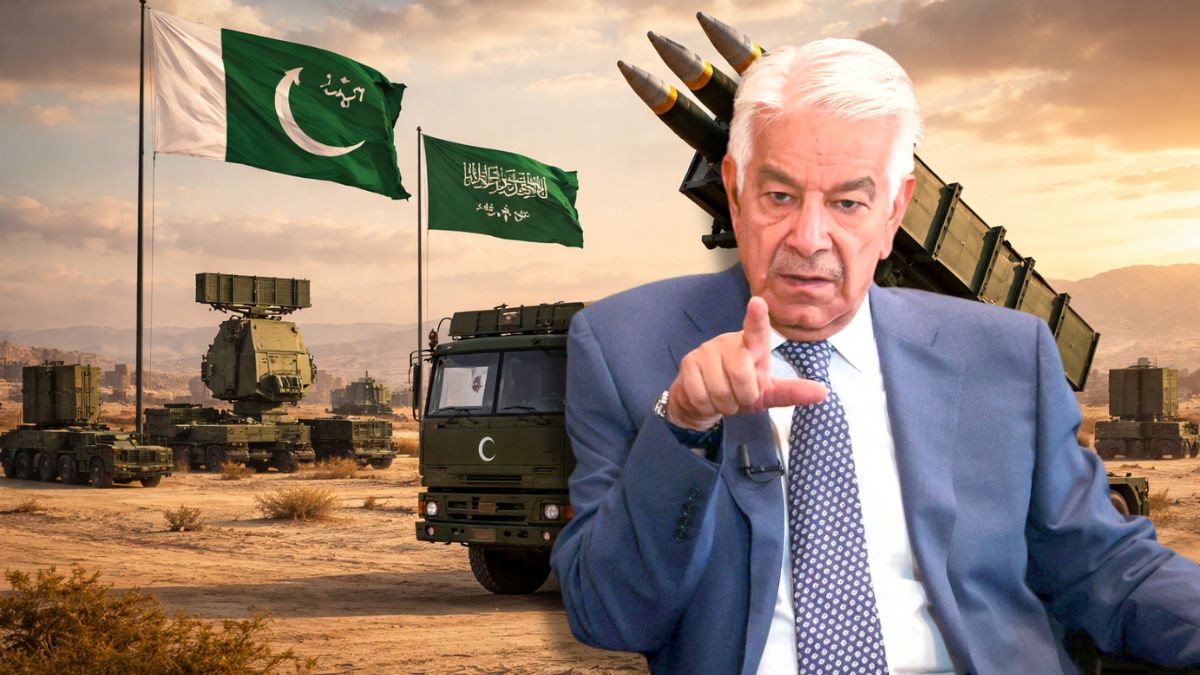
As West Asia spirals deeper into conflict following US-Israel strikes on Iran and Tehran’s sweeping retaliation, Pakistan has moved swiftly on two fronts. On the one hand, it has shown solidarity and is deploying military assets to Saudi Arabia under a strategic defence pact, on the other, Islamabad is framing the regional war as part of a larger conspiracy aimed at surrounding and weakening Islamabad.
Pakistan seems to be growing anxious over a conflict unfolding along its 900-km border with Iran, with Defence Minister Khawaja Asif suggesting the West Asian developments as a Zionist plot to encircle the nation. He even stated that “the might of our armed forces is recognised worldwide”.
Iran war: Why has Pakistan deployed air defence systems to Saudi Arabia?
In a significant security move, Pakistan has activated its commitments under the Pakistan-Saudi Strategic Mutual Defence Agreement, pledging full military support to Riyadh. Senior security sources, as quoted by CNN-News18, indicate that Pakistan has already deployed LY-80 medium-range air defence systems, FM-90 short-range missile systems, Anza-series shoulder-fired missiles, along with Army, Air Force and Naval personnel.
These assets are reportedly operating under Pakistani command but in close coordination with Saudi forces.
Oversight is being carried out under the supervision of former Pakistani Army Chief General Raheel Sharif, who heads the 43-nation Islamic Military Counter Terrorism Coalition headquartered in Riyadh. The deployment comes as Iran’s retaliatory missile and drone strikes have targeted Gulf states including Saudi Arabia, the UAE, Bahrain and Oman.
Is Pakistan expanding military footprint in the gulf?
Flight tracking data and Pakistani security sources suggest that two Pakistan Air Force IL-78MP air tanker-cargo aircraft were repositioned from Nur Khan Air Base to Karachi on March 1, potentially ferrying troops, missile batteries, strategic equipment, the News18 report added.
Analysts believe the move may also support forward air patrols over the Arabian Sea and could include deployment of JF-17 Thunder fighter jets under the defence framework with Saudi Arabia. Prime Minister Shehbaz Sharif spoke with Crown Prince Mohammed bin Salman on February 28, reaffirming “full solidarity” with Saudi Arabia and Gulf states during what he described as a “perilous time.”
Zionist plot: Pakistan alarmed by the Iran conflict
The US-Israel campaign against Iran, including strikes that killed Supreme Leader Ayatollah Ali Khamenei, has heightened Pakistan’s security calculus. Iran shares a volatile border with Pakistan’s Balochistan province, long plagued by insurgency. Islamabad also faces tensions on its eastern border with India, its western frontier with Taliban-led Afghanistan.
Defence Minister Khawaja Asif described the Iran war as “orchestrated by Zionists” with the express aim of extending Israel’s influence toward Pakistan’s borders. He also warned that an Israeli victory could embolden what he termed a coordinated axis involving India, Afghanistan and Iran, potentially “surrounding Pakistan from all sides.”
What did Khawaja Asif claim?
In a series of remarks and posts on X, Asif alleged that the Iran conflict was “imposed” despite Tehran’s willingness to negotiate, adding that the Zionist ideology had played a “direct or indirect” role in major Muslim-world conflicts since 1948. Global powers were “held hostage” by Zionism, he noted, further suggesting that Israel’s strategic objective was to destabilise Pakistan.
He urged Pakistan’s 250 million citizens to recognise what he called a broader conspiracy and called for unity among Muslim-majority countries.
Reaffirming Pakistan’s nuclear deterrent, Asif said the country’s atomic capability remains its ultimate shield against external threats.
Islamabad has long framed itself as encircled by hostile forces. It has accused India of backing Baloch insurgents, alleged Taliban links to Indian influence, portrayed itself as the frontline state against regional destabilisation.
Asif also reaffirmed Pakistan’s status as a nuclear power, which he argued was protecting Pakistan from the “Zionists”. The defence minister also added that “the might of our armed forces is recognised worldwide”, expressing support for Palestine. “May Palestine be free,” Asif said, concluding by calling for unity among Muslim-majority countries.