


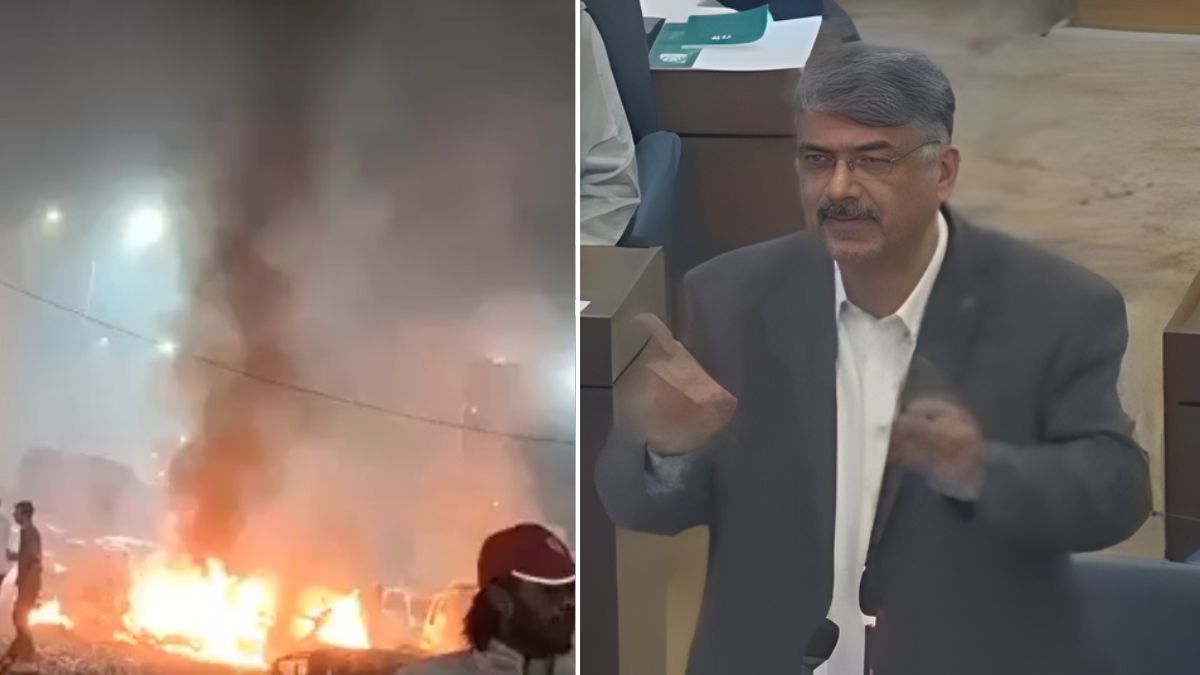
India has long maintained that Pakistan can’t be trusted with maintaining peace and that the country itself promotes violates, and rightly so. A Pakistani leader has himself apparently confirmed that the country was behind the recent 10/11 Red Fort car blast in New Delhi, which came months after the deadly Pahalgam terror attack on April 22, 2025.
Now, Pakistan seems to have itself confirmed that it was behind the recent Red Fort explosion, which killed around a dozen people and injured several. Pakistan-occupied Kashmir leader Chaudhry Anwarul Haq has openly boasted that terror groups struck India “from the Red Fort to the forests of Kashmir”.
In a statement that has sent shockwaves through India’s security establishment, Haq’s remarks come at a time when India is still reeling from the November 10 Red Fort car bombing in Delhi, and the April 22 terror attack in Pahalgam’s Baisaran Valley that left 26 tourists dead.
How do Haq’s words connect Delhi 10/11 blast and Pahalgam massacre?
Haq’s direct reference to both attacks is being viewed as a rare, explicit admission that Pakistani-linked groups continue to orchestrate cross-border terror operations targeting civilians and high-value national sites. The Delhi blast was carried out by Dr Umar un Nabi, a radicalised medical professional associated with a Jaish-e-Mohammed (JeM)-linked “white-collar” terror network exposed in Faridabad.
In a video that has now gone viral, Haq is heard using a celebratory tone, “By the grace of Allah, we’ve done it and they’re still unable to count bodies”. He claimed, “I earlier said that if you keep bleeding Balochistan, we’ll hit India from Red Fort to the forests of Kashmir.”
His mention of the “forests of Kashmir” ties back to the April Pahalgam attack where terrorists ambushed tourists, killing 26 people in an area previously considered low-risk. This linkage, coming from a serving Pakistani political figure, speaks volumes of Pakistan’s overt political patronage of terror ecosystems.
How is India responding to Pakistan’s escalating provocations?
Following the Pahalgam killings, India launched a retaliatory strike, codenamed Operation Sindoor. It suspended the Indus Waters Treaty framework, a move unseen in decades, and declared that any revival would depend on Islamabad ending terror sponsorship. Pakistani attempts to blame India for Baloch unrest were sharply rejected by New Delhi.
Haq’s video further shows him saying, “Few days later, armed men entered and attacked (Delhi) and they haven’t probably counted all the bodies so far.”
Is this a first instance of Pakistan’s political class exposing own terror links?
Haq is not the first to inadvertently reveal Pakistan’s terror policy. Khyber Pakhtunkhwa Chief Minister Sohail Afridi recently accused Islamabad of staging “fake terror attacks” for political gain and blocking peace efforts in the restive Khyber region. He alleged that Pakistan’s state apparatus “manufactures terrorism” to justify its internal narrative and international positioning.
Meanwhile, Indian probe agencies have uncovered that the JeM-linked Faridabad cell was preparing for a much larger attack. Interrogations revealed plans for a December 6 suicide bombing, codenamed “Operation D-6”, to mark the anniversary of the Babri Masjid demolition.
What is known about the Faridabad terror module?
The module consisted of nine to ten operatives, including five to six doctors working at Al-Falah University. Their medical credentials helped them procure chemicals and explosive materials without raising suspicion. Dr Shaheen Shaheed was allegedly tasked by JeM to establish a women’s terror wing in India under the banner of Jamaat-ul-Momineen.
Dr Umar executed the Red Fort suicide blast. The arrest of Dr Shaheen, followed by the detention of Dr Muzammil Ahmad Ganai, has placed Al-Falah University under intense scrutiny now as investigators examine how an academic institution became a cover for radicalisation and bomb-making.
While the Modi government has officially recognised the Delhi blast as a terrorist attack, it has not yet been able to prove if it has direct links to Pakistan. However, as Delhi strengthens its counterterror grid and diplomatic pressure, Haq’s statement may go down as the most blatant proof yet.