


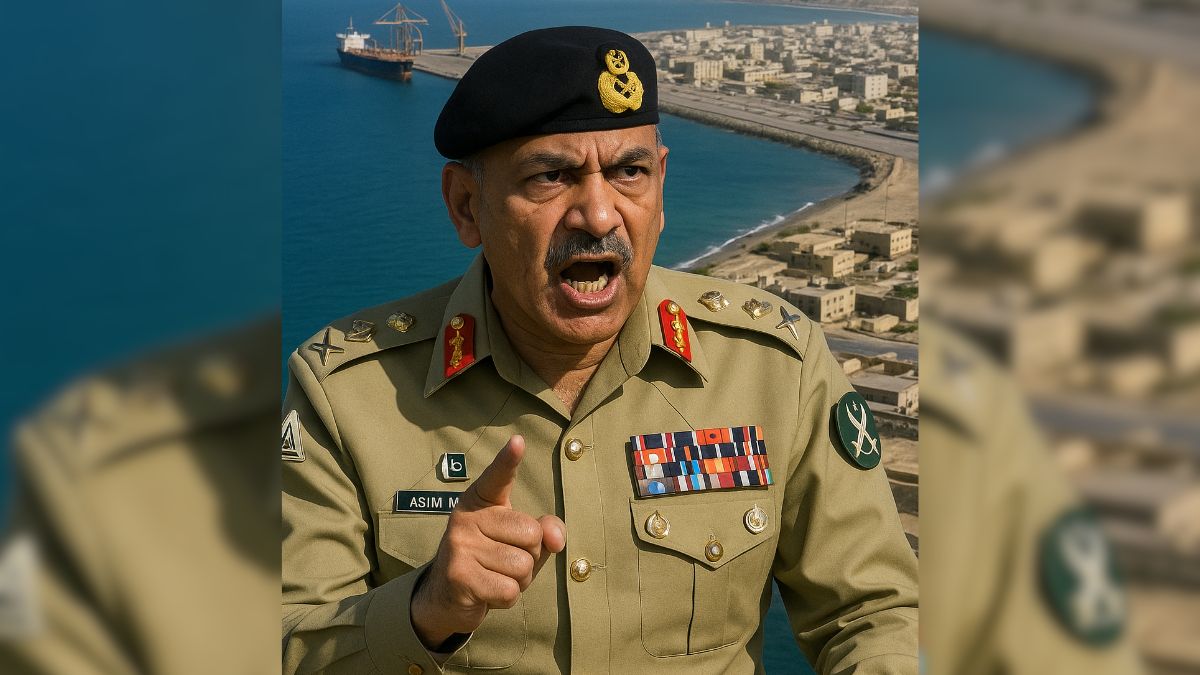
Pakistan’s newly appointed Chief of Defence Forces (CDF) Asim Munir has issued his sharpest warning yet to India, at a moment when Islamabad’s fraught relationship with Afghanistan is also intensifying. In his first public address after assuming charge, Munir declared that Pakistan’s response to any “aggression” from India would be “swift, severe, and intense”.
Munir said that “India must remain under no illusion that Pakistan’s next response will be even swifter and more severe.” He said that Pakistan is a peace-loving country, “but no one will be allowed to test its resolve regarding sovereignty, territorial integrity, peace or stability.”
The elevation of Munir to Pakistan’s first-ever CDF position, combining oversight of the Army, Air Force, and Navy, was described by him as a “historic” restructuring meant to counter “growing and changing threats.” He underlined intergrating all three services under the aegis of the newly-launched Defence Forces Headquarters was the need of the hour.
Munir’s remarks pointed to a Pakistan preparing for multi-domain challenges, from cyberspace and AI to advanced information warfare. But even as Munir attempted to project confidence, Islamabad’s strategic vulnerabilities are becoming increasingly pronounced, particularly with Afghanistan’s growing ties with India.
How is Afghanistan’s shift toward India and Iran weakening Pakistan’s leverage?
Taliban’s ambassador in Moscow Gul Hassan openly stated that Iran’s Chabahar Port is rapidly emerging as Afghanistan’s key foreign trade artery, with commercial flows through the port now increasing daily. Crucially, he added that the Taliban is actively coordinating with both Iran and India to strengthen this route.
Afghanistan’s expanding trade ties with Tehran and New Delhi clearly signal an economic and strategic realignment that cuts directly into Pakistan’s influence over Afghan trade. Worth mentioning here is that both the countries have been engaged in intense conflict since early October 2025.
Taliban ambassador’s statement came against the backdrop of severe border tensions. After clashes between Taliban forces and Pakistani troops, Islamabad shut down the Torkham and Chaman crossings, choking off major trade channels. The Taliban responded by pivoting away from Pakistan, redirecting commerce to Chabahar.
India–Afghanistan closer engagement impact on Pakistan’s security?
While Asim Munir warned India against any “delusion” of military advantage, he now faces the reality of a possible convergence between India’s strategic objectives and Afghanistan’s trade aspirations. With the Taliban seeking stronger economic ties with New Delhi through Chabahar, Islamabad risks losing both influence and revenue.
For Munir, the optics seem stark as on Pakistan’s eastern front, he issued threats to India while grappling with the consequences of Operation Sindoor, where India inflicted heavy military losses. On the western front, Afghanistan is steadily reducing dependence on Pakistan and building alternative corridors with India and Iran.
In his inauguratory speech, Munir told officers that a “clear message” had been delivered to the Taliban government in Kabul: it must decide between Pakistan and “Fitna al-Khawarij,” a term authorities use for the outlawed Pakistani Taliban, known a s Tehrik-e-Taliban Pakistan, or TTP.
Is Pakistan’s two-front anxiety driving its military posturing?
Munir’s emphasis on unified command structures, modern warfare requirements, and Pakistan’s “resilience” suggests that Islamabad is preparing for a more turbulent regional landscape. In his speech, CDF Munir underscored the evolution of modern warfare, while praising the military’s performance during Operation Sindoor, calling it a “case study”.
“Wars have now expanded to cyberspace, electromagnetic spectrum, space, information operations, AI, quantum computing; [therefore], the armed forces will have to adapt to new requirements of war,” he added.
As Delhi and Kabul grow closer, and Chabahar emerges as Afghanistan’s primary trading gateway, Pakistan’s two-front dilemma is becoming more acute, so much so that Munir now has more reasons to worry than his fiery speech suggests.