


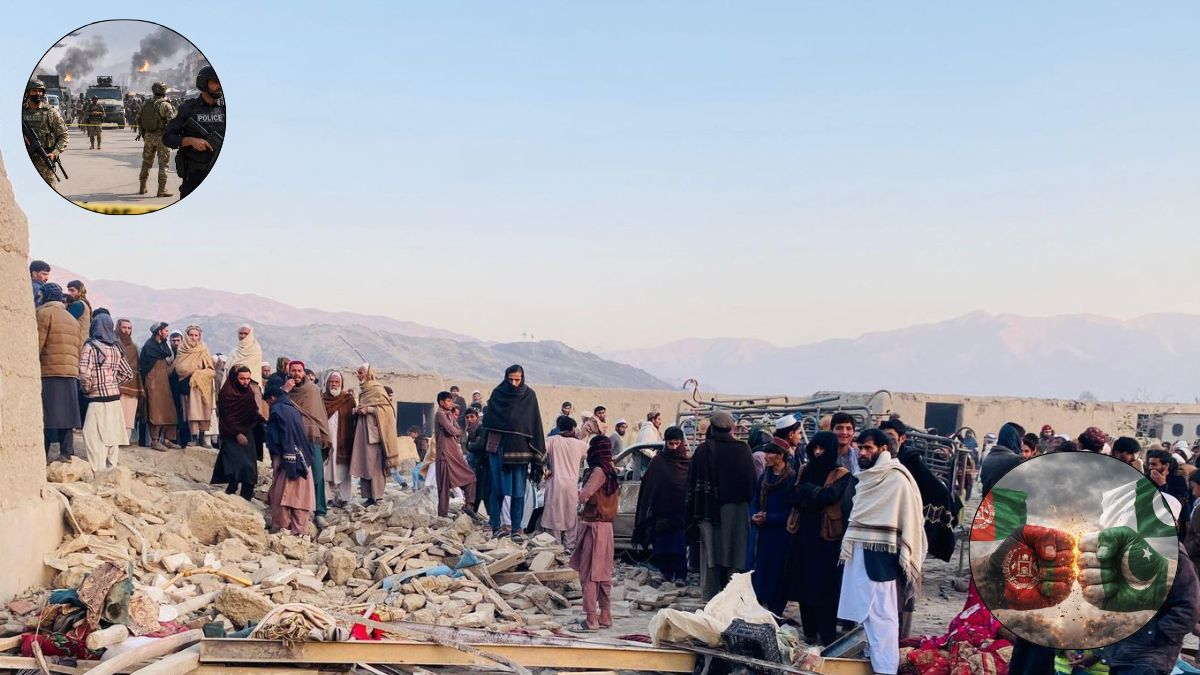
A day after it carried out air strikes inside Afghanistan killing civilians, Pakistan has been forced to boost its security, apart from arresting dozens of individuals, fearing a wave of military attacks on its soil.
“Our forces are on high-alert to combat any attacks,” Pakistan’s Junior Interior Minister Talal Chaudhry told international media platforms on Wednesday (February 25, 2026).
“You know the militants always react whenever we go after their hideouts in Afghanistan,” Chaudhry said in his comments.
Pakistan had carried out air strikes inside Afghanistan over the weekend, citing it was responding to military attacks on its soil including a spate of suicide bombings recently.
The air strikes had resulted in casualties among the civilian population inside Afghanistan, forcing Kabul to warn Islamabad with retaliation.
India had condemned the air strikes on Afghanistan, terming them as Pakistan’s bid to divert attention for its own domestic troubles.
Pakistan, on the other hand, blamed Afghanistan for the military attacks on its soil, accusing Kabul of providing a haven to militants that threatened Islamabad.
Afghanistan has vehemently rejected the Pakistani charges, pointing out that militancy was an internal problem that Islamabad should tackle on its own without blaming its neighbours.
Afghanistan and Pakistan have exchanged strong words against each other over the military strikes inside Pakistan, apart from Kabul’s strong opposition to Pakistan pushing Afghan-origin people out of its territory in the recent years.
The two nations have blamed each other of initiating the current spate of clashes on the border between the security forces of the two countries.
Taliban’s Pakistani outfit has targeted Pakistan’s police and military convoys, including in the Kohat city of northwestern Khyber Pakhtunkhwa province in which five officers and two civilians were killed, apart from a suicide bombing on a police check post, killing two policemen.
In Chaudhry’s view, Pakistan’s air strikes were retaliatory in nature against militants, whom Islamabad alleged had Afghanistan connection, claiming that Pakistani forces had thwarted several militant attacks in recent weeks apart from arresting a number of suspects for the attacks.
Security forces have accelerated search and intelligence based operations and “have arrested dozens of suspected militants, their handlers and their facilitators,” the Minister said.
Government officials have stated in recent days that Pakistan’s intelligence agencies issued alerts for a possible increase in militant attacks inside Pakistan in the coming days in response to the air strikes.
“We have been given a strong caution about more terror attacks in our official communications. In this regard, we have almost doubled our search operations across Pakistan,” an intelligence official was quoted as saying by Reuters.
Another intelligence official added the provinces of Khyber Pakhtunkhwa and Balochistan are already under terror attacks and “we fear that Afghanistan will retaliate against Pakistan through terror networks in Punjab and Sindh as well.”
Data from Armed Conflict Location & Event Data (ACLED), a global monitoring organisation, showed attacks in Pakistan rose nearly fourfold to 2,425 in 2025 from 658 in 2022 and over the same period, TTP attacks increased more than seven-fold to 838 from 118.