


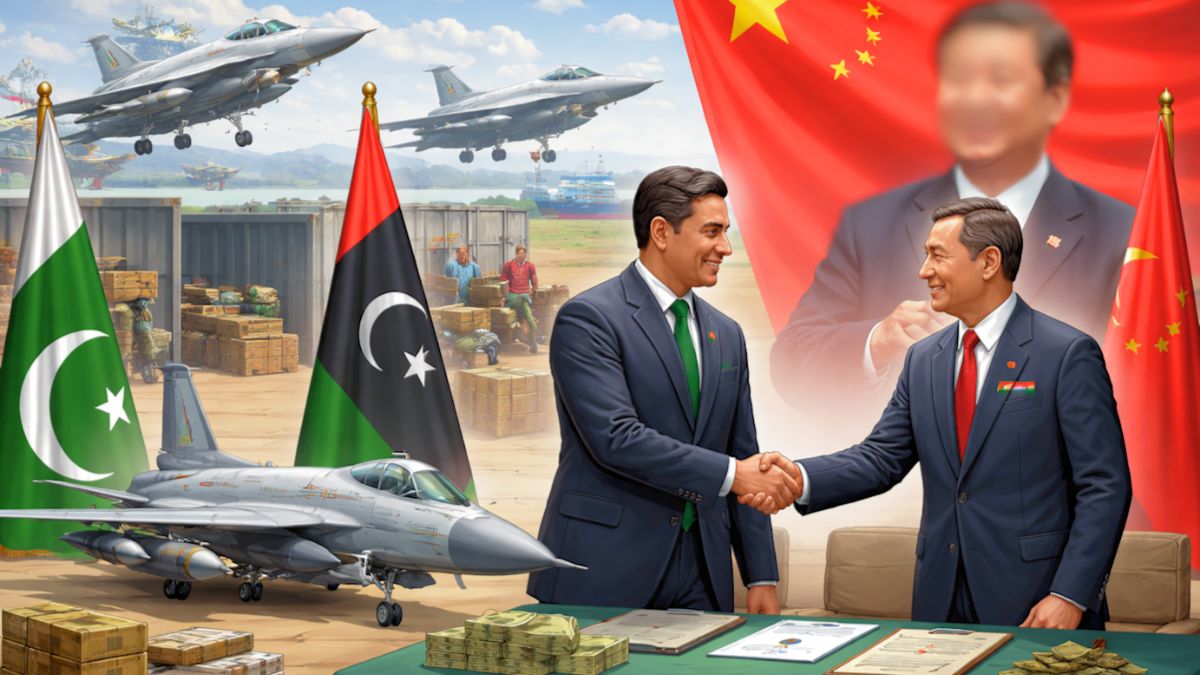
Earlier this week, it emerged that Pakistan has secured a whopping $4 billion deal with Libya’s eastern-based Libyan National Army (LNA), in what could be the cash-strapped economy’s one of the largest-ever defence deals. However, it might end up benefitting China versus Islamabad.
As part of the mega deal, Pakistan has agreed to sell JF-17 “Thunder” fighter jets, jointly developed with China, to the LNA, a move analysts now say carries consequences far beyond conventional arms export. Under the deal, 16 JF-17 fighters were listed among over $4 billion worth of equipment sold to Khalifa Hifter-led forces, who controls eastern Libya.
The package reportedly also includes 12 Super Mushak trainer aircraft, along with naval and ground systems, to be delivered over two-and-a-half years. While formally executed by Pakistan, experts see the deal as a geopolitical multiplier for China, allowing Beijing to deepen its influence in North Africa.
ALSO READ: Pakistan Seals Over $4 Billion Arms Deal With Libya’s Eastern Forces, Testing UN Embargo
Pakistan $4 billion deal with Libya: Why is could be a geopolitical win for China?
Though the aircraft is exported under Pakistan’s name, the JF-17 is largely a Chinese-designed platform, making the deal an indirect expansion of China’s defence-industrial footprint. The JF-17’s production remains heavily dependent on imported Chinese components.
Pakistan is mainly responsible for building the airframe and assembly of the fighter jet and many of its key parts, like the Active Electronic Scanned Array (AESA) radars, electronic warfare suite, cockpit avionics and most of its munitions, are imported from Beijing.
“The deal is a way of expanding China’s geopolitical influence through defence-industrial partnerships,” Liselotte Odgaard, senior fellow at the Hudson Institute, told South China Morning Post, adding, “It enables China to establish market presence behind the veneer of Pakistani exports.”
This approach allows Beijing to expand arms influence in politically sensitive regions; avoid direct scrutiny tied to Chinese state-to-state weapons deals; test and validate Chinese combat systems in foreign service.
ALSO READ: Why is Pakistan’s Largest-Ever $4 Billion Arms Deal With Libya Drawing Global Scrutiny?
How does the JF-17 fit into China’s global arms strategy?
The JF-17, also known as the FC-1 in China, is a fourth-generation, single-engine multirole fighter jointly developed by Chengdu Aircraft Corporation and the Pakistan Aeronautical Complex. Its chief designer, Yang Wei, also led the development of China’s J-20 stealth fighter, underscoring the aircraft’s technological lineage.
Key features of the latest Block III variant include:
AESA radar
Advanced avionics
Compatibility with Chinese weapons such as PL-15E long-range air-to-air missiles
Although the aircraft is not used by the People’s Liberation Army, analysts say that is deliberate, allowing China to export capable but non-frontline systems while maintaining its own technological edge.
Why does Pakistan play a critical role here?
China and Pakistan share one of the world’s closest defence partnerships, which spans joint fighter development (JF-17); submarines and naval platforms; missiles, air defence systems and drones; along with training and logistics support. For Pakistan, the JF-17 provided a cost-effective alternative to F-16s, while for China, it became a testbed for competing with Western arms exporters.
By routing sales through Pakistan, China avoids the geopolitical friction often associated with arms deals involving the US, EU or Russia, particularly in conflict zones or embargoed regions.
Why is Libya a sensitive but strategic market?
Libya remains under a UN Security Council arms embargo, though enforcement has been widely inconsistent. Multiple states have continued supplying arms to rival factions in the civil war. Analysts argue that registering the sale as a Pakistani export allows China to reduce reputational risk as a permanent UNSC member.
A UN panel of experts noted in a December 2024 report that the embargo remained “ineffective,” observing that several foreign states had become increasingly open about providing military assistance to both sides of Libya’s conflict.
It further allows Beijing to maintain a plausible distance from embargo violations, and limit diplomatic fallout with regional players such as Turkey. Meanwhile, Chinese-made Wing Loong II armed drones, reportedly supplied to the LNA via the UAE, are already active in the conflict.
Why is the JF-17 attractive to buyers?
On the global market, the JF-17 appeals to countries that face budget constraints, have political friction with Western powers, want fewer export controls and end-use restrictions. While not matching top-tier jets like the Rafale or F-16V, the JF-17 offers modern capabilities at a fraction of the cost, bundled with training, maintenance and flexible financing.
Previous buyers include Myanmar, Nigeria and Azerbaijan, with negotiations reportedly underway with Iraq.
What does this mean for China’s long-term ambitions?
For Beijing, increased overseas deployment of the JF-17 validates Chinese aerospace technology, expands strategic influence without formal alliances, strengthens defence-industrial diplomacy in Africa and the Middle East.
As one analyst noted, the Libya deal is “primarily a good thing for China”, boosting credibility while keeping diplomatic risk at arm’s length.
Worth mentioning here is that the Pakistan–Libya JF-17 deal underscores how China is reshaping global arms markets, using trusted partners like Pakistan to project power indirectly. Amid Western scrutiny, this model offers Beijing a low-cost, low-visibility path to expanding influence in volatile regions.